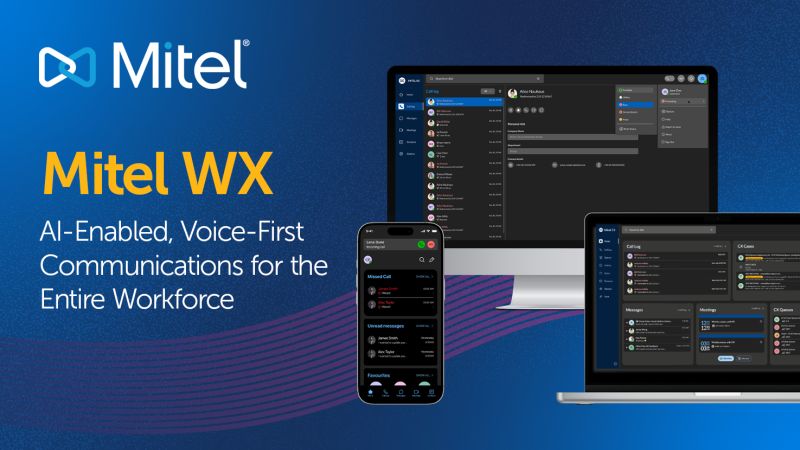
Mitel Networks has introduced Mitel Workforce Experience, a unified communications product aimed at the roughly 80% of the global workforce that does not sit at a desk, according to the company. The product combines voice, messaging, meetings, contact center functions and vertical applications in a single client that adjusts to a worker's role instead of the device. Mitel executives Eric Hanson, executive vice president and chief marketing officer, and Martin Bitzinger, executive vice president of product management, presented the product in a pre-briefing. The company says the launch targets nurses, warehouse workers and other frontline employees who have largely been overlooked by an industry built around knowledge workers.
Hanson said many vendors have tried to serve everyone and ended up optimizing for no one, a problem he said leaves frontline staff with tools built for calendar invites rather than their actual work. Mitel commissioned a Vanson Bourne study of about 2,000 workers in Canada, France, Germany and the U.K. that found 57% of workers lose time switching among an average of seven tools, 79% turn to voice when they need rapid action, and frontline workers are twice as likely to use unapproved tools.
Mitel said WX was built from a blank sheet rather than as a refresh of MiCollab or a rebrand of clients inherited from Unify. Only foundational functions such as voice sit in the core client, while other capabilities are plugins that administrators enable by role, an approach Bitzinger said takes longer to reach market but produces cleaner code. In a demonstration, a hospital desk worker handling contact center queues saw chat, call queues and an electronic health record panel on one screen, while an environmental services worker saw a streamlined view for work group log-in and task completion. A doctor driving received calls on a work number through Apple CarPlay or Android Auto, with calls migrating between mobile and desktop rather than being transferred.
Role design is controlled by IT rather than users, with administrators managing templated roles in Mitel Central, including across multiple domains common in health systems built through acquisition. Mitel differentiates WX through deployment flexibility, supporting public cloud, hybrid, private cloud, on-premises and edge deployments on the same client, which is built on a common application programming interface for its CloudLink cloud back end and on-premises Mitel Central. Bitzinger said a customer could run the product completely air-gapped and fully on-premises. WX also delivers private push notifications over a customer's own network, so calls and alerts still arrive in hospitals running private 5G or at sites that lose internet connectivity.
Hanson said only about 25% of the industry's 450 million to 500 million seats have moved to the multitenant public cloud, and he described hybrid as increasingly a deliberate strategy. Mitel has a large European install base, where data sovereignty is a major issue in regulated verticals. Tom Boyle of the NHS said he needs clinicians to be able to make calls regardless of global events and that the organization will keep its communications system on-premises for the foreseeable future.
Availability is phased, starting in November, with full platform availability expected in 2027. MiVoice Business support comes first, followed by OpenScape Business and OpenScape Voice in the next couple of quarters. Artificial intelligence capabilities will arrive after launch, and Mitel says AI makes people more capable rather than unnecessary. The Mitel AI Services Framework will include MCP support, with incremental AI in the Elite tier still to come.
Mitel will build core integrations itself and rely on services and technology partners for the rest. Bitzinger said most channel partners will not become vertical workflow integrators. Mitel positions WX as complementary to Microsoft Teams and Zoom for knowledge workers, meaning it must win on the frontline against health care specialists and the frontline offerings of the large platforms. Hanson said two large longtime customers, one in the U.S. and one in France, are already pushing to begin migration plans after seeing WX at Mitel's User Group. Mitel also sees install bases at Avaya and NEC as opportunities.
More company and startup news from TechManNews.