The dominant story in Big Tech this week is not any single company's win or loss. It is that the AI buildout has reached the stage where its costs are being itemized in public. Anthropic's IPO filing, Nvidia's looming earnings call, and a piracy settlement in Turkey look unrelated, but each one prices something that the industry has been deferring: growth that depends on commitments someone eventually has to honor. For US technology companies, the question is shifting from whether AI can generate revenue to whether the bills behind that revenue can be carried.
The IPO That Reads Like a Bill
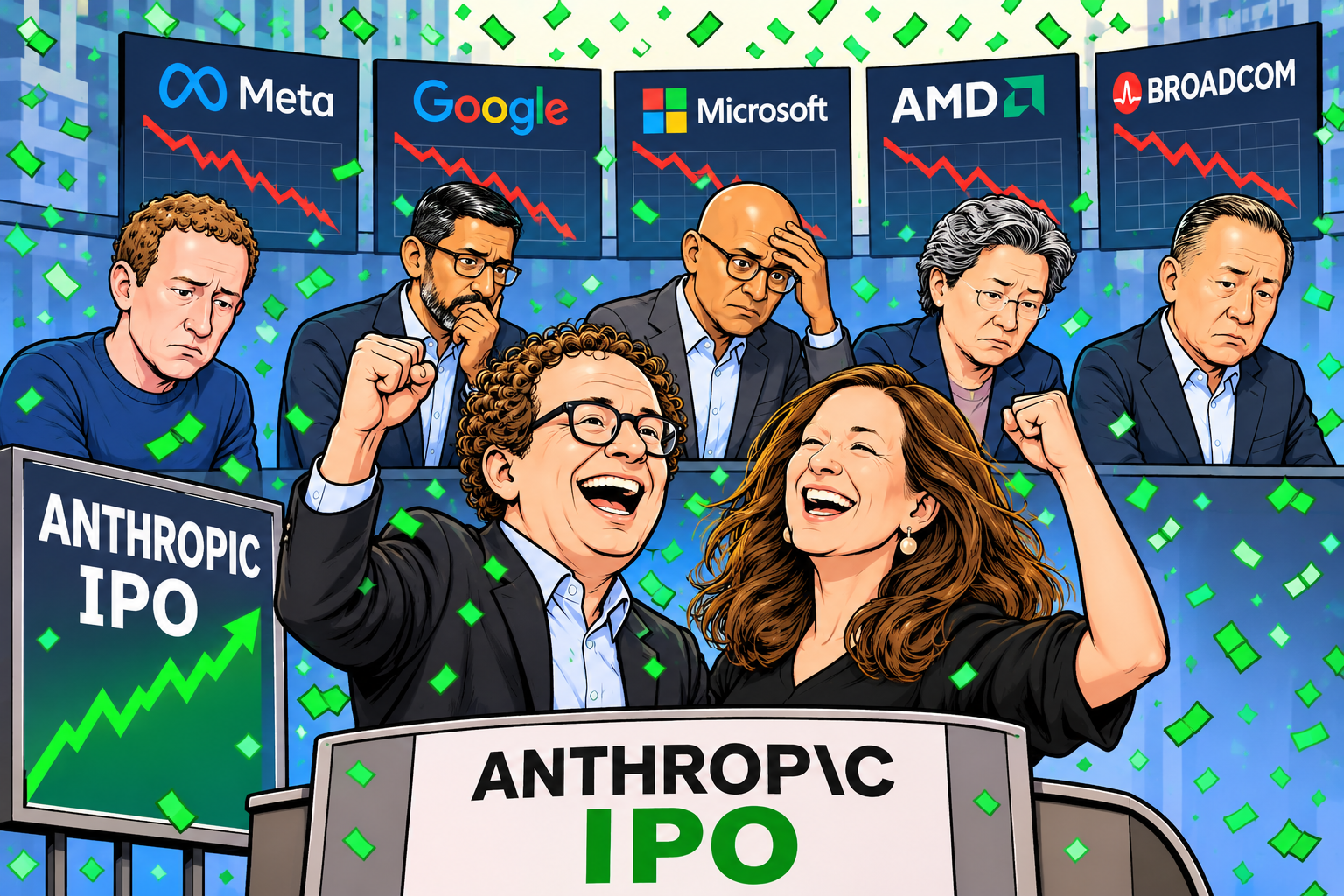
Anthropic's debut is being framed as a validation story. As Crunchbase News reported, the company launched three years ago with zero revenue, brought in $17 billion, and says more than 11,900 customers now spend at least $100,000 a year. Those are the numbers an IPO needs. But the same filing, per Crunchbase, reveals enormous computing commitments and hard questions about balancing growth with risk.
That combination is the thread. The revenue is real and large, and so are the obligations that produced it. Big Tech investors have spent two years rewarding top-line AI growth; filings like this one begin to show what was signed to get there. A customer spending six figures annually is a durable asset only if the cost of serving that customer is below what it pays. When compute commitments run ahead of contracted revenue, growth becomes a financing decision as much as a product decision. That is a different company than the one the narrative has described, and it is the one public-market investors will now be able to examine.
Nvidia as the Sector's Stress Test
CNET's framing of Nvidia's earnings call as the AI economy's next stress test captures the same dynamic from the supply side. Nvidia has been the clearest beneficiary of the buildout, and its results have functioned as a proxy for the whole sector's health. A stress test is not a celebration. It is an exercise in finding out what happens under pressure, and CNET's reference to Jensen Huang's departure as a symptom of a bigger problem signals that the market is no longer reading Nvidia's numbers as pure demand.
The connection to Anthropic is direct. The computing commitments disclosed in an AI company's IPO filing are, from the other side of the ledger, revenue for the companies selling that capacity. If buyers are committing to enormous future spending, their ability to honor those commitments becomes the supplier's risk. Nvidia's call matters to US markets because it is where the sector's largest revenue line meets the sector's largest cost line in public. When the same commitments appear as an asset on one company's books and a liability on another's, investors start asking which characterization is right.
The Cost of Legitimacy
The Dizigom shutdown looks like an outlier and is not. As BleepingComputer reported, the Alliance for Creativity and Entertainment announced the shutdown of one of Turkey's largest piracy sites after a settlement agreement with its operators. The site had 21 million monthly visits. That is a distribution business built on taking content without paying for it, and it was large enough to matter.
The thread here is that the legitimate market has a cost structure the illegal one never did. Streaming services pay for content, for rights, and increasingly for the compute and infrastructure behind their platforms. A site with 21 million monthly visits operating without those costs is not just a legal problem; it is a price competitor that doesn't carry the same load. Removing it does not create demand, but it does mean some of that audience must eventually be served by businesses that do pay. For US technology companies, many of which sell the infrastructure, advertising, and distribution that legitimate services depend on, enforcement is a quiet input to the economics rather than a headline win.