The venture market in late 2026 is not short of capital, but it is short of patience. What three funding stories logged on this beat recently share is not a sector or a stage but a posture: each is a first-time or early-stage entrant aiming at a piece of infrastructure that larger players have had reason not to fix. The pattern matters for US technology companies because it suggests where the next round of competition in AI will actually be fought, and it matters for investors because it shows how emerging managers are trying to survive a fundraising environment that has been unkind to them.
The Emerging-Manager Squeeze as Backdrop
The clearest framing of the pattern comes from Olaf Sakkers, who, as TechCrunch reported, has spent the past five years proving that entering venture capital as a first-time fund manager is difficult but not impossible. TechCrunch's account is explicit that the difficulty is acute right now. That is the context in which the other two stories should be read. When established firms control both the largest pools of capital and the safest deal flow, an emerging manager's only realistic path is to be early and specific, to hold a thesis before the consensus forms. The same discipline applies to the founders such managers back. A startup that competes head-on with an entrenched platform needs capital it cannot easily raise; a startup that attacks a gap the platform has left open can raise a modest round and make progress.
That is precisely the shape of the two company financings logged this week. Neither is trying to outspend an incumbent. Each is trying to make an incumbent's advantage less decisive.
Attacking the Software Moat
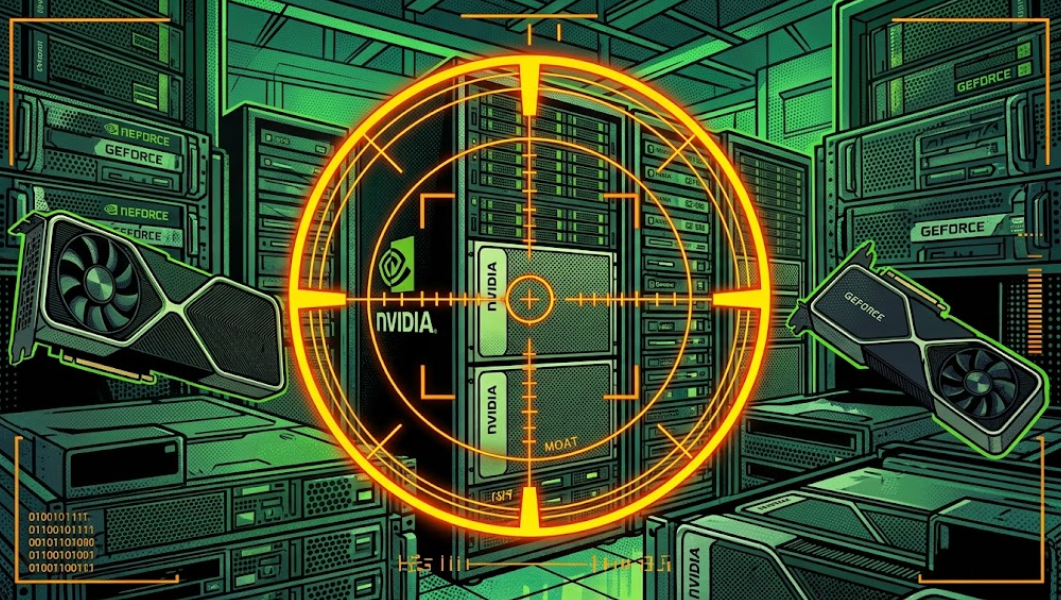
Luminal AI Inc. raised $23 million in early-stage funding, as SiliconANGLE reported, with a plan to tear down Nvidia Corp.'s formidable software moat in the AI chip industry. The Series A was led by Standard Capital, with participation from existing investors including Y Combinator, SagaVC, Liquid 2 and Felicis. The size of the round is the detail worth dwelling on. Twenty-three million dollars is not a sum that buys a challenger to a dominant chipmaker; it is a sum that buys a credible attempt to make the chipmaker's software layer less of a lock-in. The investors named are not making a capital-intensive bet on new silicon. They are funding a thesis about compatibility and switching costs.
For US technology companies, this is the more consequential of the two financings. The moat in question is not a manufacturing advantage but a software ecosystem, and software ecosystems are defended by the cost of rewriting code rather than by physics. If that cost can be reduced, the practical effect is not the dethroning of a supplier but a change in bargaining power across the many American companies that buy AI compute. Buyers benefit when switching becomes plausible, even if they never switch. That is the wager the round encodes, and it is a wager that can be tested at $23 million in a way that a fabrication plant cannot.
Safety Validation as Underbuilt Infrastructure
Qvyon Technologies Inc. launched with $8 million in total funding to help companies validate autonomous vehicles and robots before deployment, as SiliconANGLE reported. MaC Venture Capital led the round, with participation from BDC Capital, BKR Capital and Spotlight VP. The company describes its field as physical AI, meaning artificial intelligence that moves from digital systems into machines that operate in the world.
This is the smaller round and, in some ways, the more revealing one. Validation is the kind of function that everyone in an industry needs and no one wants to own as a core product until a deployment goes wrong. It is unglamorous, it sits between engineering and compliance, and it is exactly the sort of gap that a well-capitalized platform company has little incentive to fill. The investor list is also notable: a US venture firm leading alongside Canadian institutional and specialist participants, which is a reminder that the infrastructure layer of physical AI is being built across borders even as the deployment happens in US markets and on US roads.
For US consumers, the relevance is direct. Autonomous vehicles and robots reach the public through safety cases, and the credibility of those cases depends on independent validation rather than on a developer grading its own work. An $8 million launch round is small relative to the stakes, which is itself the argument: the validation layer has been underpriced relative to the deployment layer it is meant to police.