
Capital Concentrates as Dealmaking Splinters Across Tech
Article

Capital Concentrates as Dealmaking Splinters Across Tech

Three recent deals reveal a funding market that rewards scale at the top while niche builders and self-funders fill the gaps.

JaysuryaNovember 19, 20265 min read

Photo: SiliconANGLE

The recent flow of technology deals shows a market pulling in two directions at once. Capital is concentrating at the very top, where the largest listings can command premium pricing, while the rest of the market fragments into small acquisitions and founder-financed ventures that rarely disclose their terms. For US technology companies and the investors who back them, the pattern matters more than any single transaction.

The Top of the Market Pays Up

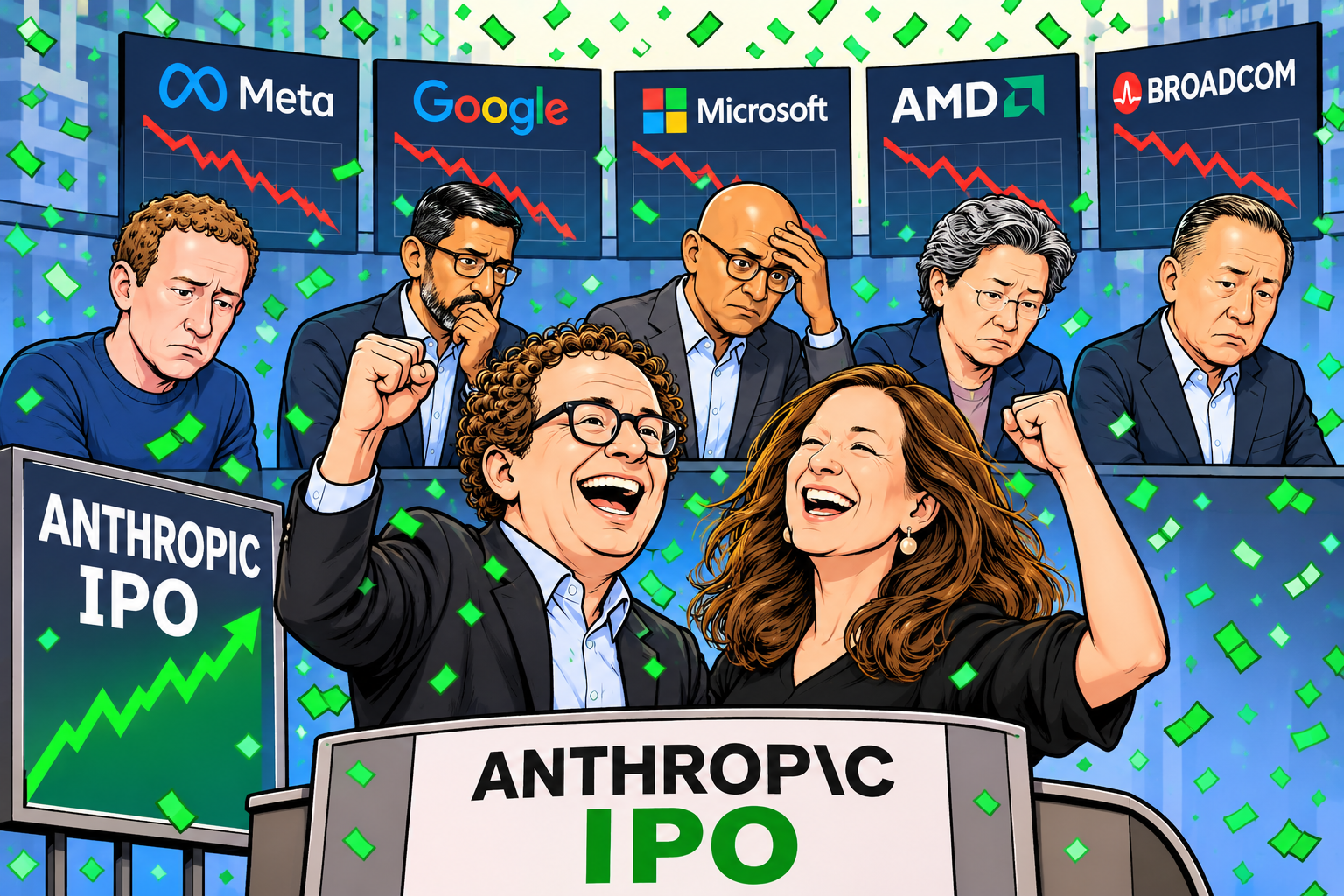
Anthropic PBC priced its initial public offering at $83 per share, according to SiliconANGLE, which reported that the figure came in higher than expected and was covered by Bloomberg, Reuters and the Financial Times. SiliconANGLE described the listing as setting the stage for the biggest stock market listing ever.

The detail worth dwelling on is not the size but the direction of the surprise. Pricing above expectations means demand outran even the bankers' optimistic case. In a public market, that is the clearest signal available that institutional money is willing to pay for scale in artificial intelligence rather than wait for a discount. The IPO is the most transparent pricing event in the funding cycle, and this one priced upward.

That outcome has consequences beyond Anthropic. A record listing at a premium establishes a reference point for every private AI company weighing whether to test the public market. It also shapes how limited partners judge their venture exposure: if the largest names can clear at premium pricing, the argument for concentrating capital in fewer, bigger positions strengthens.

A Quiet Bolt-On at the Other End

At almost the opposite extreme sits Balance Theory Inc., a cybersecurity investment management company that announced the acquisition of VectorBlack, a decision intelligence platform for chief information security officers built by ThreatShare.ai, for an undisclosed sum, as SiliconANGLE reported. The platform was developed by Jason Lewis, Gerry Eaton and Wayne Schepens and is designed to give CISOs timely decision support on emerging threats and industry developments.

An undisclosed price on a small acquisition is routine, but it is also informative. Deals of this shape are typically absorbed without a headline number because neither side needs the market to know the figure. What the transaction shows is a buyer using acquisitions to assemble capability rather than to buy revenue. Balance Theory is in the business of cybersecurity investment management; adding a decision-support tool aimed at security chiefs is a move along its own value chain, not a diversification.

This is where a large share of technology deal volume now sits. Not every transaction can be a record listing, and the companies building specialized tools for narrow professional audiences are being folded into adjacent owners rather than raising standalone rounds at conspicuous valuations.

Self-Funding as a Funding Strategy

TechCrunch reported that Hank Green is self-funding ClockwiseTV, a curated educational video platform for kids, built alongside CEO Leslie Morgan. Green set out to create the video platform he wished his kid had, according to TechCrunch.

Self-funding is easy to read as a lifestyle choice. On the funding beat it is better understood as a response to market conditions. Founders who can finance a venture themselves avoid the dilution, board obligations and growth expectations that come with institutional capital. They also avoid the pressure to justify a valuation in a market where the spread between the largest and smallest companies has widened.
For US consumers, ventures financed this way tend to be shaped by the founder's own product judgment rather than by a return timeline. That can produce more idiosyncratic offerings in categories such as children's media, where the audience is narrow and the revenue models are unglamorous. For the investment market, it means a segment of new companies simply does not appear in funding data at all.

What the Three Together Show

The common thread is not sector and not stage. It is where pricing power sits. Anthropic's IPO priced above expectations because public investors competed for a scarce large asset. Balance Theory bought VectorBlack without disclosing terms because the asset was small enough that disclosure served no purpose. Green is building without outside capital because the kind of company he wants to run does not require, and may not benefit from, an institutional round.

Three different mechanisms, one underlying condition: capital is abundant for the few assets that can absorb it at scale and comparatively selective everywhere else. The middle of the market, where a company raises a conventional venture round at a conventional valuation, is where the pressure is greatest. Companies that cannot reach the public market and do not want to self-fund are the ones most exposed to a market that increasingly rewards either extreme.

What It Means for US Companies and Investors

For US technology companies, the practical implication is that the route to capital is becoming more binary. A company with genuine scale and a compelling AI narrative can access public markets on favorable terms, as the Anthropic pricing suggests. A company with a specialized product and a strategic buyer can exit quietly, as the VectorBlack acquisition shows. A company with neither needs either a founder willing to write the checks or a patience that venture timelines rarely allow.

For the US market, the concentration of public-market capital into the largest listings raises a familiar question about index weight and liquidity. When the biggest listing ever prices above expectations, the public market's exposure to a single name grows accordingly. That is a portfolio-construction issue as much as a technology one, and it will be argued over by allocators long after the listing itself fades from the headlines.

For US consumers, the effects are indirect but real. Premium IPO pricing validates continued heavy spending on AI products and infrastructure. Undisclosed acquisitions consolidate specialized security tooling under fewer owners. Self-funded media ventures add offerings that would not survive a growth-at-all-costs mandate. None of these is inherently good or bad for consumers; together they describe an industry where the shape of a company is increasingly determined by how it was financed.

What to Watch

Three things in the material above are worth tracking. First, whether the Anthropic IPO holds its pricing once it trades, since a premium listing price is a statement about demand that the secondary market will either confirm or revise. Second, whether Balance Theory discloses any terms for VectorBlack later, and whether other security-focused investment managers follow with similar bolt-ons. Third, whether self-funded ventures like ClockwiseTV remain a curiosity or become a visible cohort, which funding data would not capture either way. Each is a different test of the same question: which parts of the technology market still have pricing power, and which have quietly lost it.

The sources for the facts above are SiliconANGLE, which reported the Balance Theory acquisition and the Anthropic IPO pricing, and TechCrunch, which reported on ClockwiseTV.

More on this beat: Companies on TechManNews.

#funding#IPOs#acquisitions#venture capital#cybersecurity#artificial intelligence

Newsletter

Get Tech News in Your Inbox

The latest AI, gadgets, software and startup stories from TechManNews, delivered every morning - free.