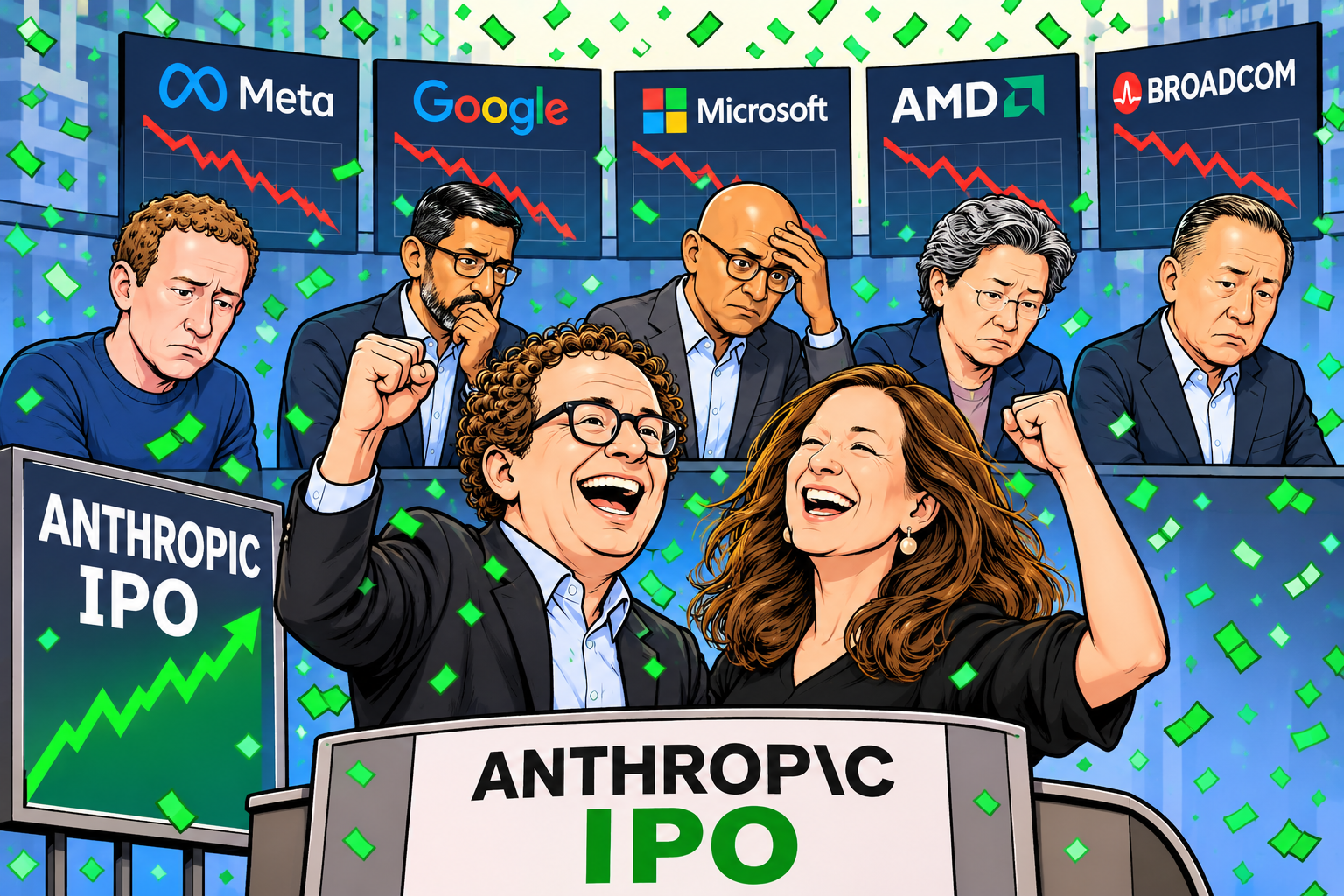
The most consequential funding story in technology right now is not how much capital is being raised but who ends up owning the assets that capital builds. Two platform giants are set to hold nearly 30% of Anthropic after its IPO, public investors are being far more selective about which AI companies they will reward, and Europe's most established venture firm is warning that the continent keeps producing world-class companies without keeping enough of the upside. Read together, these developments describe a market in which ownership is concentrating among a small set of players while the distribution of returns becomes more contested.
The Anthropic cap table as a case study
TechCrunch reports that Amazon will own just under 15% of Anthropic following its IPO, with the option to go much higher, while Google holds nearly 14%. Combined, the two companies will control close to 30% of the AI developer once it is public. That is an unusual structure for a newly listed technology company, and it carries implications that go well beyond Anthropic itself.
For US public-market investors, the arrangement raises a familiar governance question in a new context. A company can list its shares and still have its strategic direction substantially shaped by two corporate holders whose interests are not identical to those of ordinary shareholders. Amazon and Google are both customers, partners and competitors in cloud and AI infrastructure. Their stakes give them influence over a company whose models are increasingly embedded in the products of other businesses.
For US technology companies, the deeper signal is that the largest AI developers may not arrive on public markets as independent entities in any meaningful sense. The capital required to train and serve frontier models has been supplied disproportionately by a handful of platform companies, and that funding is now converting into equity. The IPO becomes a liquidity event for those backers as much as a coming-out party for the issuer.
The public market is not buying the whole sector
The second thread comes from PwC's US IPO services leader, Mike Bellin, in a Q&A with Crunchbase News. Bellin described a slowdown in IPO momentum and explained how public investors are evaluating AI companies. The detail matters less than the framing: the window is open, but it is selective. Not every AI issuer gets through, and those that do are being priced on evidence rather than narrative.
That selectivity interacts directly with the Anthropic structure. If public investors are discriminating about AI valuations, they are likely to be equally discriminating about ownership arrangements that leave strategic control elsewhere. A company that lists with two corporate holders approaching 30% combined has to persuade buyers that minority shareholders are not simply along for a ride defined by two large partners.
The same Q&A points to renewed interest in SPACs and a biotech resurgence, both of which suggest capital is looking for alternative routes to public markets when the traditional IPO path is slow. For US companies weighing a listing, the practical takeaway is that the IPO is no longer the default exit. The route chosen now signals something about how investors view the asset.