Three funding announcements logged on this beat point to the same conclusion: investors are concentrating early-stage capital on narrowly defined automation plays and on founders whose backgrounds sit outside the technology mainstream. Multiply Labs raised $75 million for pharmaceutical manufacturing robots, a former magician's assistant and ballet dancer raised $4.2 million in seed funding for a cybersecurity startup, and Nous Research confirmed a $1.5 billion valuation alongside a $90 million Series B for business-facing AI agents. Read together, the deals suggest that the appetite for capital is not broad, but specific.
Narrow Automation Wins the Larger Checks
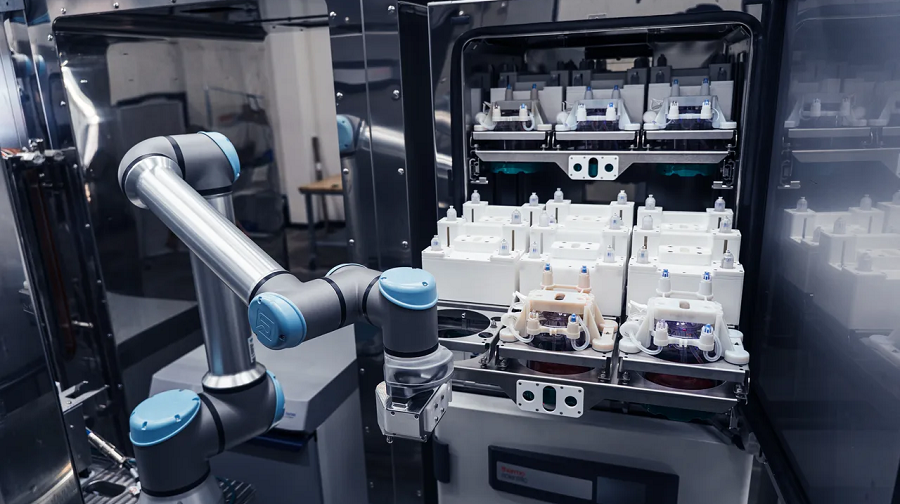
The largest single raise in the group is Multiply Labs' $75 million, as SiliconANGLE reported. The company develops automation equipment for drugmakers, which places it in a category that has attracted steady interest from both financial and strategic investors. The composition of the round is notable. Prominent medical researcher Patrick Soon-Shiong led the deal, and the Series B drew more than a half-dozen other backers, including AstraZeneca plc and Teradyne Inc., a robotics company.
The presence of AstraZeneca, a pharmaceutical company, and Teradyne, a robotics company, indicates that the capital is not purely financial. Strategic backers typically invest where they see direct operational relevance to their own businesses. For US technology companies, that matters because it signals a funding path that runs through industrial customers rather than through consumer adoption or platform scale. A robotics firm selling into pharmaceutical manufacturing can point to a specific buyer with a specific bottleneck, and that specificity appears to be what unlocks larger checks in the current environment.
Specialists Are Beating Generalists at the Seed Stage
The cybersecurity seed round covered by Crunchbase News sits at the opposite end of the size spectrum but reinforces the same pattern. A former magician's assistant and ballet dancer raised $4.2 million in seed funding for a cybersecurity startup. Crunchbase News framed the raise as part of a series on venture funding for non-tech founders.
Two things stand out. First, the founder's background is presented as unusual for the sector, which suggests investors are willing to underwrite domain-specific software businesses even when the founder's résumé does not follow the standard engineering or product management route. Second, the amount is modest by the standards of the other two deals, which is consistent with seed-stage discipline: the round is small enough to fund a focused build rather than a broad platform ambition. For US consumers, cybersecurity spending by startups ultimately feeds into the tools that protect accounts, payments and personal data, but the funding decision itself is driven by a narrow product thesis rather than a sweeping claim.
The AI Agent Trade Is Now Priced at Scale
Nous Research confirmed it hit a $1.5 billion valuation and launched AI agents for business users, as TechCrunch reported. The same report noted the developer of the Hermes agent raised a $90 million Series B.
The round size and the valuation are the notable data points. A $90 million Series B is a substantial raise for a company at that stage, and the $1.5 billion valuation places it in a tier that invites scrutiny of whether business demand will match the price. The company's positioning, AI agents for business users, places it in a crowded field. What the announcement shows is that investors are still willing to write large checks for agent software aimed at enterprises, even as the broader debate about AI monetization continues. For US technology companies, this sets a benchmark: agent startups with enterprise distribution stories can still command premium valuations in late 2026.

