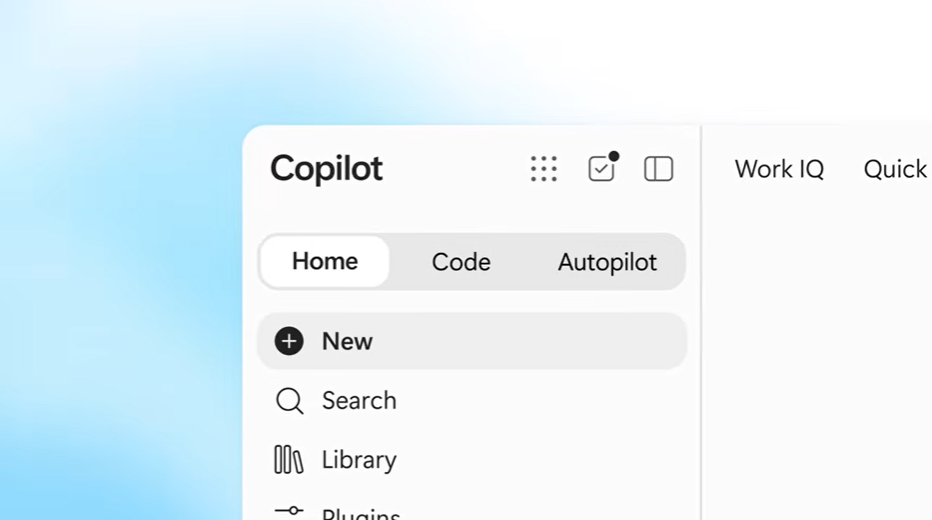
The three stories on this beat share one thread. Developer tooling is being pulled in two directions at once, and the middle layer where most working programmers have historically made their living is thinning. Nvidia is pushing ray-tracing geometry management down into the runtime so engines stop hand-managing VRAM. Microsoft is pulling app creation up into a prompt box that non-engineers can use. GitHub is relearning that the automation layer between them is a supply chain with its own failure modes.
The Abstraction Is Moving Up
Microsoft's Copilot overhaul, as SiliconANGLE reported, adds an interface section called Code that lets non-technical workers build simple apps from prompts. The example given is a business analyst creating a dashboard that tracks store sales. That is a task that once required JavaScript, a charting library, a data connector, and a deployment pipeline. Now it requires a sentence.
The immediate read is that Microsoft is chasing seats. The more useful read for anyone on this beat is that the company is treating the prompt as a first-class authoring surface, not a helper bolted onto an editor. That matters because the dashboard case is exactly the kind of internal tooling that mid-level developers have been paid to build for two decades. Not the hard parts of the job. The plumbing. The glue. The one-off report nobody wants to own.
If that layer moves into the assistant, the demand for junior generalists on internal tools softens. The demand for people who can specify data models, govern access, and audit what the assistant generated does not. Microsoft is not replacing developers here. It is relocating where the leverage sits, and the relocation favors whoever owns the semantics of the business rather than whoever can wire up a component.
For US enterprise buyers, the practical consequence is a faster path from idea to internal app, plus a new governance problem. Every prompt-built dashboard is a small system of record. The material does not say how Microsoft handles that, and buyers should not assume it is solved.
The Abstraction Is Also Moving Down
Nvidia's RTX Mega Geometry 2.0 SDK, arriving with RTX Kit 2026.3, streams ray-tracing geometry into VRAM on demand, according to Tom's Hardware. This is a lower-level move than it looks. Historically, getting large ray-traced scenes to fit in memory was an engine programmer's problem, solved with hand-tuned LODs, custom streaming, and a lot of profiling.
Nvidia is making that the runtime's problem. The engine author stops writing the memory management and starts describing intent. The GPU vendor absorbs the complexity.
That is the same gesture as Copilot's Code, pointed the other way. One moves complexity up into an assistant so a non-developer can act. The other moves complexity down into a vendor SDK so a developer can stop acting. In both cases, a capability that used to be a person's job becomes a platform feature.
For US graphics and game studios, that is mostly good news. Streaming geometry on demand removes a class of out-of-memory crashes and lets artists ship denser scenes without an engine team rewriting the renderer. It also deepens the lock-in to one vendor's runtime, which is the trade every studio makes knowingly and then complains about later. The material does not describe cross-vendor support, and readers should notice that absence.
The Middle Layer Is Now Attack Surface
The third story is the one that should change behavior. BleepingComputer reported that two third-party GitHub Actions previously compromised in a Mini Shai-Hulud campaign were re-enabled by their maintainer and remained accessible for more than a week despite still pointing to malicious code.