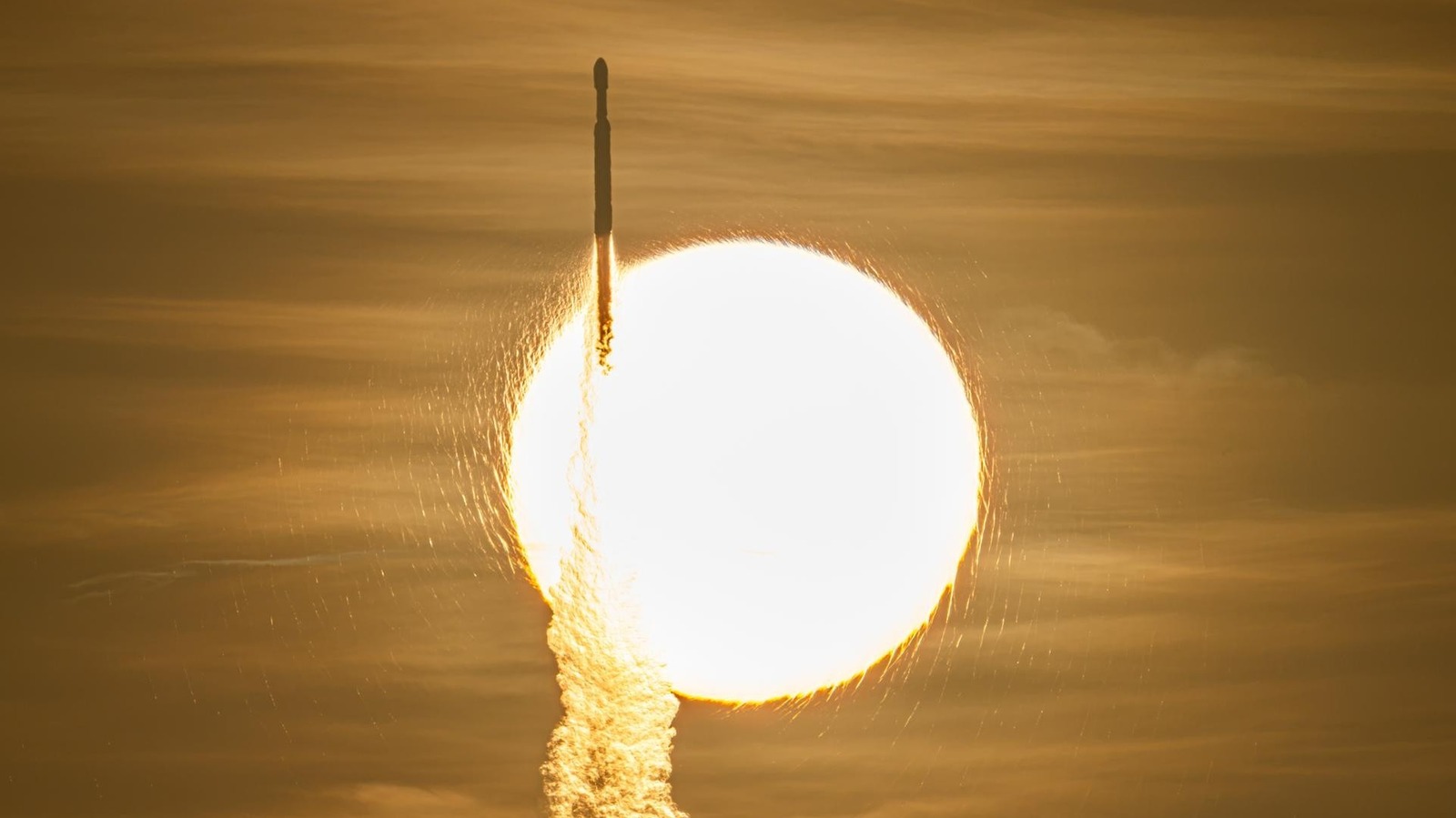
NASA's Nancy Grace Roman Space Telescope launched this morning from Kennedy Space Center in Florida aboard a SpaceX Falcon Heavy rocket, beginning its mission to investigate dark matter and dark energy. The telescope, which can image areas of the sky 100 times larger than what the Hubble Space Telescope could capture, is now heading into orbit for what NASA describes as a study of the "dark universe." The agency confirmed shortly after liftoff that Roman successfully deployed its solar panels and lower instrument sun shade.
Over the coming days and weeks, the remaining instruments on the telescope will deploy and activate, according to NASA. Once fully operational, Roman is expected to transmit 1.4 terabytes of data per day back to Earth, with the first images anticipated in early 2027. The mission is designed to survey vast portions of the cosmos at speeds that previous observatories could not match, giving researchers a new tool for probing fundamental questions about the universe's structure and history.
Nicky Fox, associate administrator for NASA's Science Mission Directorate, said Roman will act as a discovery machine that brings scientists closer to answering deep questions about cosmic history. Fox added that the telescope's large field of view and fast survey speeds will open a new era of discovery, making the invisible visible and laying groundwork for the search for life beyond our solar system. Her remarks frame the mission as a bridge between studying the large-scale universe and identifying potential targets for future biological investigations.
Beyond dark matter and dark energy, the Nancy Grace Roman Space Telescope will observe exoplanets and the disks of material around young stars where planets form. NASA has indicated that the observatory may measure light from a billion galaxies over the course of its mission, providing a massive dataset for astrophysicists. For US researchers and the broader American space science community, Roman represents a new generation of space-based observatories focused on statistical surveys rather than narrow deep-field views.
The launch adds to a busy period for US space infrastructure, with the Falcon Heavy serving as the heavy-lift vehicle for this science payload. The telescope is named after Nancy Grace Roman, a pioneering NASA astronomer known for her role in developing the Hubble program, though the source article does not provide further biographical detail. No timeline has been given for when full science operations will begin beyond the early 2027 first-light target.
The mission's daily data output of 1.4 terabytes will require substantial ground-based processing and archival infrastructure, though the source article does not specify where that data will be stored or analyzed. As the telescope settles into its operational orbit and instruments come online, US scientists will gain a new window into the distribution of matter across the universe. The source article offers no information on the telescope's total mission duration or its planned end-of-life procedures.
More gadget news from TechManNews.