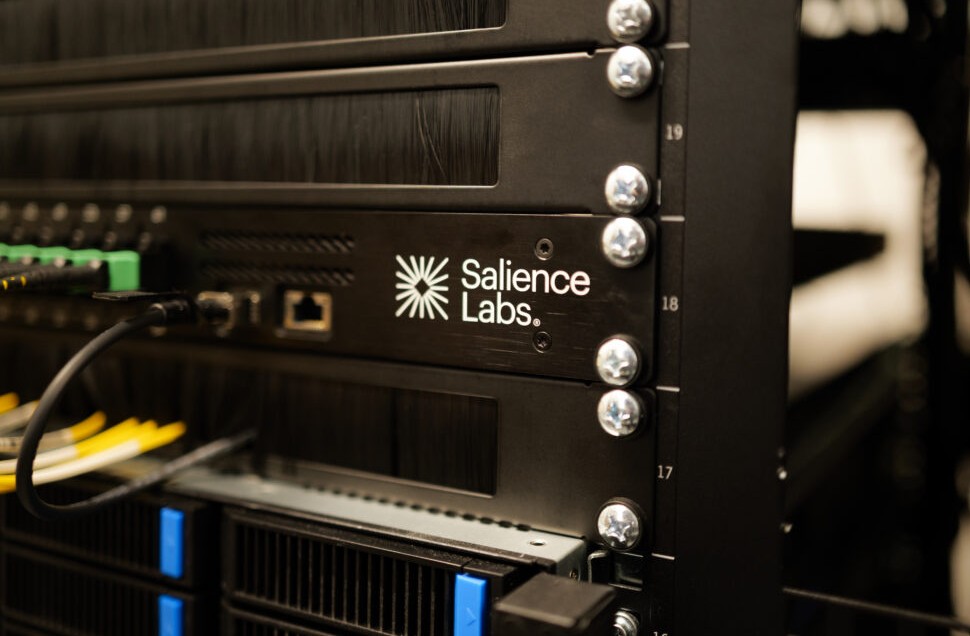
Three funding announcements logged today on this beat point at one pattern: the money is going to startups that supply or govern AI infrastructure, not to companies building frontier models. Salience Labs raised $125 million for optical circuit-switching, Modal Labs raised $750 million at a $15.75 billion valuation for AI cloud infrastructure, and Harmonic Security raised $50 million for tools that govern employee use of AI. Each sits one layer below the model. Each is being financed as though that layer is where durable, defensible businesses are forming.
Capital Moves Down the Stack
The most obvious common thread is placement. None of these companies sells a model or a chatbot. Salience Labs, as SiliconANGLE reported, is pitching fully optical circuit-switching as a way to speed AI workloads. Modal sells AI infrastructure. Harmonic inspects what employees send to AI tools before it reaches them. That is a change from the pattern of the past few years, when the largest rounds went to labs training ever-larger models. The new money is buying the plumbing that models run on and the controls that surround their use inside companies. For U.S. startups, this repositions the pitch: the question is no longer whether a model is smarter, but whether the surrounding layer can handle scale, cost and risk.
The Buyers Signal Where Value Sits
Salience Labs's investor list matters as much as the amount. The round was led by Bullhound Capital and included Intel Capital and AMD Ventures, the investment arms of two of the chipmaking industry's most iconic names, per SiliconANGLE. Strategic chip investors do not typically fund optics startups for entertainment. Their participation suggests that the constraint on AI performance is increasingly moving from compute logic to how data moves between chips and systems. If that reading holds, optical switching vendors become a dependency for the same hardware vendors now backing them. For U.S. technology companies, that is a supply-chain signal: the next bottleneck may not be the accelerator itself but the interconnect around it.
Cloud and Governance as Adjacent Bets
Modal's raise shows the same logic applied to serving. Accel led the $750 million Series D, joined by Kleiner Perkins and existing investors, at a $15.75 billion valuation, according to SiliconANGLE. Modal is an AI cloud provider, which places it in the market of renting the capacity that model builders and application companies consume. The valuation, more than triple the prior mark, indicates that investors see infrastructure demand as less speculative than model demand. Harmonic takes the argument one step further. Its $50 million round, per SiliconANGLE, funds a platform that inspects employee interactions with AI tools before they leave the organization, using custom small language models to read each interaction. That is a control layer, and it only has a market because AI use inside workplaces has become widespread enough to create policy and data-leakage problems. Together, the three deals describe a stack: silicon and optics at the bottom, cloud capacity in the middle, governance on top. Capital is spreading across all three rather than concentrating at the model layer alone.