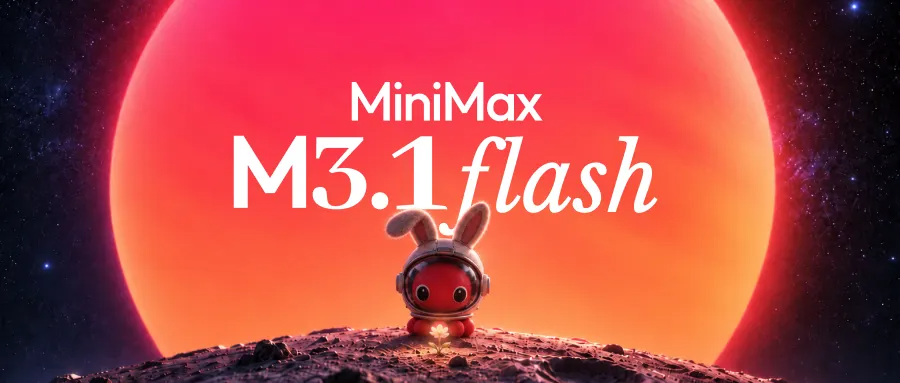
MiniMax Group Inc. released M3.1 Flash, a faster and less expensive update to the M3 large language model the Chinese artificial intelligence developer launched in June. The company said the new model cuts the cost of running AI agents by 70% compared with its previous model, targeting workloads that often require dozens of model calls to complete a single job. Inference is nearly three times as fast, with output at everyday peak exceeding 200 tokens per second, according to MiniMax.
The parameter count is essentially unchanged from M3. MiniMax's developer guide for the preview release lists 428 billion parameters in total, and the launch post attributes the added speed to more aggressive sparsity at inference time. Reasoning remains active on every request, with developers selecting among five effort levels from Low to Max. The model accepts text, image and video input, and prompts can run to 1 million tokens.
In MiniMax's internal testing, M3.1 Flash scored 61.7 on OSWorld V2, which measures how well a model operates a computer, and the company said no Chinese model has scored higher. It posted 76.2 on BankerToolBench, a banking workflow test. MiniMax also cited an 82% score on CyberGym, a benchmark built by University of California at Berkeley researchers to test whether AI agents can reproduce real software vulnerabilities. The company listed code auditing, penetration testing and malware analysis among tasks the model can handle.
At a flat 15 cents per million input tokens, M3.1 Flash competes directly with V4.1-Flash from Hangzhou DeepSeek Artificial Intelligence Basic Technology Research Co. Ltd., which charges the same rate off-peak. DeepSeek said over the weekend that its updated V4.1-Flash resolved 77% of tasks on the DeepSWE v1.1 software engineering test, while M3.1 Flash managed 73.7%. Neither result has been independently verified.
MiniMax, which has traded in Hong Kong since a $619 million initial public offering in January, saw its shares fall after the original V4.1-Flash launched in September, Bloomberg reported. The launch also confirms MiniMax as the developer behind Space Bunny, an anonymous model that appeared on OpenRouter Inc.'s model routing service in late September. Community testers linked it to MiniMax by probing its tokenizer, and the company confirmed Space Bunny was an early M3.1 Flash build. More than 200 trillion tokens passed through it while its maker remained unnamed, according to the launch post.
M3.1 Flash is available now through the MiniMax API, the company's M Plan subscription and its MiniMax Code desktop app. Output costs 60 cents per million tokens and cached input 1.5 cents. MiniMax said it will release the Flash weights later and that a more capable Pro model is also coming.
More AI news from TechManNews.