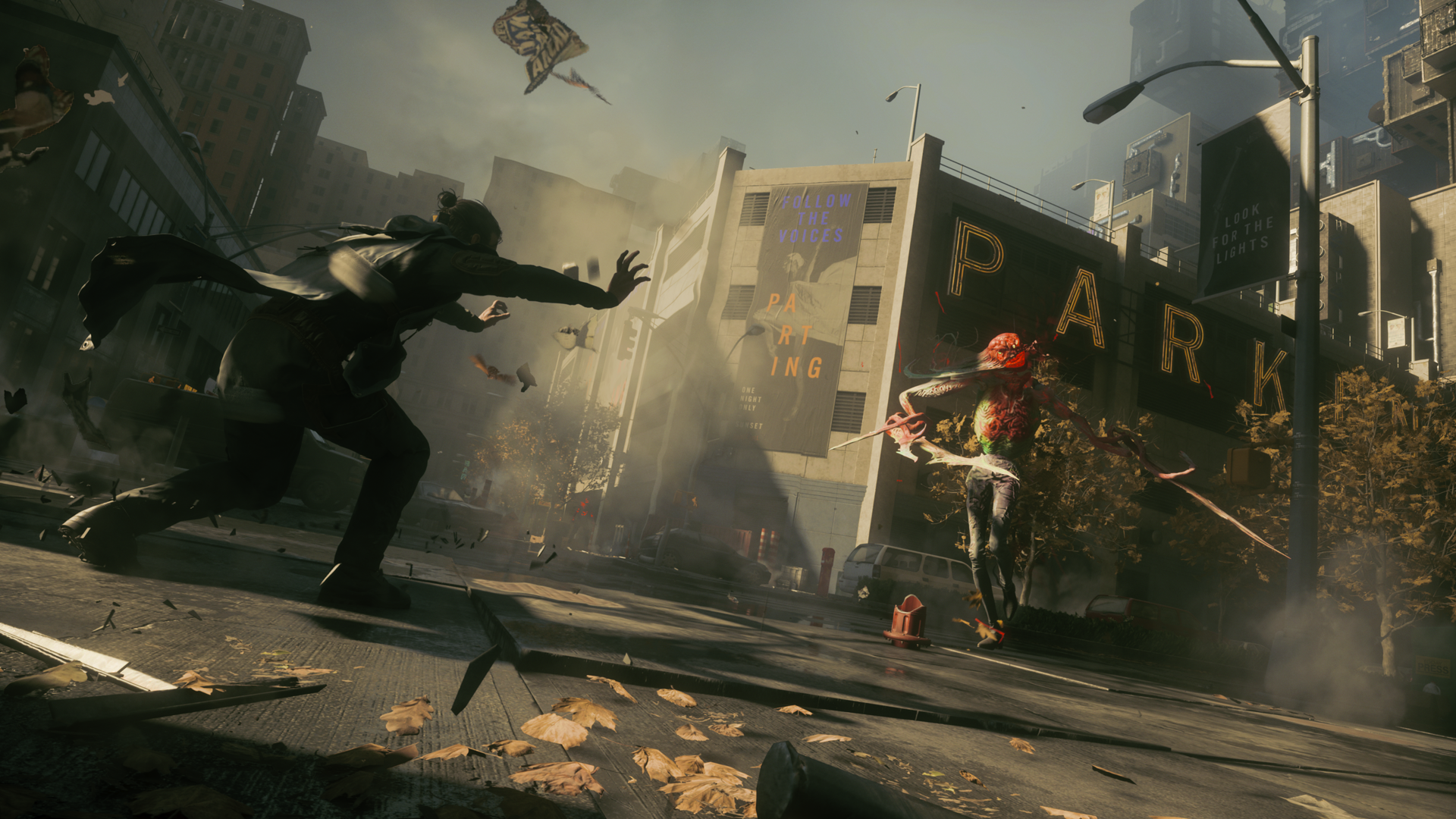
Control Resonant continues the story of the siblings at the center of Remedy's series, with Dylan waking to find that Jesse has disappeared and that the Hiss threat has broken out of the Oldest House and corrupted Manhattan. Guided by the mysterious Board, Dylan uses his own powers to search for Jesse, fight the Hiss incursion, and investigate a new paranormal entity operating in the warped city. Tom's Hardware tested the game over several days across a range of hardware and settings.
The title is a technical showcase, much as the original Control was for GeForce RTX 20-series cards and DLSS upscaling. Control Resonant adds path-traced lighting supported by Nvidia's RTX Mega Geometry technology, along with the full DLSS 4.5 suite: Super Resolution, Ray Reconstruction, and Multi Frame Generation. Without ray tracing or path tracing and without DLSS Ray Reconstruction, the game still looks good, and leaving RT off does not make it look bad for players who prioritize performance.
Ray tracing and path tracing are worth enabling where hardware allows. Outdoors, RT mainly improves the blobby shadows and soft reflections seen in Manhattan's many puddles, sometimes subtly and sometimes dramatically. At the highest settings, path tracing produces crisp shadows and stronger, clearer reflections in water and in glass such as car and shop windows. Indoors, RT models strong artificial light more accurately, shadowing Dylan's face from overhead lights and letting his back fall into darkness when he blocks them, while metallic objects like trash cans look like roughed-up metal rather than flat assets.
The polish is not uniform. Character models for Dylan, Zoe, and supporting characters such as Langston look like a step back from the detail achieved in past Remedy games, and the gap between the faces and the environmental quality stands out.
At 1080p Ultra with RT off, the game already demands an RTX 5060 Ti or better or a Radeon RX 9060 XT or better for roughly 60 FPS average among current-gen cards, or an RTX 4070, RTX 3080, or RX 7800 XT among earlier cards. The RTX 3060 cannot average 30 FPS. Radeons tend to post lower 1% lows than GeForces. The Radeon RX 6800 XT remains above a 60 FPS average at 1080p but is limited to FSR 3.x, so its image quality is noticeably worse than RX 9000- or RX 7000-series cards that get FSR 4.1. The demands of the DLSS 4.5 transformer upscaling model hit RTX 30-series products hard, the first game tested where that occurs.
At 2560x1440 Ultra, the RX 9070 GRE and RTX 4070 Ti land just below a 60 FPS average, while the RX 9070 and RTX 5070 Ti sit slightly above it. At 4K, only the RTX 5090 reaches a 60 FPS average. RT is not attainable at native resolutions: at 1080p with the medium RT preset, the RTX 4070 Ti, RX 7900 XTX, and RTX 5070 fall just below 60 FPS, the RX 9070 XT lands on it, and the RTX 5070 Ti is more comfortable. At 1440p, even the RTX 5080 cannot average 60 FPS, and at 4K, not even the RTX 5090 can.
More hardware news from TechManNews.