📣

Advertisement

Google Ad - 970×90 Leaderboard  TOP_LEADERBOARD_4

AI Assistants Are Redefining the Boundaries of Personal Data
Article

AI Assistants Are Redefining the Boundaries of Personal Data

New ChatGPT features for style mimicry, teen controls, and research automation show AI companies pushing deeper into personal data and user trust.

Arjun NairSeptember 7, 20265 min read

Photo: BleepingComputer

📣

Advertisement

Google Ad - 970×90 Leaderboard  TOP_LEADERBOARD_4

The Thread

The recent spate of ChatGPT-related announcements reveals a single pattern: OpenAI is no longer just building a chatbot that answers questions. It is constructing a system that ingests personal data, imitates individual writing habits, restricts access based on age, and aims to replace junior-level research tasks. The common thread is a deliberate expansion of AI into the most intimate and consequential parts of daily life - how people write, what children can see, and how knowledge work gets done. For US consumers and technology companies, this shift raises a central question: where does the line between helpful assistance and invasive data collection now sit?

Writing Style Mimicry

As BleepingComputer reported, OpenAI appears to be testing a “Writing Style” feature that lets ChatGPT learn from examples in connected personal apps and then mimic that style. This is not cosmetic. It transforms the assistant from a generic text generator into a persona calibrated to imitate a specific person’s voice. The implication for American users is significant: the tool must read substantial amounts of their own prose - emails, documents, messages - to capture tone, rhythm, and word choice. That requires broad access to platforms where people write with informal candor and sensitive context.

For US consumers, the convenience is real. Drafting replies, composing memos, or refining a blog post in one’s own voice saves time and feels natural. But the trade-off is that personal writing patterns, once considered the province of human identity, become training material. Writing style is a biometric marker of sorts; it is stable, unique, and revealing. If a US-based subscription service absorbs that data, it gains a permanent model of how a person thinks and communicates. The question is whether current federal privacy rules - which remain a patchwork of state laws - offer enough protection for that kind of highly sensitive inference.

Teen Controls and Parental Authority

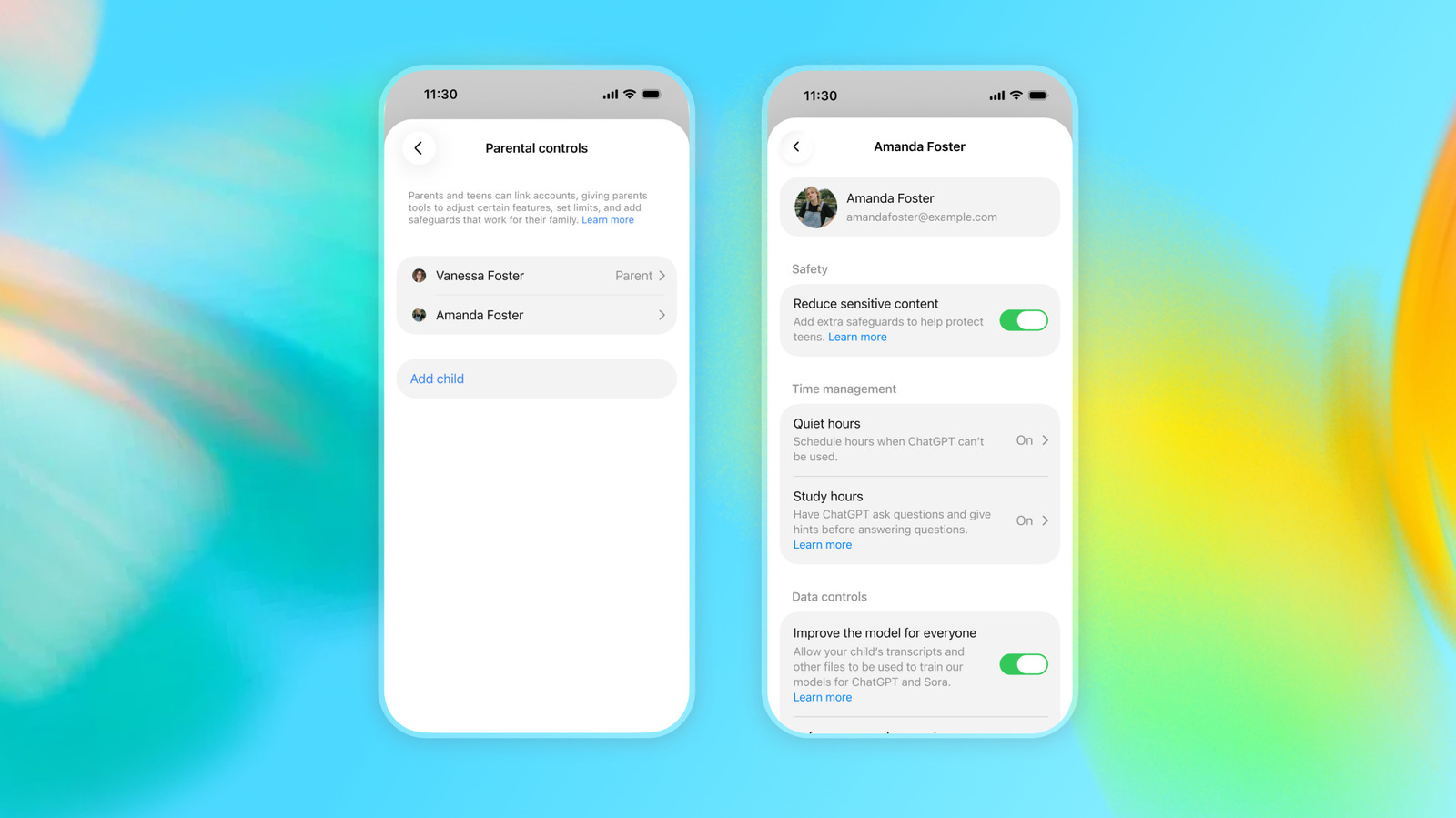
Engadget reported that OpenAI has introduced teen-focused parental controls, giving granular management over what younger users can and cannot access. This feature acknowledges that ChatGPT is no longer a curiosity for adults but a mainstream utility used by high schoolers for homework, research, and social communication. In the US, where parental anxiety about screen time and AI is high, such controls may ease adoption. But they also cement a new role: AI providers become gatekeepers of adolescent information access, a position historically held by parents, teachers, and public libraries.

The pattern here is not just about safety features. It is about OpenAI positioning itself as a trusted intermediary within the family unit. By offering granular controls, the company implicitly asks US parents to delegate some judgment to its algorithms. That delegation carries risk. The criteria for blocking or allowing content remain opaque, and an error could either expose an underage user to harmful material or censor legitimate educational inquiry. Moreover, parental controls require OpenAI to track user age, usage patterns, and potentially the content of conversations involving minors - raising thorny questions about data retention under laws like COPPA.

The Automated Research Intern

Engadget also reported that OpenAI says it reached its goal of creating an automated research intern and hopes to have an even better “automated AI researcher” by March 2028. This is the most consequential development for the US labor market. An automated research intern does not merely answer queries; it scours databases, summarizes literature, cross-references sources, and produces a coherent report - tasks that occupy entry-level analysts at consulting firms, law offices, market research shops, and many corporate departments.

Advertisement

📣

728x90

MID_CONTENT_2

For US companies, that promise could lower costs and accelerate decision-making. But it also signals that AI is moving up the skill ladder. The first wave of automation hit repetitive tasks; this one targets cognitive routine work. A young professional in the US who expected to spend their first two years doing research support may find that a system can outperform them in speed and consistency. The pattern is not necessarily job destruction - it is role redefinition. The automated intern will not close a deal or persuade a client, but it will handle the grunt work that historically trained new hires. That changes the on-ramp to white-collar careers just as deeply as factory automation changed blue-collar ones.

Trust as the Real Product

Across all three stories, the deeper subject is trust. To mimic a person’s writing style, the system must be trusted with private prose. To manage a teen’s access, parents must trust the vendor’s judgment. To replace a research intern, employers must trust that the output is accurate enough to act on without verification. Each new feature erodes an old boundary - between personal expression and algorithmic generation, between parental oversight and corporate filtering, between human judgment and machine synthesis.

The US technology sector thrives on rapid iteration, but this pattern suggests that trust is being spent faster than it is being earned. OpenAI is not alone; other platforms will follow similar paths as they chase engagement and utility. The risk is that users accept these features without reading the fine print, then learn later how much data was used and for what purpose. The benefits are immediate and tangible, while the costs are diffuse and delayed - a classic recipe for regulatory backlash once examples of misuse surface.

What to Watch

Three concrete indicators will determine whether this pattern strengthens or collapses. First, watch how US regulators respond to writing-style mimicry. If state attorneys general or the Federal Trade Commission begin probing what data is collected to train voice models, expect a compliance scramble. Second, watch whether parental controls remain a differentiator or become a de facto standard. If competitors adopt similar granular settings, the market will treat teen safety as table stakes rather than a premium feature. Third, watch the timeline to 2028 for the automated researcher. If OpenAI misses its own bet, the technology may have hit a reliability ceiling; if it succeeds, expect a wave of lawsuits over job displacement and copyright of synthesized research.

The common thread is not AI capability - it is the quiet expansion of data intimacy. Each feature asks the user to surrender a new slice of private life in exchange for convenience. For US consumers, the question is not whether to use these tools, but how to use them without surrendering the very things that make human writing, parenting, and research distinct: unpredictability, context, and accountable judgment. The next stage of the AI race will be fought not over model size, but over the terms of that surrender.


Sources: BleepingComputer, TechCrunch, Engadget

More on this beat: AI on TechManNews.

Advertisement

📣

728x90

IN_ARTICLE_5

#ChatGPT#OpenAI#AI privacy#Parental controls#AI research#US tech

Newsletter

Get Tech News in Your Inbox

The latest AI, gadgets, software and startup stories from TechManNews, delivered every morning - free.