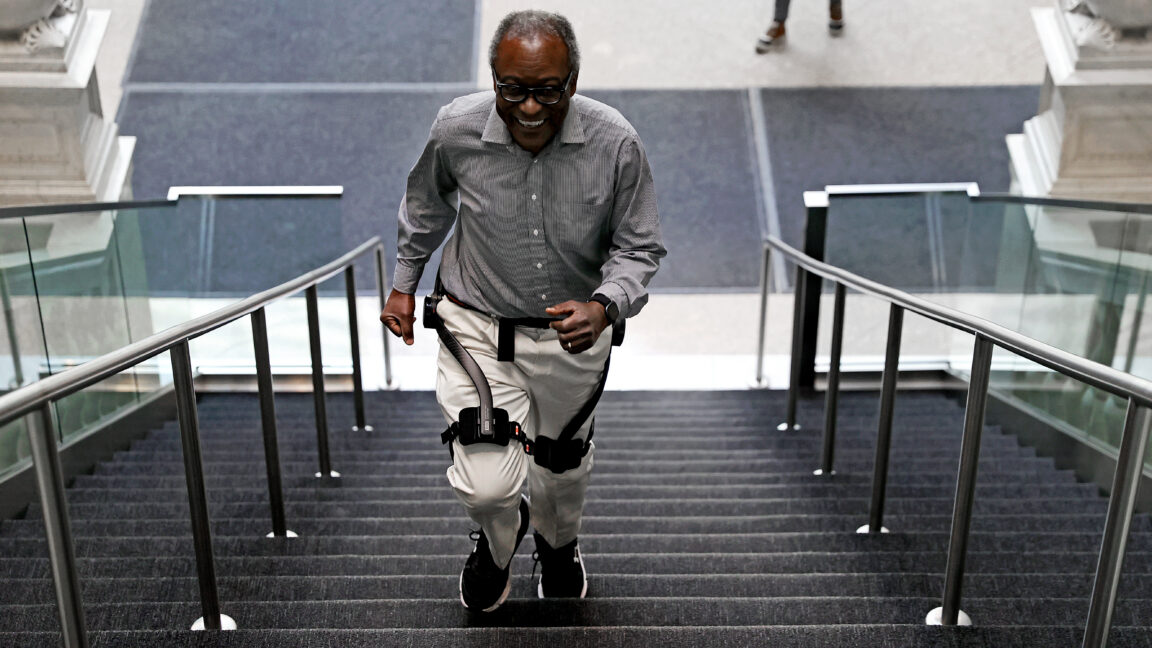
Rescue teams are testing powered devices worn on the hips and legs to see whether the equipment can increase their speed and endurance during searches for stranded people. The devices, known as human exoskeletons, attach to parts of the body to form an external mechanical frame that enhances the wearer's physical capabilities. Workers in physically demanding fields are increasingly using them for strenuous tasks.
IKEA has used SuitX exoskeletons for several years to help warehouse workers handle heavy materials, and Ford, Boeing and Mazda Toyota have adopted the technology on some assembly lines. In Finland, a project called ExoPELA assessed whether exoskeletons could reduce muscle load and strain in rescue and firefighting work, finding noticeable benefits for users in certain real-world tasks. In early 2026, the Ukrainian military revealed that its soldiers had been using Hypershell exoskeletons on the front lines to carry artillery shells. Colonel Vitalii Serdiuk told the Ukrainska Pravda newspaper in March that test results showed soldiers wearing the devices become less fatigued, work faster and maintain combat effectiveness for longer.
Consumer and clinical devices for everyday assistance, rehabilitation and exercise are also available. Some estimates have valued the total sector at around $500 million, with predictions it could double or triple in size by the mid-2030s. The technology has advanced significantly over the past decade, largely because robotic motors, sensors and control systems have become more affordable and accessible.
The concept dates back much earlier. Nicholas Yagn, a self-taught Russian inventor, patented a wearable exercising apparatus in 1890, and in 1919 the American Leslie C. Kelley received a patent for a steam-powered device to support walking. By the end of the 1960s, multiple actuated robotic exoskeletons with electronic control systems had been developed.
Exoskeletons generate forces that make the wearer stronger, faster or slower to fatigue, and some improve movement accuracy, dexterity or posture. Modern active robotic exoskeletons typically use a lightweight mechanical frame with ergonomic attachments affixed at the trunk, waist and upper or lower limbs. The Hypershell device attaches to the waist and thighs to assist hip flexion and extension, while the SuitX device attaches to the torso and upper limbs to support the back and shoulders.
In most powered exoskeletons, actuators convert electric power from batteries into mechanical movement. Control units coordinate the actuators, defining movement trajectories and force, with sensors determining what the task and the user's state require. Assistance generally falls into three categories: power augmentation, assist-as-needed or resist-as-needed settings used in rehabilitation, and full robotic control for users who have lost motor functions.
Most exoskeletons currently rely on sensor feedback and are wholly mechanical, though research is exploring operation through signals from the wearer's muscles or brain. Batteries must be integrated and regularly recharged, introducing weight and size constraints, although energy density is steadily improving.
More technology news from TechManNews.