ICEYE, the Finnish satellite developer, said Tuesday it wants to acquire Italian rocket-maker Avio for more than $2.2 billion, a deal aimed at building Europe’s first fully integrated end-to-end space company. Avio produces the Vega C, a solid-fueled rocket capable of lifting up to 3.3 metric tons (7,300 pounds) of payload to low-Earth orbit. ICEYE, valued at more than $12 billion after a June fundraising round, is described as Europe’s most successful space startup. The combined company would pair satellite manufacturing and operations with an in-house launch vehicle.
ICEYE said the tie-up is intended to address Europe’s need for sovereign space and defense capabilities. The company builds and operates radar surveillance satellites and sells the resulting data to commercial customers and national governments, including Ukraine, which uses ICEYE imagery to target and track Russian troop movements. Most of ICEYE’s satellites have flown on SpaceX Falcon 9 rockets, and with Falcon 9’s retirement approaching, the company will need alternative rides to orbit. Vega C holds a substantial backlog of European government contracts but has not succeeded commercially, and ICEYE investment could strengthen the Vega program and potentially speed work on a new rocket.
Separately, NATO is contracting commercial rockets and spaceports to expand its satellite launch network and reduce risks to the space systems it depends on. The alliance launched two efforts Tuesday: Starlift, which lets participating countries secure slots on commercial rockets, and the Global Data Marketplace, which will supply commercial data and services for military space operations. Under Starlift, Belgium, Canada, Finland, Germany, Italy, the Netherlands, Norway, Sweden, Turkey, the UK, and South Korea will pool military launch requirements and reserve launch slots, while NATO prepares and tests procedures for short-notice launches in a crisis. NATO’s tech agency will offer about $2.7 billion in contracts over the next two years, including to commercial space companies and in areas such as AI, cyber, and command and control networks.
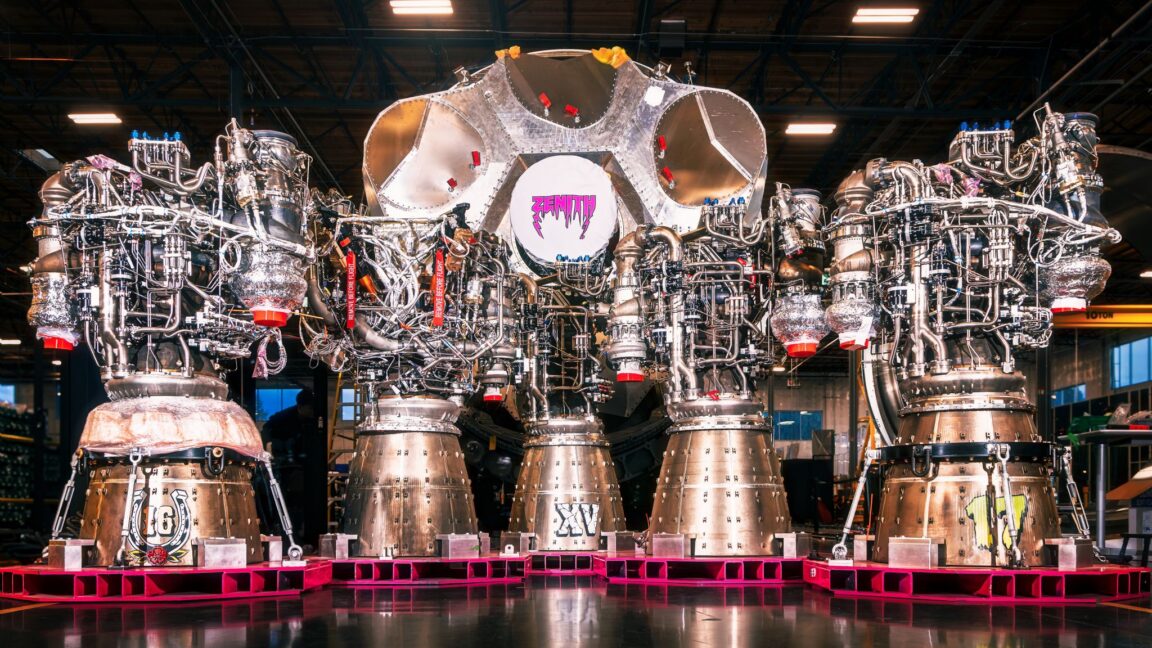
Stoke Space said Thursday it has completed development of its Zenith engine, the methane-fueled powerplant for its medium-class Nova rocket. The company said flight engines are clearing acceptance testing and shipping weekly to Cape Canaveral for integration with Nova’s first stage. Seven Zenith engines will power the reusable first-stage booster, producing about 700,000 pounds of thrust at full throttle.
Stoke cleared a proto-qualification milestone on Stage 1 earlier this year, and Stage 2 is undergoing cryogenic proof testing and a hot-fire campaign at the company’s test complex in rural Washington. Nova’s second stage carries 24 thrusters around a regeneratively cooled heat shield to protect it during reentry, part of Stoke’s plan for full reuse of both stages. The first launch is expected sometime next year.
In other launch activity, a Soyuz-2.1b rocket made its first and only flight this year from Russia’s Vostochny Cosmodrome on November 14 local time, according to RussianSpaceWeb.com. Its Fregat upper stage deployed two high-resolution imaging satellites and a cluster of smaller payloads, including a pair of CubeSat-class satellites owned by Russian arms manufacturer NPO Kaisant, which says they will join a constellation providing secure communications to Russian drones over Ukraine. Roscosmos reported 12 secondary payloads in total. Vostochny, in Russia’s Far East, hosted its first launch in 2016 and has averaged about two launches per year despite more than $5 billion in construction spending.
Chinese company LandSpace said it completed ground acceptance and testing of the nine methane-fueled engines recovered from the first stage of its Zhuque-3 rocket after an August flight, according to Guandian News. The engines were disassembled, inspected, refurbished, reassembled, and retested. LandSpace did not say whether any will fly again, and the booster toppled over soon after landing at its downrange recovery zone in northwestern China, though engineers appear to have salvaged the engines.
SpaceX achieved the first successful catch of its Starship upper stage on November 14, a step toward rapid reuse of the vehicle and its Super Heavy booster. Ars Space Editor Eric Berger, watching from Starbase, Texas, said seeing the ship return under its own power after orbiting the planet felt like stepping into the future, and that capturing a vehicle of Starship’s size with the tower’s chopstick arms would have seemed fantastical until recently.
United Launch Alliance’s Vulcan rocket and 40 Amazon Leo broadband satellites fell back to Earth minutes after liftoff Sunday, a setback for ULA, Amazon, and the US military. The mission was the first of 38 Vulcan launches Amazon has booked to build its satellite Internet network competing with SpaceX’s Starlink, and Vulcan is under contract for roughly half of US Space Force national security missions over the next few years. ULA said Wednesday it had identified the cause.
More gadget news from TechManNews.