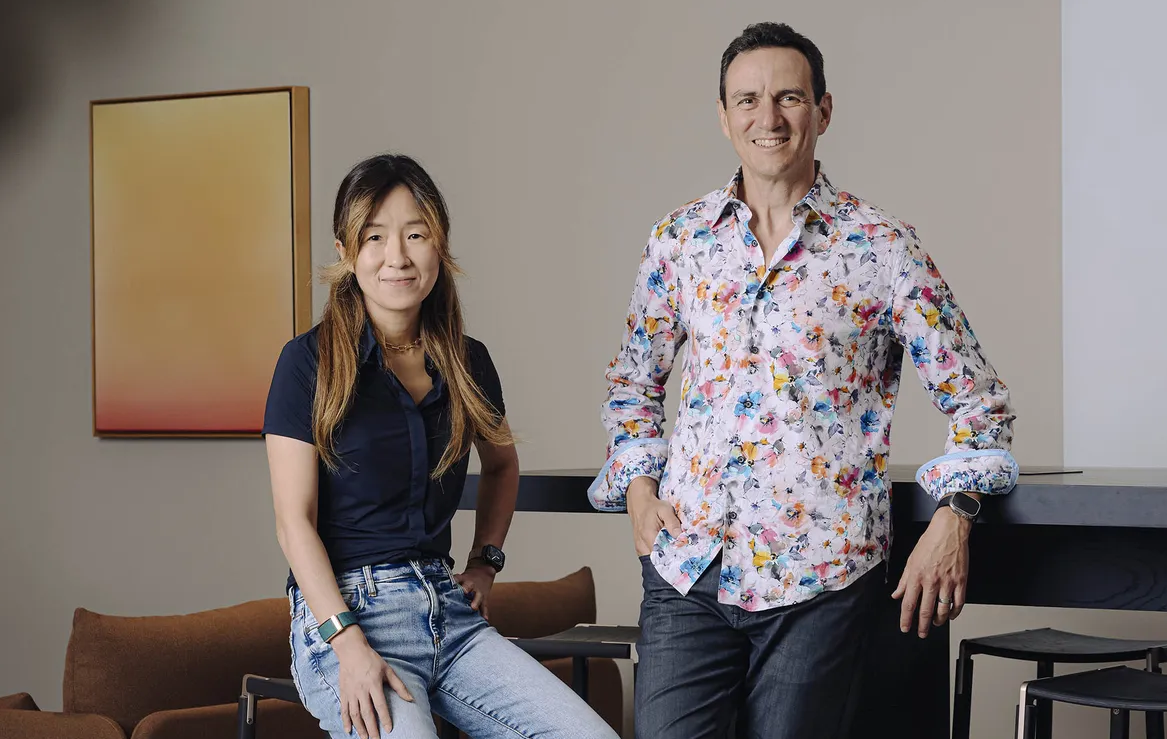
Noeri Inc. launched with $110 million in funding to develop artificial intelligence systems that improve their outputs as they learn from an organization's data and work. The round was led by Menlo Ventures, with participation from Madrona Ventures, Kindred Ventures, Wing Venture Capital and NEA, as well as Snowflake and Cisco Ventures. The company was founded by Stanford University researchers Yejin Choi and Carlos Guestrin, who developed self-improving systems at the University of Washington before moving to Stanford.
Noeri's software studies a company's data, workflows and business processes, then proposes changes to specific tasks to make them more efficient. The co-founders describe it as a living AI system that gets better over time. Suggestions might include different instructions, different tools, or swapping out the model handling each step of a workflow. Each recommendation comes with an explanation and goes to a human for review before it is accepted, similar to how AI-generated code changes are implemented.
The software works with both open-weight and proprietary AI models, and Noeri says customers retain full ownership of their workflows and the AI systems they build. Choi told Bloomberg that Noeri is aimed at organizations forced to choose between paying fees they cannot afford for the most capable AI models or accepting results from a less effective one. The company's name means "intelligence, in the plural," reflecting the founders' belief that the future of AI will not be dominated by one or a handful of extremely powerful models.
The company grew out of an effort to help a microbiology and immunology team at Stanford use OpenAI Group PBC's models more cost effectively. Choi said she and Guestrin built a small AI model that learned to use OpenAI's older models and fine-tuned it to outperform the more advanced GPT-5 on that team's projects. Guestrin has argued publicly that the future of intelligence cannot be controlled by one or two companies that own the models; in a blog post, the founders compared relying on a single centralized AI to building core operations on a consultant who advises every competitor and can never be brought in-house.
Noeri's systems rest on two research efforts. Guestrin pioneered a self-distillation technique that lets AI models become their own teachers, turning mistakes into lessons for improving responses over time. Choi's work on agentic orchestration has shown that smaller models directing teams of AI agents and tools can outperform much larger frontier models at lower cost.
The startup says it is working with partners across multiple industries, including some of its investors, chosen to expose its systems to a wide variety of work. Menlo Ventures Partner Venky Ganesan said most new AI labs ask the market to wait years for a breakthrough, while Choi and Guestrin are doing world-class research and putting it to work inside companies at the same time, a combination he called rare.
Guestrin previously helped develop the machine learning tool XGBoost and co-founded GraphLab Inc., later known as Turi Inc., which Apple Inc. acquired in 2016; he later led Apple's machine learning and AI research organization. Choi previously led the Allen Institute for AI's common-sense reasoning research team, joined Nvidia Corp. in 2024 as a distinguished scientist, and left about a year later for Stanford in early 2025, where she helped Guestrin start Noeri in May.
More company and startup news from TechManNews.