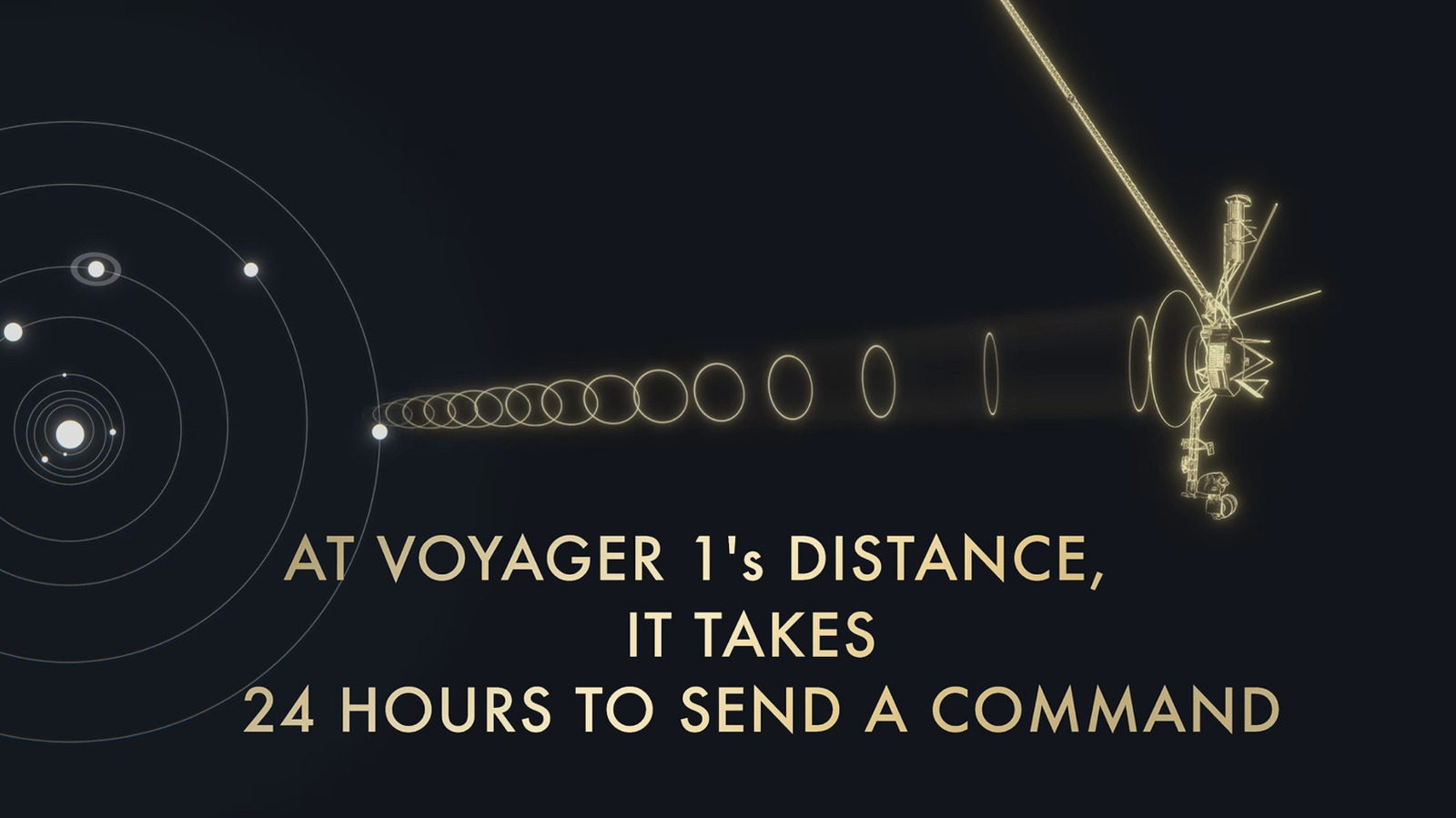
NASA’s Voyager 1 probe is believed to have reached a distance of one light-day from Earth, a milestone the agency projects it hit at 5:16:07 AM Eastern time today, November 18. One light-day is the distance light travels in a single day. Because radio signals move at the speed of light, commands sent to Voyager 1 now take 24 hours to arrive, and replies take another 24 hours to return.
That delay means NASA cannot confirm the exact moment the probe crossed the threshold until tomorrow, when its next message reaches Earth. The agency’s estimate puts the spacecraft roughly 16 billion miles from the planet after 49 years, two months and 11 days of flight. Voyager mission manager Kareem Badaruddin described the event as unprecedented and possibly unrepeatable.
Voyager 1 launched in 1977 as part of NASA’s effort to study both the Solar System and interstellar space, the region between star systems. It lifted off 16 days after its twin, Voyager 2, but has traveled farther than Voyager 2 and any other probe launched from Earth. Voyager 1 entered interstellar space in 2012, ahead of Voyager 2.
The probe has remained operational despite technical glitches and the diminishing plutonium supply in its generator, which forced NASA to shut down some of its features to keep it running. It continues its journey outbound. Its projected path points toward Gliese 445, a star about 17 light-years from Earth in the constellation Ursa Minor.
Voyager 1 is expected to pass within 1.7 light-years of Gliese 445 in 40,000 years. For NASA, the one-light-day mark adds a practical constraint to an already long-running mission: every command and every response now carries a full-day transit each way. The confirmation of the crossing is expected once the probe’s signal completes its 24-hour return trip.
More gadget news from TechManNews.