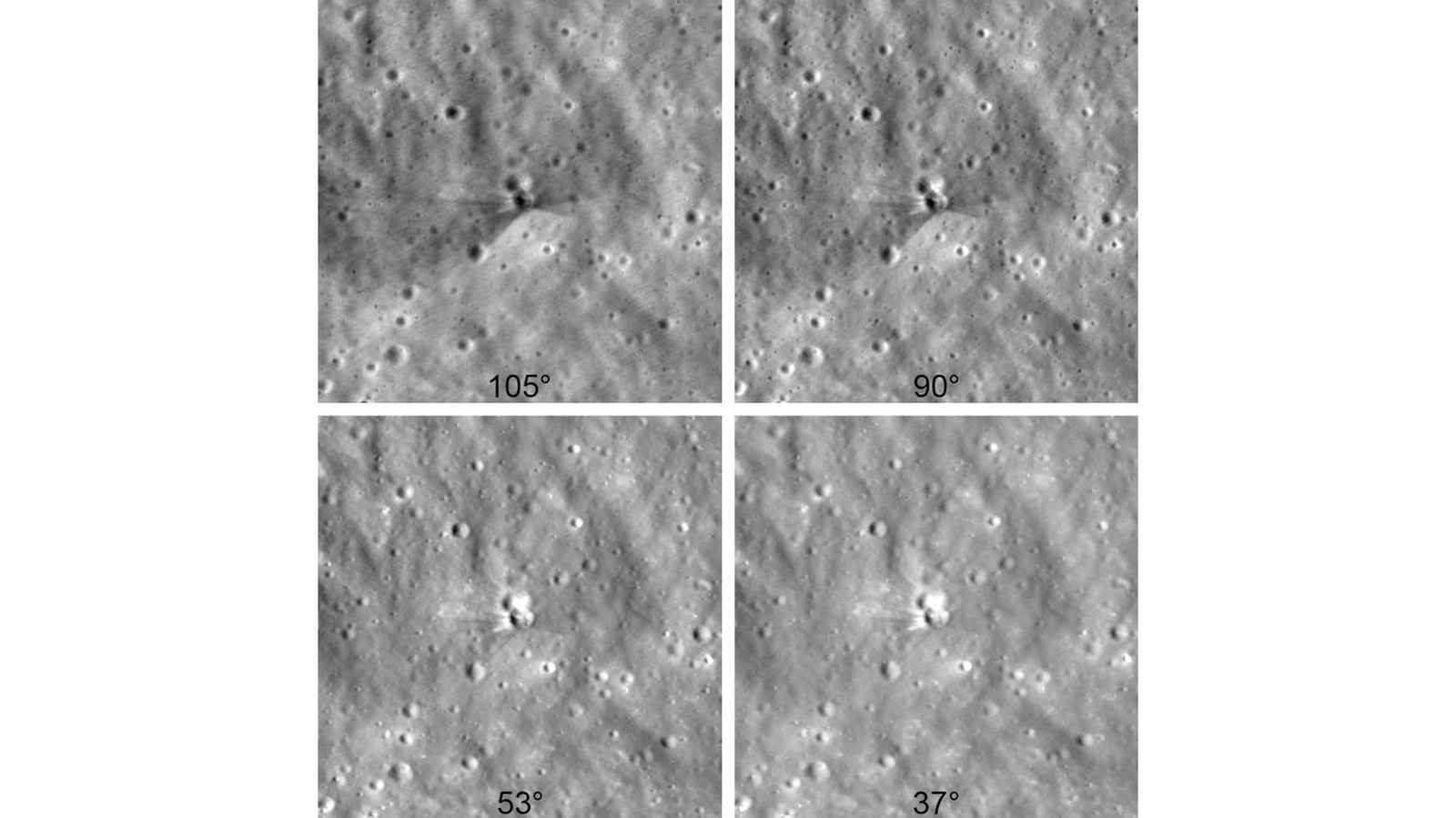
NASA has released images from its Lunar Reconnaissance Orbiter showing a fresh crater on the moon, the result of a SpaceX Falcon 9 rocket upper stage crashing into the lunar surface in early August. The spacecraft captured the photos on August 11 and 12 after engineers tilted it sideways to point its cameras downward while passing roughly 60 miles above the impact site. The orbiter’s Narrow-Angle Camera was used for the task, capable of resolving features as small as three feet across on the moon’s surface.
Getting those images required careful timing, as the Lunar Reconnaissance Orbiter travels from pole to pole every two hours at about one mile per second while the moon rotates beneath it. NASA waited six days for the spacecraft’s orbit and the crash site to align, then released before-and-after pictures of the area. The new photographs show the crater from several angles, with a darker streak of material radiating outward from the impact point.
That darker material consists of older dust and rocks from near the lunar surface, altered by long exposure to solar winds and cosmic rays, while lighter material near the crater’s rim came from deeper underground. The crater itself measures about 60 feet wide and 12 feet deep, according to NASA’s calculations, created when the rocket struck at 5,400 miles per hour. The upper stage was roughly 39 feet long and 13 feet wide, weighing about 4,000 kilograms.
The crash was first flagged months earlier by independent astronomer Bill Grey, who used orbit-computing software in April to determine where and when the rocket would hit the moon. Grey and his colleagues then applied a physics simulator to the data, concluding that the upper stage would not produce a significant impact. That prediction appears consistent with the crater size now documented by NASA.
The Falcon 9 upper stage involved came from the Blue Ghost mission launched on January 15, 2025, which carried two lunar landers into orbit. The rocket expended most of its fuel delivering those landers to their intended path and could not return to Earth. Gravity and solar activity subsequently pulled it toward the moon, where it eventually crashed.
For US technology audiences, the event underscores the growing challenge of tracking space debris and the need for coordination between commercial launch providers like SpaceX and federal agencies such as NASA. The Lunar Reconnaissance Orbiter’s ability to document such impacts relies on precise orbital adjustments, a capability that will likely become more important as lunar missions increase in frequency. The images also provide scientists with fresh data on how impacts alter the moon’s surface, useful for future landings and exploration efforts.
More gadget news from TechManNews.