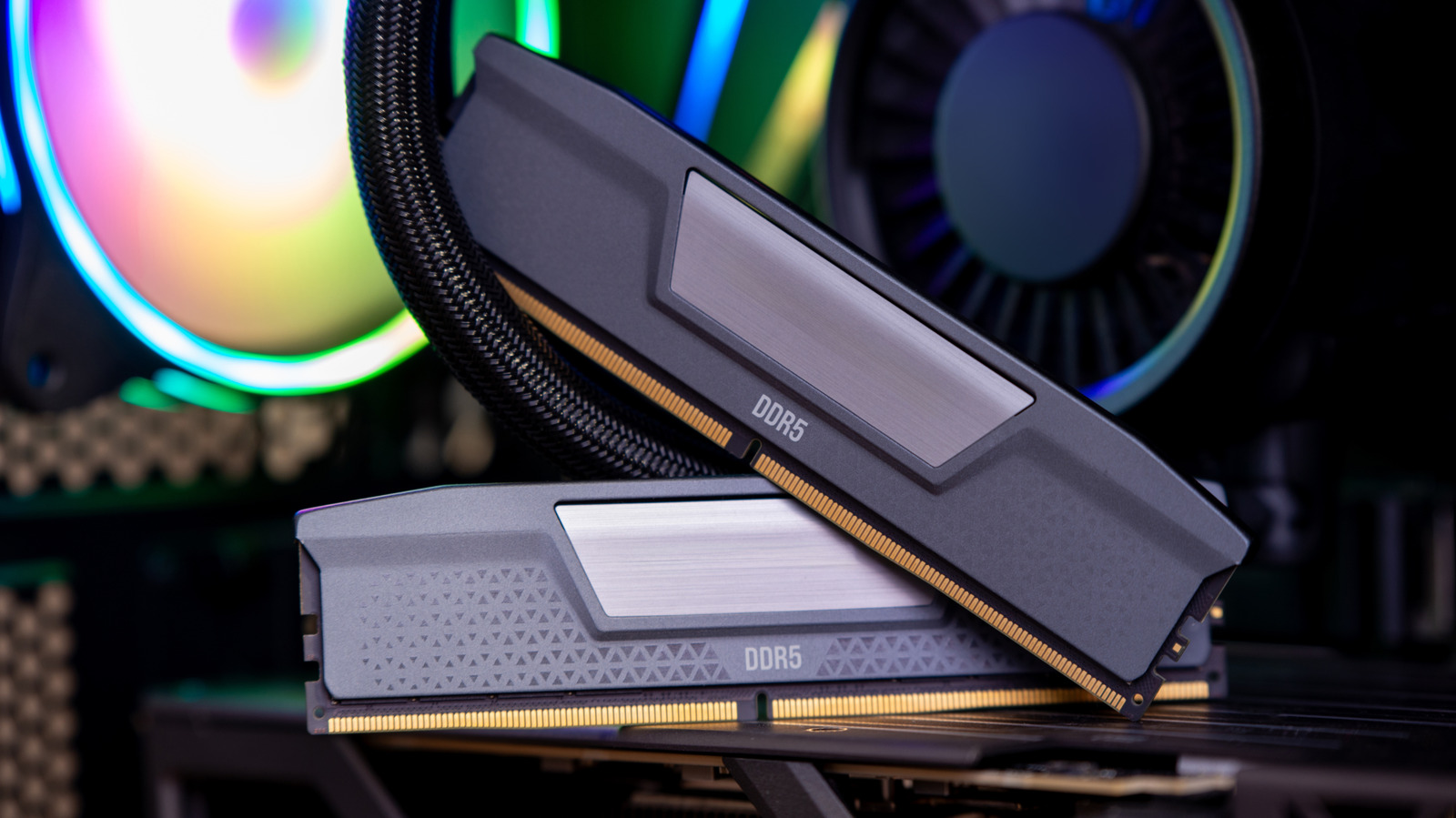
Gamers shopping for DDR5 memory do not need to chase the fastest kits on the market, according to a review of the current hardware landscape. No game requires a specific DDR5 speed, and any title that runs on DDR5 will run on the low-end DDR5-4800 kits. Faster modules such as DDR5-7200 and DDR5-8400 only deliver marginal frame rate gains during processor-bound gameplay.
Confusion around memory labels is common, since the four-digit number in a kit name resembles a clock speed but is not one. The figure after DDR5, as in DDR5-6000 CL30, is the data rate in millions of transfers per second, while the CL figure counts latency in clock cycles. A DDR5-6000 module's clock actually ticks at 3,000 MHz, with data moving on both the up and down stroke to reach 6000.
Real response time in nanoseconds comes from multiplying the CAS latency by 2000 and dividing by the data rate. A DDR5-6000 CL30 kit lands at 10 nanoseconds, while a budget DDR5-4800 CL40 kit sits near 17. JEDEC standard timings hold that figure close to 14 nanoseconds across the range from DDR5-3200 to DDR5-8800, so a faster kit with looser timings is not quicker to respond, only wider once data flows.
Platform support shapes what buyers should install. AMD's spec sheet for Ryzen 9000 lists DDR5-5600 as the supported speed, and Ryzen 7000 lists DDR5-5200, but most AMD builds use DDR5-6000 because the memory controller can match the memory clock up to roughly 3,000 MHz. Anything faster forces the controller to run at half the memory clock, adding delay. Testing by Tom's Hardware showed DDR5-6000 CL30 beating a DDR5-6400 CL32 kit despite the latter's higher paper rating.
Intel's Core Ultra 200S desktop chips accept DDR5-6400 out of the box with CUDIMMs, or DDR5-5600 with standard sticks. Corsair states that DDR5 between 6400 and 7200 is best for 13th Gen Intel, though the memory maker is describing its own top-end products. As for the ceiling, JEDEC raised its official limit to 8,800 MT/s in 2024, and the fastest kits now reach 9600.
For practical purposes, DDR5-4800, the 2021 launch speed, remains the baseline every DDR5 processor is built to run, and DDR5-5200 is the speed AMD validated for Ryzen 7000. Either is described as perfectly good for gaming. In Tom's Hardware Intel testing, the slowest 32GB kit, a loose-timed DDR5-6400, finished about 4 percent behind the fastest across heavy productivity workloads.
Enthusiasts continue pushing past official ratings. At June's Computex event, Gigabyte used liquid nitrogen to drive a Corsair kit to 13,556 MT/s, a figure with no bearing on ordinary consumer use.
More hardware news from TechManNews.