Microsoft has launched the Surface Laptop Ultra, a high-end Windows laptop that serves as the debut platform for Nvidia's RTX Spark chip. The device marks Nvidia's entry into Arm-based PC chips and is aimed at competing directly with Apple's MacBook Pro. A model with 24GB of RAM starts at $2,599.99, while a top configuration with 128GB of memory costs $5,899.99.
Brett Ostrum, corporate vice president of Surface at Microsoft, said the company's earlier Copilot Plus PC initiative from 2024 was aimed at the MacBook Air. Microsoft also wanted to challenge the MacBook Pro, but existing chips could not reach that level of compute. Nvidia began privately demonstrating its forthcoming chips' AI capabilities around that time, and Microsoft chose to work with the company. Ostrum described Nvidia as a logical choice for competing with the MacBook Pro.
The Surface Laptop Ultra features a CNC-machined aluminum body, a large trackpad, chicklet keys, and fan vents beneath a slightly elevated base. It includes HDMI and an SD card slot, along with a high-resolution touchscreen. The RTX Spark combines CPU and GPU, and Microsoft says the chip can run compressed 280 billion-parameter AI models locally. The system uses unified memory, the same approach Apple takes with its M-series chips. Because Nvidia combined the CPU and GPU, Microsoft shrank the motherboard and enlarged the fans, arranging components in a black grid. The laptop contains no glued-down components and includes marked instructions and QR codes for disassembly.
Microsoft designed a built-in magnetic connector for USB-C, a project lead designer Jit Hirani said went through roughly 300 iterations. Hirani said the team's single constraint was that it could not change the universal USB-C port. The connector includes a charging light and can detach from a 140-watt charging block, which can then charge other devices through a regular USB-C port. Ostrum said Microsoft spent years developing the magnetic USB-C charging solution and would not say whether it will appear on more Surface devices.
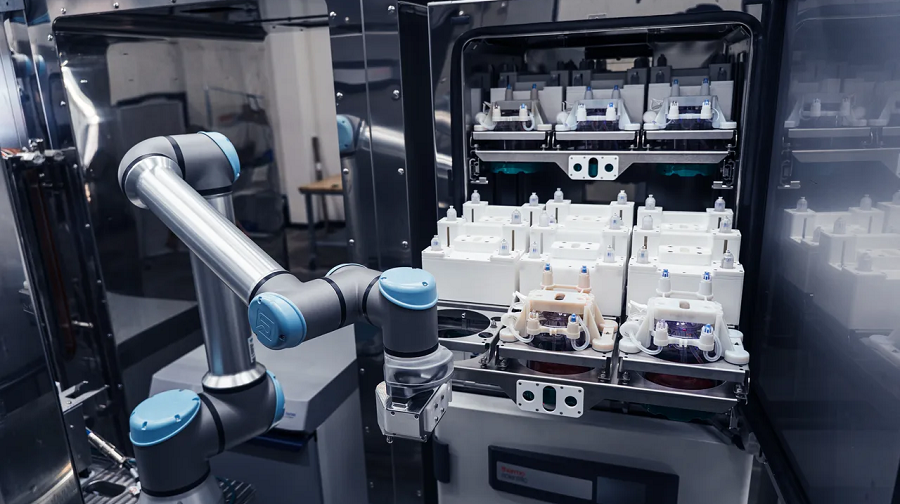
Testing takes place in a windowless, warehouse-like lab on Microsoft's Redmond, Washington, campus. Robots press buttons thousands of times, antennas direct radio waves at devices, and contraptions drop objects from increasing heights. Microsoft's Automated Experience Lab measures device responsiveness beyond standard benchmarks, including how long Microsoft Teams takes to launch and how fast letters appear when typing. An Arduino board injects code to measure response times, and a small robot automates tasks such as unplugging USB-C devices, using the touchscreen, pen, and trackpad, and opening and closing the device.
Nvidia engineers working on power, performance, graphics, stability, and Wi-Fi must complete code and check it into Nvidia before it moves to the next branch, a process that can create weeks of lag. Microsoft allows those engineers to upload code remotely to the robot, which Ostrum said greatly accelerates testing and can return data the next day. Because the RTX Spark is an Arm chip, most games are not native and must be emulated. An emulated version of Gears of War: E-Day ran smoothly, including when the laptop switched between plugged-in and battery power. Microsoft is positioning the Ultra mainly for developers who want a powerful GPU for local AI compute, as well as for creatives and professionals who would buy a MacBook Pro.
More gadget news from TechManNews.