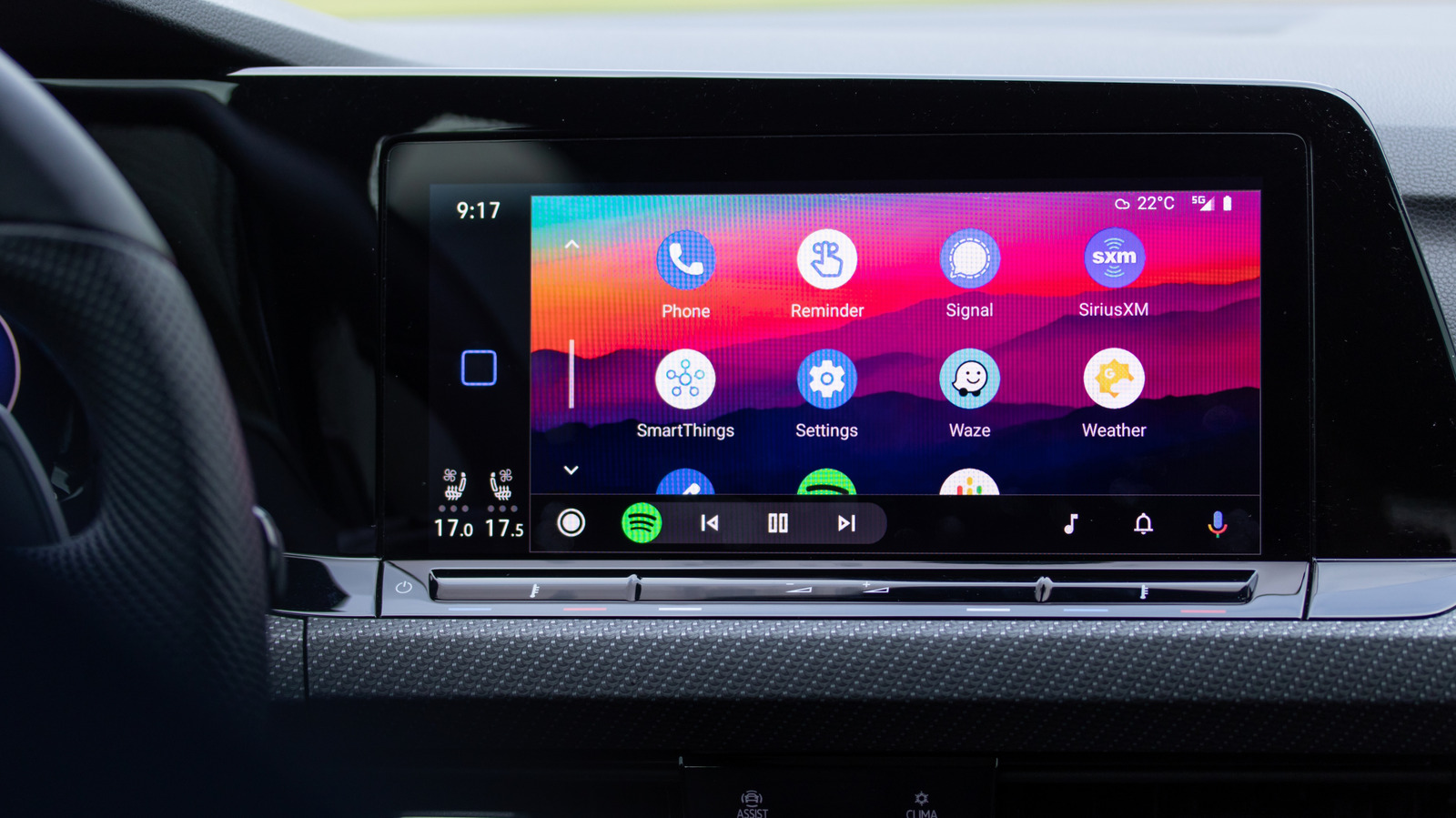
Android Auto and Android Automotive OS are two distinct systems that often get confused, but the difference is straightforward. Android Auto relies on a driver’s Android phone to power the experience, with a compatible car display showing a simplified interface for navigation, music, messaging, and supported apps. It works over USB or wirelessly, depending on the phone and vehicle, and serves as Google’s answer to Apple CarPlay.
Android Automotive OS, or AAOS, runs directly on the car’s hardware, so no phone is needed to handle the processing. It is the software platform built into the vehicle itself, allowing automakers to integrate it with infotainment, instrument displays, climate controls, EV information, and other vehicle functions. This goes beyond merely projecting a phone interface, as AAOS can manage core car features without any external device.
The phone dependency of Android Auto is a key advantage for many drivers. Connecting to a compatible vehicle brings personal apps, accounts, and preferences along, regardless of whether the car runs Android, another operating system, or a proprietary system. Android Auto is not a replacement for the car’s built-in software; it simply displays a specialized interface from the phone on the dashboard screen. In some cases, Android Auto apps can access vehicle data, such as battery level or estimated range, if the manufacturer supports it.
Apple CarPlay works on a similar principle, requiring an iPhone even when it extends deeper into a vehicle’s displays and controls. Android Automotive OS, by contrast, is open source, while Google built-in is a separately licensed collection of Google Automotive Services. Google built-in can provide native Google Maps, Google Play, and Google’s voice assistant directly in the car, without the driver’s phone, and is treated as an optional package rather than part of AAOS itself.
This distinction matters when evaluating spec sheets. Rivian, for example, builds its own software on top of AAOS and does not offer Android Auto or CarPlay projection. Polestar shows that the two systems are not mutually exclusive, as its AAOS-based cars can have Google built-in and still support both Android Auto and Apple CarPlay. In 2020, the Polestar 2 became the first production vehicle to feature Android Automotive OS. For US consumers, understanding this separation clarifies why some new cars offer phone-based projection while others run Google services natively, and why some automakers choose one approach over the other.
More software news from TechManNews.