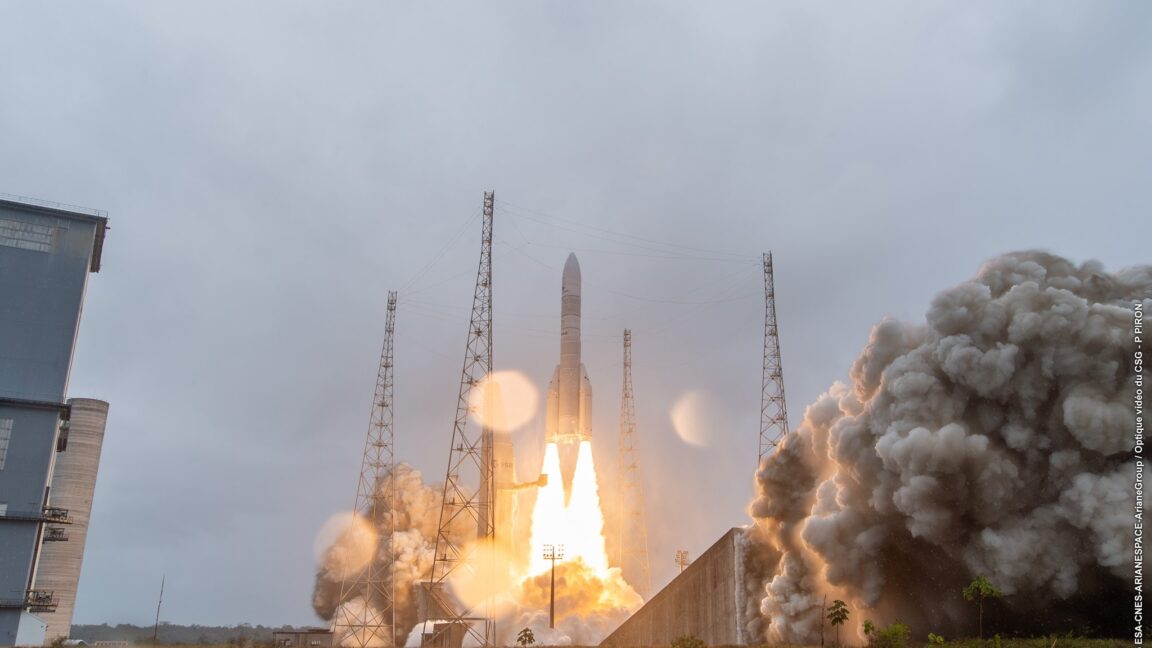
The European Space Agency has shelved planned upgrades for the Ariane 6 rocket, a move that raises questions about the program’s long-term viability as the continent seeks to balance commercial competitiveness with high operational costs. The shelved upgrades, reported by European Spaceflight on Thursday, were part of a "Block 3" evolution that included a lightweight carbon-composite upper stage known as ICARUS. The cancellation affects certain ESA science missions, including a planned probe to Saturn’s icy moon Enceladus.
The decision comes despite a relatively smooth debut for the large expendable rocket, which can lift more than 20 metric tons to low-Earth orbit. European engineers have avoided the significant growing pains seen with comparable US vehicles, such as Blue Origin’s New Glenn and United Launch Alliance’s Vulcan rockets. The Ariane 6 has also provided reliable access to orbit for Europe’s critical satellites following the war in Ukraine, which cut off the continent’s use of Russian rockets and reduced its reliance on SpaceX.
However, costs remain a central concern. Arianespace has not publicly disclosed a per-launch price, but estimates place it between 80 million and 100 million euros. Europe invested roughly 3.6 billion euros in the rocket’s development and its launch site in French Guiana, and ongoing subsidies are substantial. ESA Director General Josef Aschbacher has confirmed that, based on nine flights annually, European governments will still need to subsidize each launch by 32 million to 38 million euros. Factoring in development costs, taxpayers effectively contribute more than 100 million euros per launch before Arianespace receives any customer payment.
The rocket has attracted customers, including the US corporation Amazon, which booked 18 launches for its Kuiper constellation and has already completed three of those missions this year. Yet Europe is likely losing money on each private flight, and the fact that European ministers balked at funding the upgrades may reflect growing impatience with the vehicle’s economics.
Europe’s current target is nine or ten Ariane 6 launches per year, though Aschbacher said in June that the continent is on track for ten next year. He added that ESA is examining scenarios to increase capacity to 12, 15, or even 20 launches annually. Since the rocket is expendable, scaling up would require increased production of solid-rocket motors, first-stage engines, upper stages, and payload fairings.
Aschbacher said he hopes to have clarity from European ministers by the end of this year on whether to invest in that production expansion. Ministers face a difficult choice: funding factories and logistics to meet commercial demand while heavily subsidizing each launch, or redirecting those funds toward a next-generation Ariane rocket with at least partial reuse. The latter would better compete with the growing number of reusable vehicles emerging in the United States and China. The ministers’ decision later this year on scaling capacity will likely signal how they view Ariane 6’s future.
More technology news from TechManNews.