Edge Sound Research Inc. said today it has closed a $2 million funding round to develop audio infrastructure that helps physical AI systems interpret their surroundings in real time. The round was led by Stormbreaker Ventures and lifts the company's total funding to $9 million.
The startup's focus is a problem that shows up clearly in sports. In a basketball arena, the sound of the ball hitting the court arrives at microphones alongside stomping fans and bass from the speakers, making it hard for an AI system to pick out the dribble. Edge Sound's approach links audio with tracking and visual data so the system can determine which sound belongs to which object. Co-founder and Chief Executive Valtteri Salomaki said audio's core issue is that it is organized by channel rather than by object.
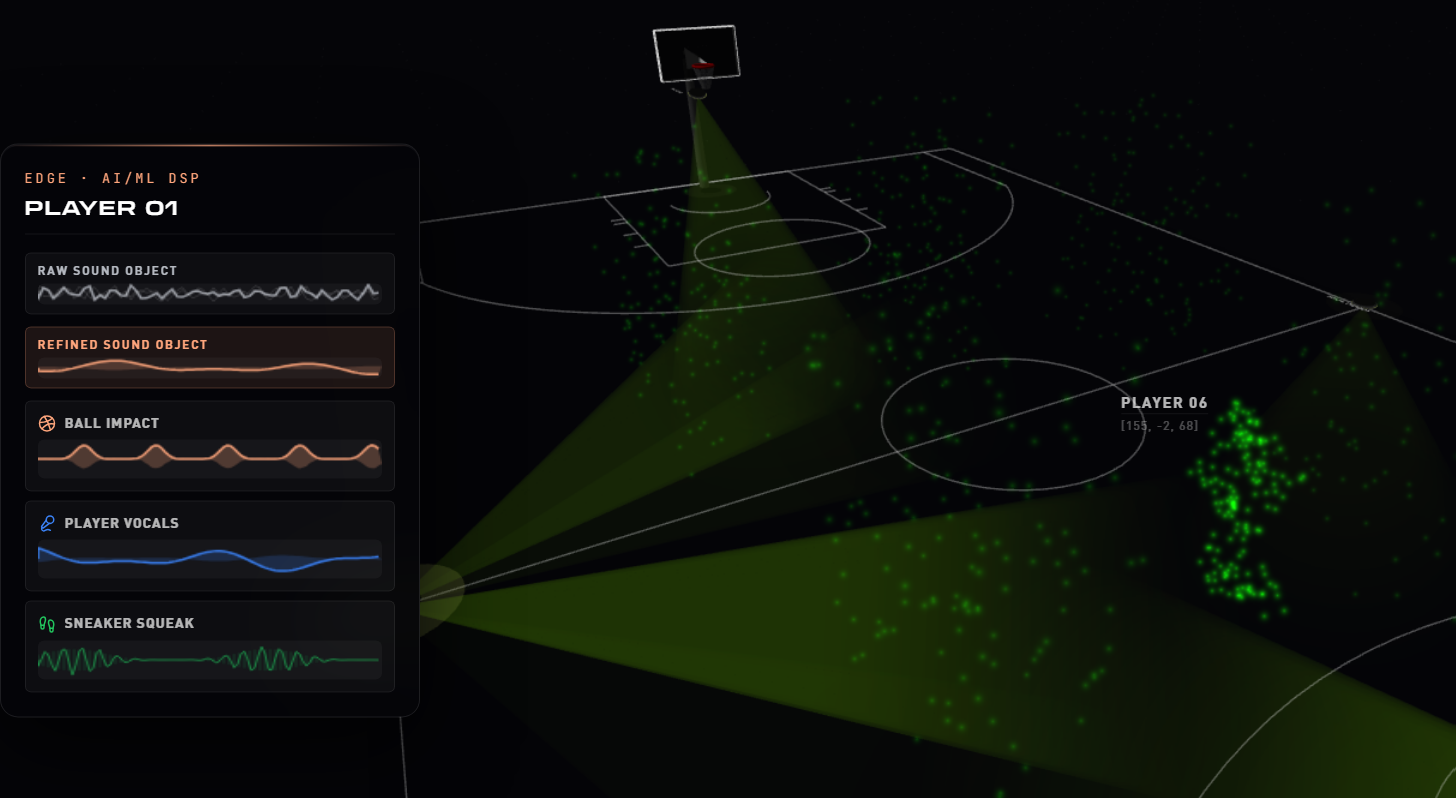
Salomaki described the technology as two layers. One builds a digital twin of all sensors in a space, and the other creates AI machine learning models that separate individual sound elements. Users can import 3D spaces or 2D layouts with coordinates and place sensors within that representation, producing a spatial map of the environment and its sensors. In the sports demonstration, microphone locations, pickup patterns and player tracking are used to select useful audio, then locations are paired so that visual and audio identify objects such as players, the ball, a coach or a referee with a whistle. The company argues the same method could help robots and other physical AI systems perceive activity their cameras cannot see.
Autonomous vehicles are another potential use. A vehicle could be given digital ears to detect an approaching siren, and the Doppler effect, in which pitch rises or falls with speed, could provide an early warning that an emergency vehicle is coming around a blind corner even when its lights are not visible on camera. Edge develops a general model and fine-tunes it for customers, Salomaki said. He cited a sub-33-millisecond tolerance for sports broadcasting, while other environments might accept 100 or 200 milliseconds.
The company is working toward hardware independence so its digital twin software and AI models can run alongside microphones and cameras customers already use. Its Virtual Sound Engine, which automatically captures and isolates sound from complex environments, is already deployed commercially. Customers and partners include Shure Inc., the National Basketball Association, Fox Sports Media Group and the United States Tennis Association Inc.
With the new funding, Salomaki said Edge will complete integration with existing enterprise customers and make the platform's components transferable across industries ahead of a Series A round. He said that for physical AI to achieve the result everyone wants, computers need to become a little more human.
More company and startup news from TechManNews.