AMD says its MEXT memory technology can hold server performance near full levels while cutting the physical DRAM a system needs, an approach the company is positioning as relief for enterprises facing rising memory prices. MEXT founder Gary Smerdon said the technology can reduce required physical DRAM by 20% to 75%, depending on the application and performance target, while the missing memory still registers as installed DRAM to the operating system. Instead of DRAM, MEXT moves cold pages to relatively inexpensive flash storage and uses an AI model to bring them back as needed.
In AMD internal workloads such as Synopsys PrimeTime, the company says a server running at 50% DRAM capacity with MEXT reaches 95% of the performance of a full server. AMD has deployed MEXT on 145 of its own servers and says that will expand to 2,000 next year. The company also announced a partnership with HPE to bring MEXT to customers.
The rollout is in its first phase, with some EPYC Venice servers carrying a MEXT Ready badge and a dedicated NVMe drive or bay for the offload. Phase 2 adds MEXT licenses and the RAM View application to those servers. AMD has not said when Phase 2 will begin.
MEXT runs as a Linux kernel module compatible with any Linux distribution and uses an ensemble of AI models, led by a transformer-based LLM. According to AMD, it trains in under a second when first deployed, operates on one EPYC core without a GPU, and keeps training as the workload runs. Flash is far slower than DRAM, so the model must predict which pages will be needed and stay ahead by at least the transfer latency from the SSD.
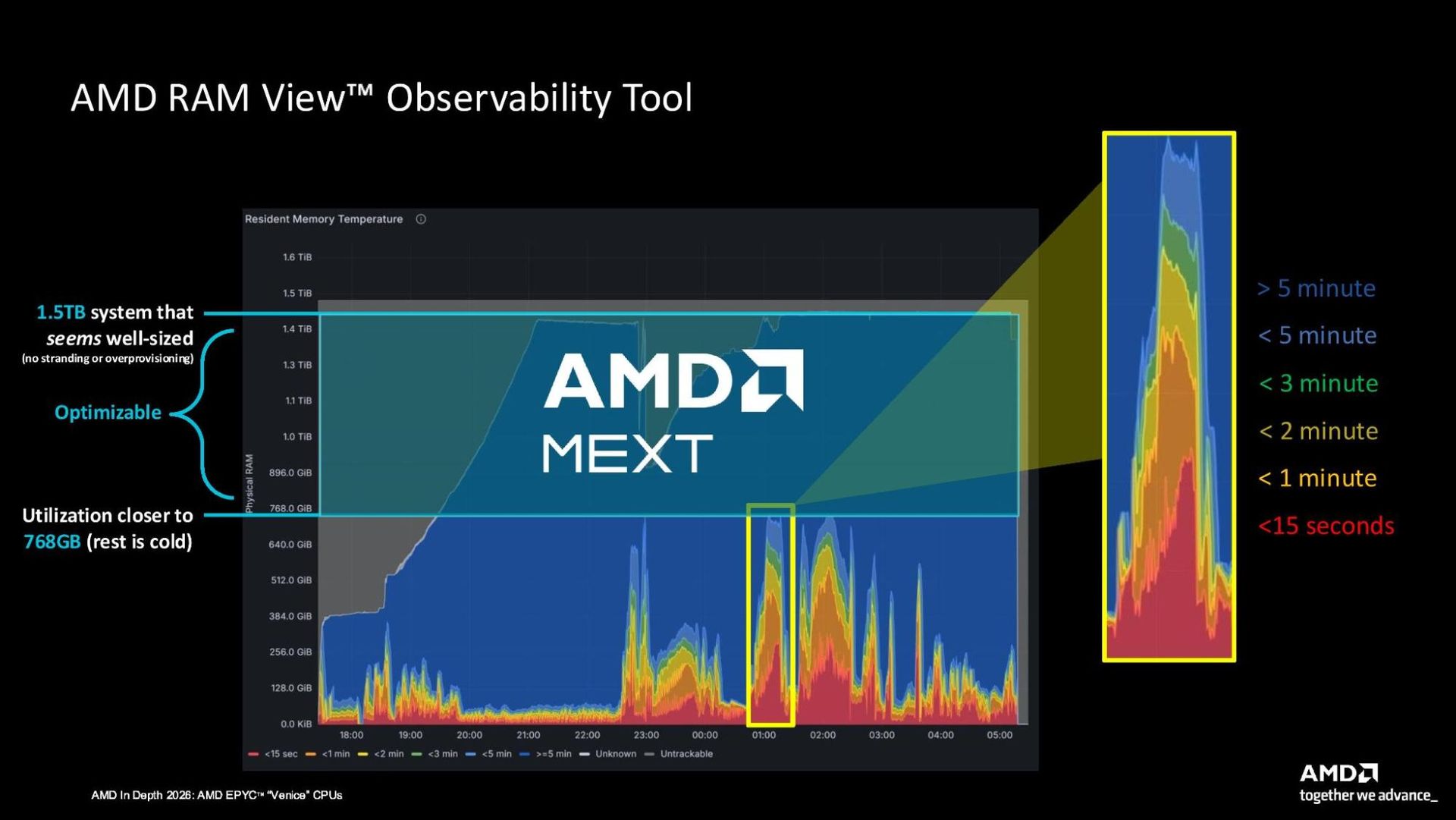
AMD developed RAM View, a memory utilization tool that shows which pages are hot and which have gone cold. In a generalized example, a system with 1.5 TB of memory showed near-full utilization across the workload, but around half the pages had not been touched in five minutes or more at any given time. AMD did not clarify what workload that example used. The company initially is applying MEXT to critical EDA applications it uses internally, including PrimeTime, and says it has focused on optimizing agentic AI, database, and media and entertainment workloads.
AMD shared internal results beyond PrimeTime. In a 3-node Azure cluster with 5th-gen EPYC CPUs running the Spark SQL workload from the TPC-DS benchmark, AMD says MEXT delivered 99% of full-cluster performance at 50% DRAM capacity. For agentic AI, AMD claims 99% of full-server performance at 50% capacity and 85% at 25% across a five-agent concurrent geomean, and 90% and 88% for a memory-hungry agent at those capacities. AMD has not shared the footnotes explaining how those tests were run.
More hardware news from TechManNews.