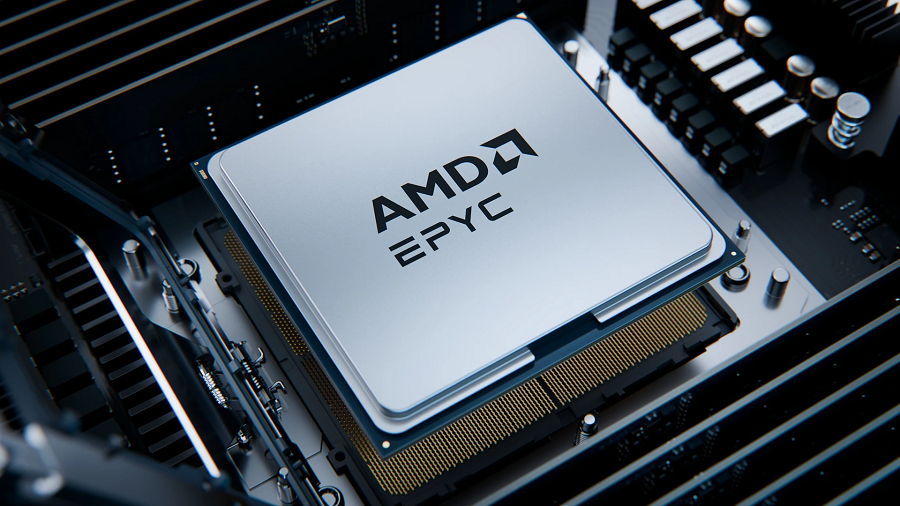
Advanced Micro Devices Inc. unveiled a new family of server central processing units on Wednesday, the Epyc 6 line, which the company code-names Venice and positions for artificial intelligence agent workloads.
The series contains 10 CPUs split into two groups. One set carries a large number of comparatively slower cores, while the other offers fewer cores running at higher frequencies. Both groups include optimizations intended to accelerate AI agents, which execute their neural networks on graphics cards and rely on CPUs to run the tools through which they perform work. CPUs also handle other jobs in machine learning clusters.
AMD claims Epyc 6 can support up to 3.3 more agents per watt than Nvidia Corp.'s Vera CPU, and says the chips substantially outperform comparable Intel Corp. silicon.
The two highest-frequency Epyc 6 chips run at a 4.05 gigahertz base clock and can boost to 5.3 GHz under demanding workloads, with 96 cores and a 384-megabyte cache each. The two densest chips carry 256 cores at a 2.55 GHz base speed, with each core handling two threads for 512 total, a design aimed at running many AI agents simultaneously; some large language models spin up hundreds of agents or more for complex tasks. AMD notes that running an agent's tools on CPUs with fewer cores can cut software costs in some cases, since certain enterprise applications, notably databases, are billed by core count.
The Epyc 6 series uses a new core architecture, Zen 6, whose instructions-per-clock measurement is 31% higher than AMD's prior design on AI workloads, an increase the company partly attributes to building Zen 6 cores on Taiwan Semiconductor Manufacturing Co.'s latest two-nanometer node. The cores ship in two editions: Zen 6, tuned for clock speed, and a scaled-down Zen 6c for high-core-count parts. Zen 6c adds an enhanced out-of-order processing mechanism absent from the standard edition that speeds programs by performing some calculations ahead of when results are needed. The architecture also supports the FP16 data format, which can shrink agents' hardware footprint by compressing the information they process, and improves support for VNNI-INT8, which condenses multiple AI calculations into one operation.
"AI is significantly expanding the role of the CPU across every layer of the data center," said Dan McNamara, senior vice president and general manager of AMD's Compute and Enterprise AI unit. He said customers can standardize on the proven x86 foundation while choosing a workload-optimized solution to run more agents.
AMD said several major data center suppliers have begun shipping servers with Epyc 6 chips, and that the processors power two Microsoft Azure instances tuned for AI inference workloads and chip design software.
More hardware news from TechManNews.