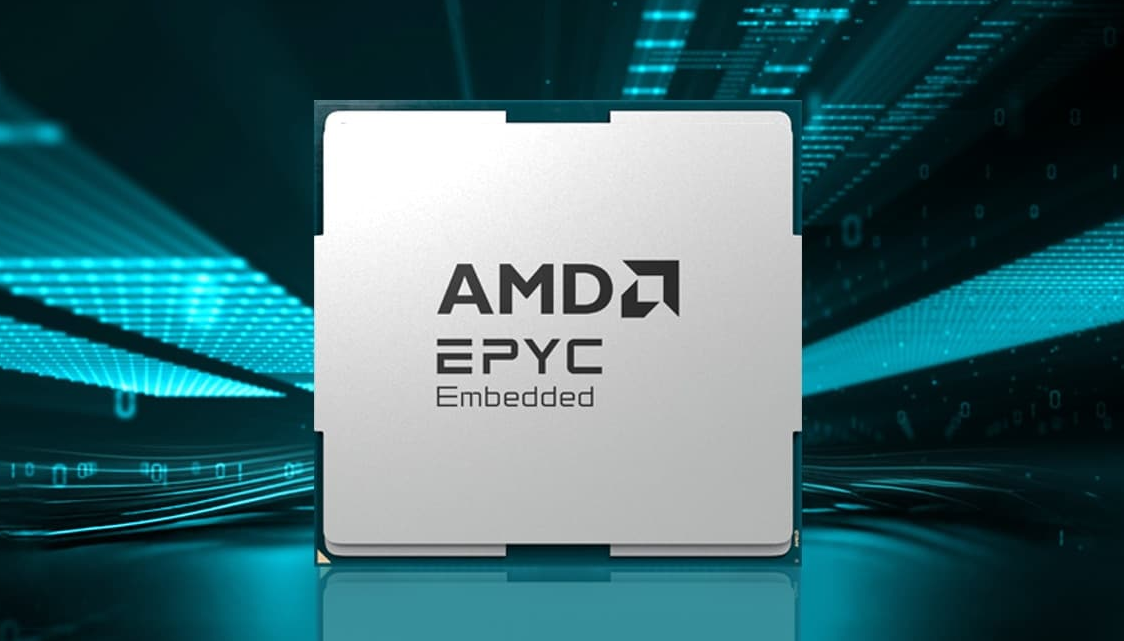
Advanced Micro Devices Inc. has introduced its 6th Gen AMD EPYC Embedded 9006 Series SP7 processors, a family of chips aimed at the embedded systems that validate semiconductors, secure enterprise networks and manage stored data. The company said the new parts bring data center-class compute to those systems as growing artificial intelligence workloads push them toward their limits. Mass volume production is already underway, and AMD expects shipments to customers later this month.
The EPYC Embedded 9006 lineup is built on AMD's Zen 6 core architecture and scales to 256 cores and 512 threads in a single socket. AMD claims that density delivers 1.8 times the throughput, 1.5 times the networking bandwidth and 2.7 times the memory bandwidth of its previous 5th Gen 9005 series embedded chips. The processors support up to 96 lanes of PCIe Gen 6 at 64 gigatransfers per second, CXL 3.1 expansion and 16 DDR5 memory channels running at up to 12,800 megatransfers per second with multiplexed rank dual inline memory modules.
Much of AMD's pitch centers on semiconductor automated test equipment, the high-speed rigs that run electrical parametric tests, functional stress tests and signal validation on dozens of silicon dies at once to catch defects before mass production. AMD said existing ATE controllers cannot supply the parallel compute needed to orchestrate testing as chip capabilities rise. The 9006 series also adds control plane capacity for 400G and 800G network firewalls, along with faster compression and RAID processing for storage workloads.
Salil Raje, senior vice president and general manager of AMD's Adaptive and Embedded Computing Group, said the systems that test semiconductors, secure networks and manage enterprise data have to keep pace with development or become bottlenecks to progress. He said the new chips extend AMD's CPU leadership and help customers raise capacity within their power budgets.
AMD has emphasized security features in the design. The chips include the company's Root of Trust technology, which establishes an immutable boot chain protected by post-quantum cryptography to guard firmware signing against future quantum computer threats. A new AMD Security Processor handles runtime trust execution, virtual machine encryption and authorized diagnostic debugging, and the chips integrate Caliptra, an open-source, vendor-agnostic silicon root of trust that supports remote attestation to verify device identities and detect firmware tampering.
Customers will be able to choose configurations from 64 to 256 cores, AMD said, with the first 128-core offering launching on Nov. 15. The launch lands as US chipmakers face rising demand for validation and networking hardware tied to AI infrastructure buildouts.
More hardware news from TechManNews.