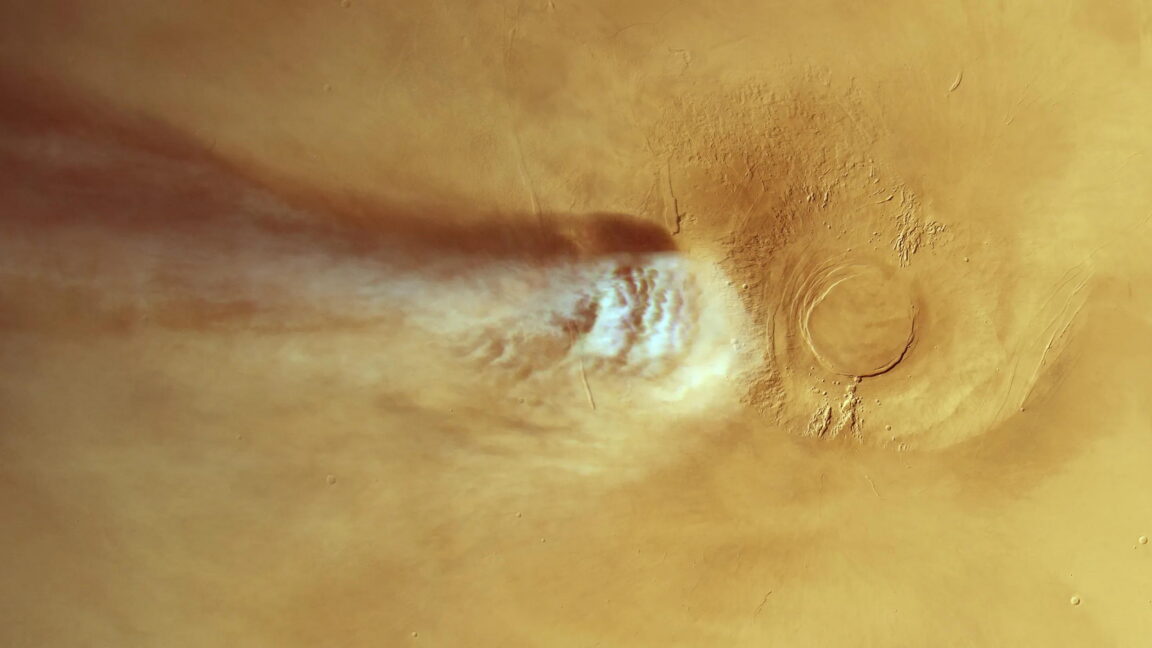
Researchers have for the first time modeled how a cloud stretching roughly 1,000 miles forms above Mars, and their results point to an atmospheric process that has never been directly observed on any planet. The work, published in Nature Geoscience, concerns a feature known as the Arsia Mons Elongated Cloud, or AMEC, which a probe first recorded in 2018. Until now, scientists had no plausible explanation for why the cloud exists.
Jorge Hernández-Bernal, a planetary scientist at Paris' Sorbonne Université and the study's lead author, said the team found it necessary to incorporate exotic physics into its simulations. That physics appears in textbooks but is treated as theoretical and is generally assumed not to occur in nature, he said. Once it was added to the models, the cloud formed as the researchers had hoped.
On Earth, clouds typically develop when water vapor produces droplets or ice crystals around tiny particles such as dust or salt. The new study instead proposes that AMEC forms through homogeneous nucleation, in which vapor turns directly into ice crystals without any such debris. Hernández-Bernal compared the effect to condensation appearing in the middle of a room rather than on a window, calling it wholly unexpected.
The process demands extreme conditions, including a temperature drop of 30 degrees Celsius within 10 minutes and high relative humidity. The Arsia Mons volcano, which stands 65,000 feet tall, also plays a central role. When wind hits the volcano, it generates a powerful wave that lifts moist air high into the atmosphere within minutes.
Scientists had assumed a similar phenomenon might occur in the upper atmospheres of other planets, including Venus and Earth, but it has never been observed. The humidity required is more than 100,000 times greater than any value measured on Earth, which helps explain the absence of observations. Before this modeling, it was not known that such humidity levels existed on Mars either.
Hernández-Bernal noted that far less is known about the Martian atmosphere than Earth's, making the reproduction of the cloud a significant success. He described the result as remarkable. The study offers a new explanation for a feature that has puzzled researchers since it was first recorded.
More technology news from TechManNews.