Four stories filed on four different beats this month share one shape. The companies that supply AI's core ingredients are tightening their grip on how those ingredients are used, while the communities and institutions that helped make AI culturally normal are turning away from it. In each case, someone who once benefited from openness is choosing control, and someone who once welcomed AI is closing the door.
The Same Reflex From Opposite Directions
On the surface the stories have nothing in common. OpenAI says it will no longer train its models on the live internet, citing "significant risks," as TechCrunch reported. Nvidia's Jensen Huang is reportedly weighing an annual software fee of around $2,000 per GPU for running agents on enterprise AI infrastructure, per Tom's Hardware. The moderators of r/opensource posted new submission rules saying that projects which use AI, are made by AI, or are intended for AI are "not welcome," a stance The Verge covered. And The Verge's Stepback newsletter examines how Google's AI search changes upended online publishing.
The shared thread is provenance. For roughly four years, the story US technology companies told about AI was that it got better by consuming more of the world. Models scraped the open web, learned from public code, and drew on published writing. The pitch to the market was that this appetite produced capability, and capability produced value. Each of these stories is a decision about where that appetite should now stop, and about who gets paid when it continues.
OpenAI Closes a Door It Once Held Open
OpenAI's move is the most striking because it reverses a founding assumption. Cutting frontier models off from the live internet is, on its face, a safety decision. But it also changes what a model is: a system trained on a snapshot of the world rather than on the world as it happens. For US enterprise customers, that makes evaluation harder and freshness a selling point that OpenAI no longer claims by default. It also shifts the physics of the training race. If the frontier largely stops ingesting the live web, the advantage moves toward firms with licensed, curated, or proprietary data. OpenAI can afford to build such a pipeline. A startup scraping the open web at scale cannot.
The timing layer matters too. TechCrunch notes the change came weeks after one of OpenAI's own engineers said that solution wouldn't work. Whatever the internal dispute, the public message to US regulators is that the leading provider is willing to restrict its own inputs in the name of risk management; the private message to competitors is that the open web is no longer the main road to the frontier.
Nvidia Puts a Meter on the Inference Layer
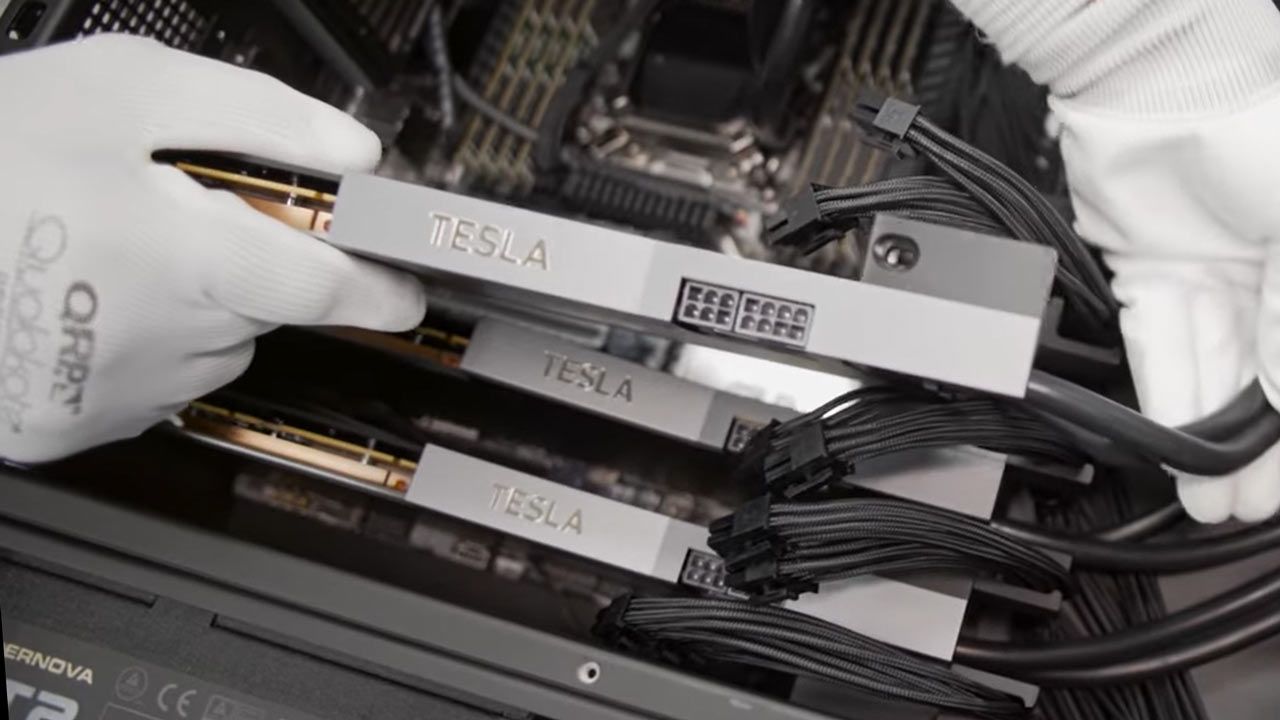
Nvidia's reported plan is the monetization counterpart. Training grabs the headlines, but running agents on deployed infrastructure is where enterprise AI spends its time and money. A software fee of around $2,000 per GPU per year for that layer, per Tom's Hardware's reporting, could generate $10 billion a year if five million licenses were sold. The pricing and launch timeline remain unconfirmed, and the arithmetic depends on adoption that has not happened yet. The direction, however, is clear: Nvidia is moving from selling a scarce component to selling the software that makes that component useful.
That matters for US buyers because agentic AI has been sold on the promise that inference becomes commoditized. A per-GPU annual fee cuts the other way. It gives Nvidia a recurring revenue stream tied to the installed base rather than to the next chip cycle, and it makes the vendor's software security tools harder to replace than a piece of silicon. For cloud customers and enterprise buyers, the GPU is no longer a one-time capex line; it is a subscription. Nvidia's own expansion into AI software and security tools, noted in the same report, suggests the fee is part of a platform strategy rather than a one-off.
