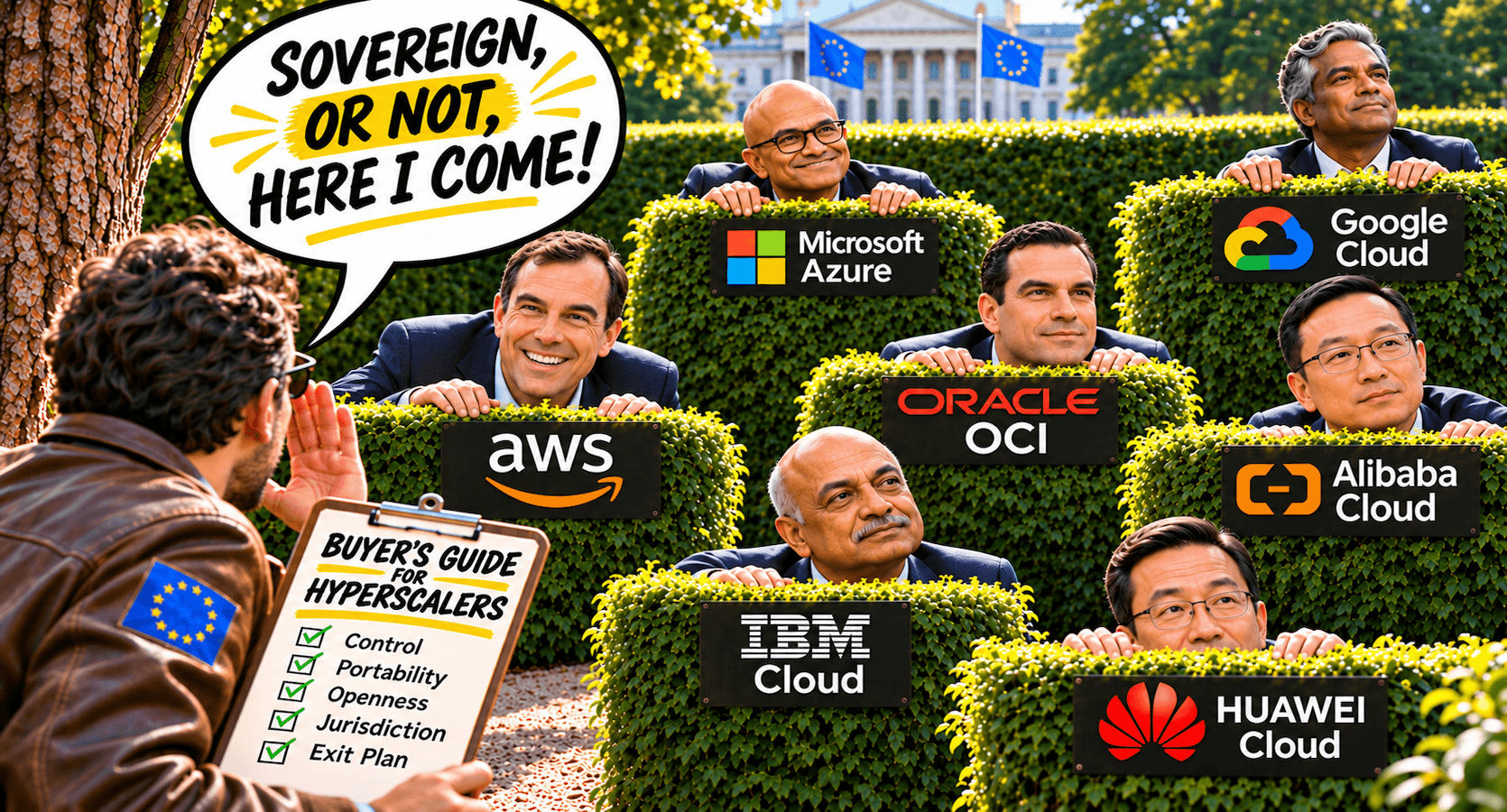
TheCUBE Research has published a new market report, Sovereign or Not? The 2026 Hyperscaler Buyer’s Guide, which assesses how each hyperscaler stands on sovereignty from a buyer's point of view. The report was written by Amit Eyal Govrin, lead analyst for sovereign AI at theCUBE Research and CEO of Agentcy Labs. Govrin said the research grew out of his years as a builder in the space, beginning with Kubiya, which he described as one of the industry's first agentic implementations, deploying agents in enterprise production environments as early as September 2023.
Govrin said customer reactions to Kubiya shaped the report's central argument. He said customers told him they were relieved he was no longer at Kubiya, not because they doubted the technology but because they feared it, since adoption could balloon into a dependency and leave them without control of their costs, or exposed to a vendor changing the meter under shareholder or regulatory pressure. That, he said, made clear the resistance was never about Kubiya itself but about losing control of what customers consider their alpha, the Agentic Operating System that drives their artificial intelligence transformation. Govrin said no enterprise can afford to mortgage its entire business on an external dependency on such a strategic issue, whether the vendor is a startup, an AI lab or a hyperscaler.
According to Govrin, sovereignty is often misunderstood as a question of where data sits. He said people hear the term and revert to the sovereign state, government initiatives, national security and on-premises air-gapped environments, which can be true in some cases, but that most sovereignty discussions involve enterprises and regulated industries that treat it as a core tenet of their AI initiatives. He cited an Alex Karp interview on CNBC about enterprises losing their alpha to frontier labs as his trigger point to educate the industry on what sovereignty is, what it isn't, and what buyers of AI can do about it.
Govrin said his team has been included in dozens of engagements with enterprises, governments and policymakers from Washington to Brussels, New Delhi, Sydney and Riyadh, and that those conversations produced the 5 Pillars of Sovereignty framework, which the firm uses to assess vendor relationships, policy and regulation, and geopolitical events. The first edition of the buyer's guide applies that buyer's lens to each hyperscaler's sovereignty posture. Govrin said working with any hyperscaler by definition means ceding a good portion of control over the Operational, Technological, Legal and Financial pillars, and that sovereignty is not a purity test: going with a hyperscaler is acceptable as long as the dependency is known and priced in as an acceptable risk.
The report examined seven hyperscalers and 40 of their offerings, scored out of 5, from the perspective of buyers in five regions: the U.S., Europe, Asia-Pacific, Latin America, and the rest, including the Middle East and Africa. The full scores appear in the report. Govrin summarized the findings by saying the most sovereign product a hyperscaler sells is the one the hyperscaler itself can't reach.
More company and startup news from TechManNews.