Intel is shifting manufacturing capacity away from consumer PC chips toward server processors as demand for data center CPUs outpaces what the company can produce. The Santa Clara chipmaker said its Data Center and AI business brought in $7.3 billion in the third quarter of 2026, a 17% sequential increase and a rise of nearly 80% year-over-year. Chief executive Lip-Bu Tan described the industry as working through one of the largest supply shortages on record, which he attributed to demand for Super Intelligence, and said he was pleased with the company's server supply growth in the quarter while acknowledging the difficulty of keeping up with server demand in the quarters ahead.
A central piece of the plan is raising output of Xeon 6 "Granite Rapids" processors, which are built on the Intel 3 process. Intel has begun expanding capacity at its Fab 24 complex near Leixlip, Ireland, but that capacity is not expected online until the end of 2027 unless the work can be sped up. Granite Rapids is already the fastest-ramping server processor family in Intel's lineup, though management said demand still exceeds available supply. Intel is also working to improve yields and shorten production cycle times, and said Intel 3 manufacturing costs have fallen about 15% since the first quarter of 2026.
In Oregon, Intel plans to convert some manufacturing resources from Intel 18A to Intel 3, with that additional capacity expected to enter production in the second half of 2027. Those resources had been intended for Panther Lake client processors, but softer PC demand let Intel move them toward higher-demand data center products. Chief financial officer Dave Zinsner said the 18A wafer capacity being taken offline was generally used for Panther Lake, and that freeing it up creates room to build more data center wafers.
Wafer capacity alone will not close the gap. Zinsner said Intel is constrained on the substrate side as well as the wafer side, pointing to shortages of advanced organic substrates needed to package multi-chiplet processors that use EMIB and Foveros 3D packaging. Intel is working with substrate suppliers to add capacity and expects roughly 40% more substrate capacity to arrive in the second half of 2027. The company is also expanding advanced packaging operations in New Mexico and Malaysia, and Tan said EMIB and EMIB-T continue to draw significant interest from external customers alongside internal products.
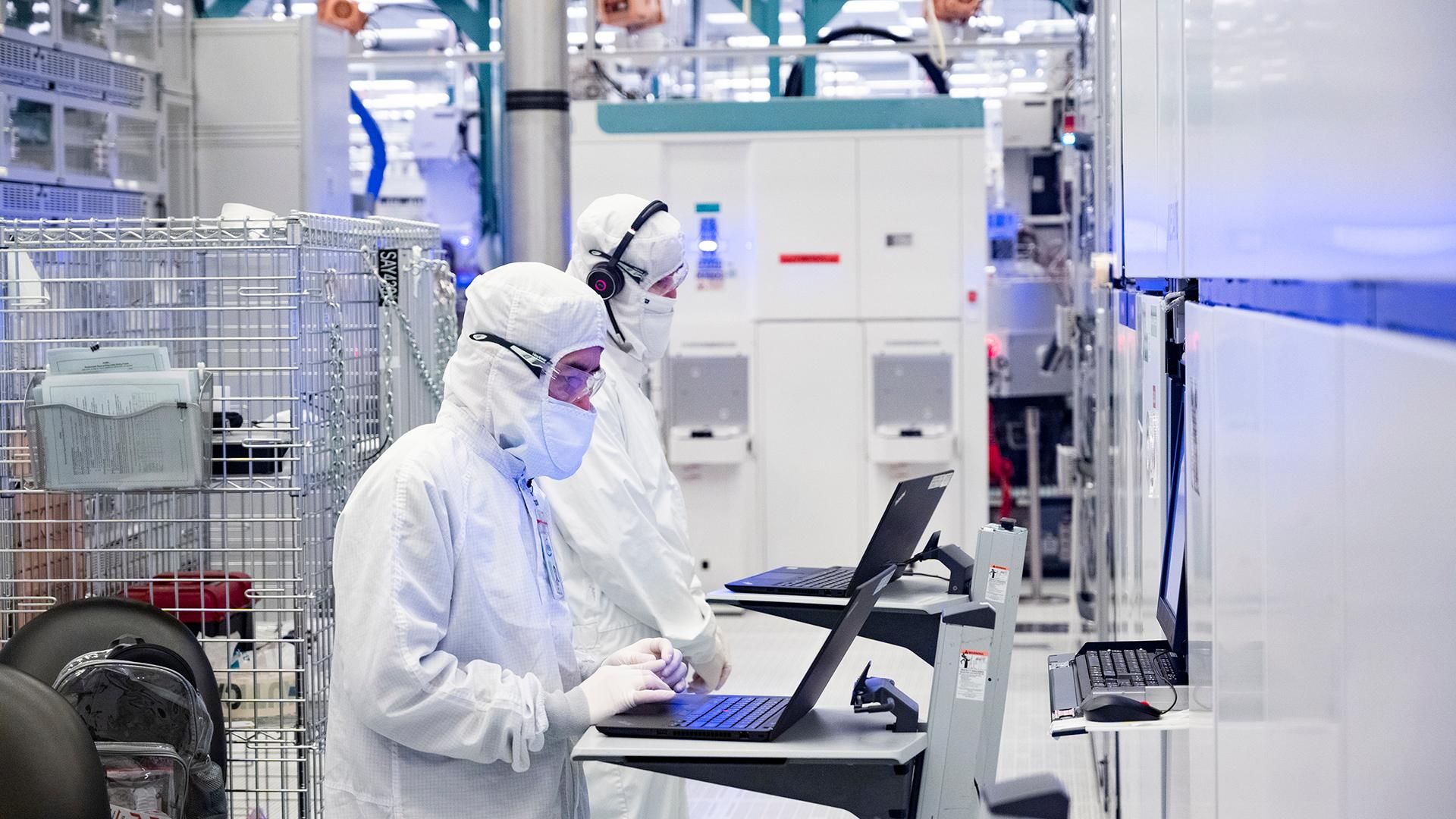
On the leading edge, Intel is ramping Intel 18A production at Fab 52 in Arizona and accelerating equipment installation into the adjacent Fab 62, which is slated to become its second high-volume site for 18A, 18A-P and derivative technologies. Intel did not disclose how capacity at that facility will be split between client and data center products. Despite the server focus, Intel said it expects to gain some client market share with its Core Ultra 400-series "Nova Lake" CPUs, which will require high-volume production.
The buildout carries a heavy price tag. Intel expects capital expenditure of approximately $20 billion in 2026, with a significant increase in 2027, and said firm purchase orders to semiconductor equipment suppliers rose nearly 40% sequentially. Zinsner cited accelerating clean room build-outs including Fab 62 in Arizona and said Intel is exploring ways to speed construction in Ohio, where the first major structural truss was recently installed. Because new tools must be installed and qualified and wafers must move through long cycles, Intel expects supply constraints to remain especially severe in the first half of 2027, even as the client PC market continues to contract.
More hardware news from TechManNews.