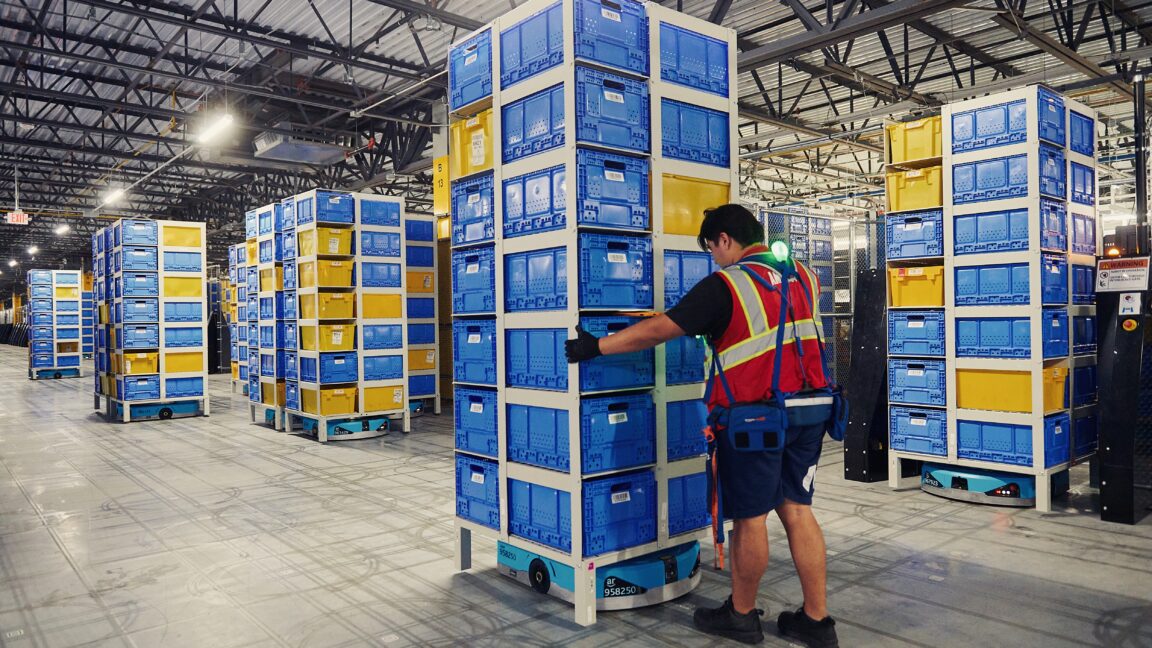
Amazon is expanding its warehouse robotics program while remaining one of the world's largest human employers, a pairing that has drawn scrutiny from labor researchers and advocacy groups. The company says its growing robot fleet reduces the physical toll on workers by absorbing the most fatiguing and injury-prone tasks in its fulfillment centers. Labor advocates and independent researchers counter that AI-driven warehouse automation carries downsides for the people working alongside the machines.
Brian Greenwood, a professor of business at George Mason University, said automation over the past century typically moved high-risk tasks away from workers and did so at a physical distance. Collaborative robots change that, he said, because they work in close proximity to people and can set the pace of work. Federal data cited by Greenwood show the US warehouse sector, which employs almost 2 million people nationally, has an injury and illness rate typically more than double the average across all industries, along with high turnover.
Amazon's robot fleet traces back to its 2012 acquisition of Kiva Systems, which pioneered wheeled robots that carry racks of items to workers rather than requiring workers to walk the floor. Renamed Amazon Robotics, the unit builds most of its mobile robots and robotic arms in Massachusetts. The company has announced additional robot factories in Austin, Texas, and Greenwood, Indiana. Amazon's 2025 annual report lists more than 1.5 million full-time and part-time human workers.
Most of the fleet consists of wheeled mobile robots. The Sequoia system, Amazon says, can identify and store items up to 75 percent faster by coordinating robot swarms. Hercules and Titan robots retrieve shelving pods for workers, while the newer Proteus moves freely around people using onboard sensors. Amazon uses AI foundation models called DeepFleet to predict and ease robot congestion.
Robotic arms make up a smaller but growing share. Amazon CFO Brian Olsavsky said on a July earnings call that the company expects to more than double its arm fleet this year; Scott Dresser, vice president of Amazon Robotics, described the current count as in the single-digit thousands. The Robin arm, first tested in 2021 and deployed in Lakeland, Florida, in 2022, uses eight suction cups to pick packages from cluttered piles. Amazon researchers reported that a machine-learning picking method reached a 93.73 percent success rate, versus 92.28 percent for the best traditional algorithm, avoiding roughly 16,500 failed picks in a run exceeding 1 million total picks.
Cardinal, an arm that places packages weighing up to 50 pounds into carts, began operating in Nashville, Tennessee, in November 2022. Dresser compared its sorting work to Tetris and said densely packed containers benefit sustainability and transportation costs.
More technology news from TechManNews.