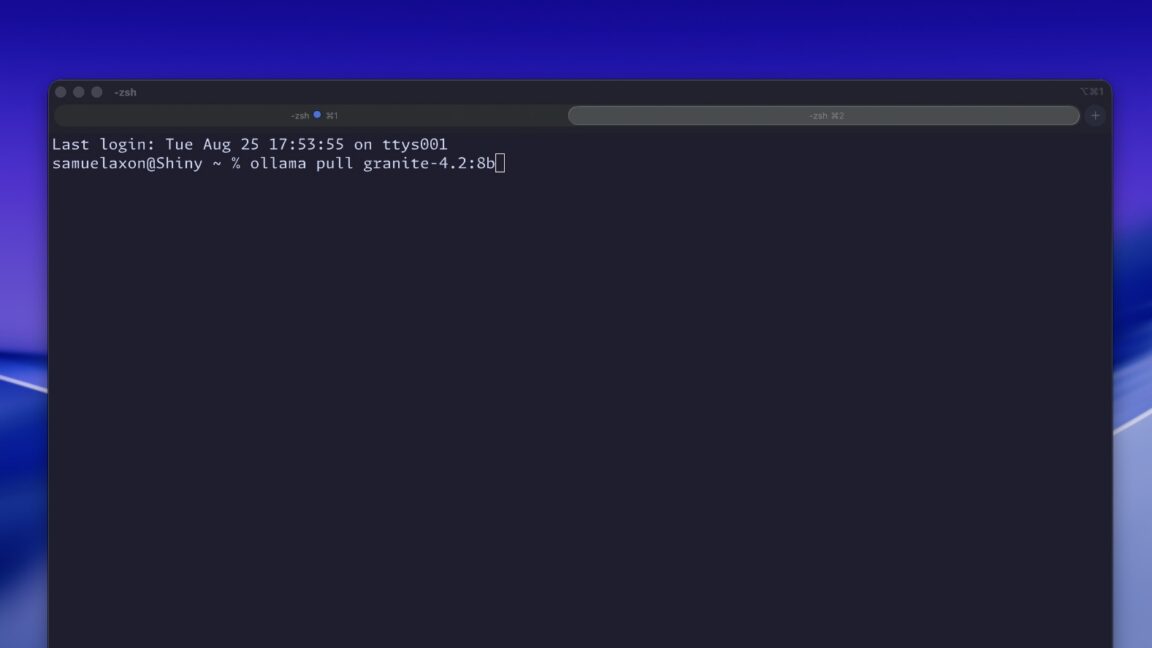
IBM has released its newest Granite family of open-weight large language models, designed specifically for users who want to download and run the AI locally rather than paying for cloud-based access. The new Granite 4.2 lineup includes three parameter sizes: 3B, 8B, and 30B. All three models natively support a 128,000-token context window.
The company continues to use a decoder-only architecture, consistent with earlier Granite releases. The 8B and 30B versions go further by undergoing an agentic reinforcement learning phase, giving them expanded abilities such as operating a terminal, searching the web, and calling external tools. The smaller 3B model also supports these tool-use features, but it lacks the same depth of specialized training found in its larger siblings.
IBM describes this release as its reasoning-focused update to the Granite family. When developers refer to reasoning in this context, they mean functional chain-of-thought processing, where the model carries intermediate results forward through multiple steps. This is distinct from human-style conscious understanding. The practical trade-off for users is that this approach can produce more rigorous and accurate responses, but it often comes with slower response times and higher compute demands.
The Granite series has never been positioned as the fastest or most cutting-edge option on the market. Even compared to rivals in the local enterprise space, such as Nvidia’s Nemotron line, IBM’s pitch centers on predictable and stable deployments. That focus aligns with the broader priorities of the company, which has leaned into reliability for enterprise customers.
The release lands amid growing concern about the cost and compute requirements of frontier cloud models from providers like Anthropic and OpenAI. Both individual developers and enterprise organizations have increasingly looked at local models as a more affordable alternative. This trend has also spurred interest in model routers, which are AI tools that interpret a user’s request and route it to the most appropriately sized model to balance performance, speed, and cost.
Granite models remain popular among hobbyists, AI researchers, and independent developers who want to experiment on their own hardware without incurring per-token API fees. The open-weight nature of the release allows for hands-on tinkering and customization. For the US technology market, this represents another option for teams seeking to keep sensitive workloads on-premises while still tapping into advanced AI capabilities.
More AI news from TechManNews.