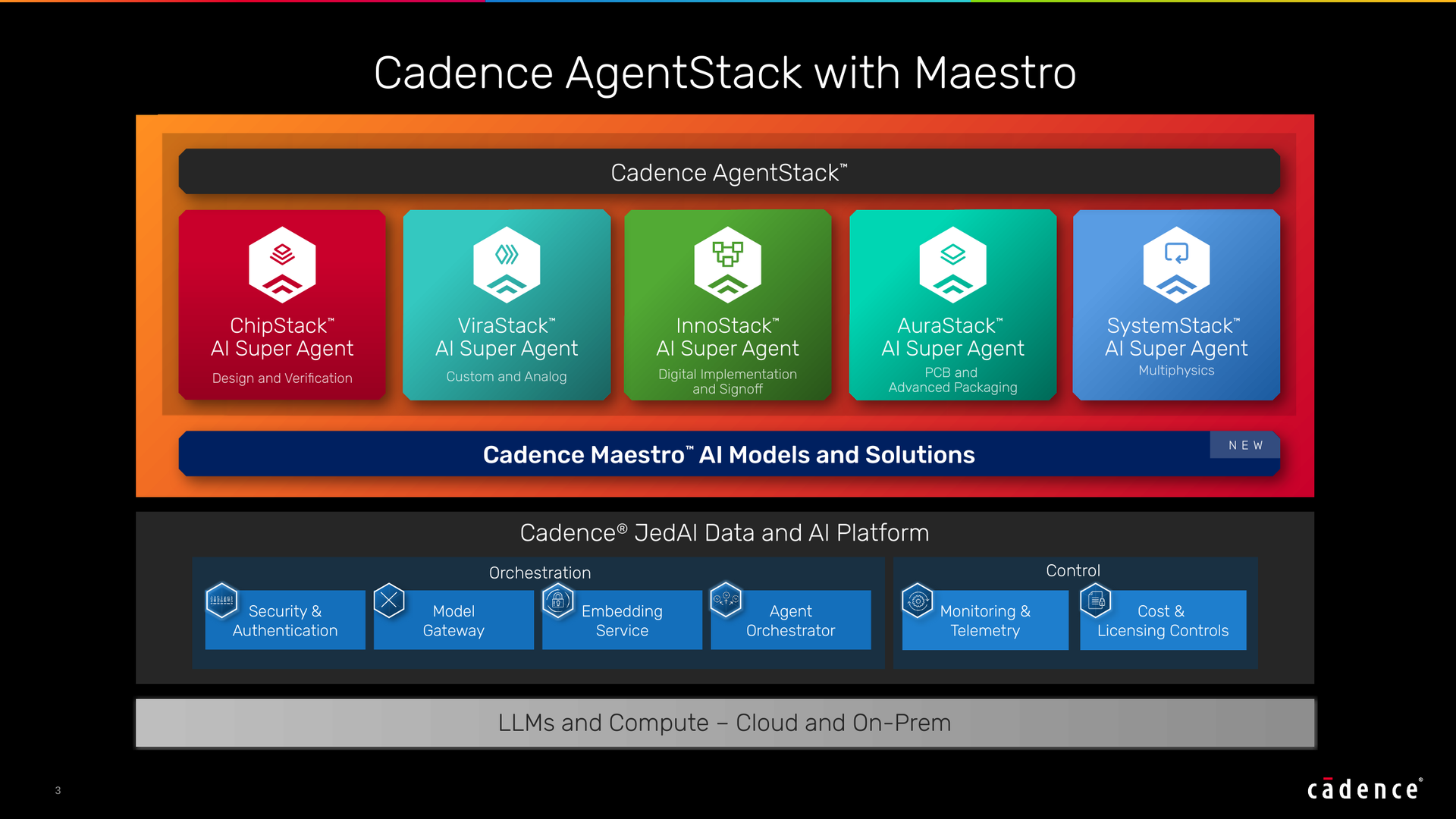
Cadence Design Systems has unveiled Maestro, a set of fine-tuned AI models built to power specialized agents for chip design, with early access planned for select customers in the fourth quarter of 2026. The announcement places Cadence in direct contrast with rival EDA vendor Synopsys, which less than a month earlier disclosed its own specialized model, GPT-Synopsys, that runs on OpenAI-hosted infrastructure without using customer data for training. The two offerings now differ on where a customer's design data is processed.
Paul Cunningham, senior vice president and general manager at Cadence, said agent costs have begun to climb sharply and that the industry has recognized the shift. He described moving more of the agents' iterative work into the weights of the models themselves as a natural progression. Maestro pursues that goal through Cadence's AI Super Agents, which interpret design intent, break tasks into components, and coordinate the Maestro portfolio alongside other frontier and open-weight models, weighing trade-offs to support decisions.
The models rely on reinforcement learning in which Cadence's deterministic solvers check outputs against engineering objectives, constraints and ground truth, with results fed back into the models. Nvidia's Nemotron is among the models used. Cunningham said customers can perform the customer-data training step themselves using Cadence's fine-tuning harness, potentially on their own GPUs and network, and that Nemotron was producing strong results and improving quickly.
Cadence claims up to 30% higher quality of results and up to 5x token efficiency versus a general-purpose foundation model, which the company said is the open-source model Maestro started from before training. Cadence did not specify what the 30% figure measures, and declined to name the foundational model beyond describing it as a leading open-source model competitive with commercial frontier models. The company attributes the token savings to balancing EDA and system design automation tool calls with LLM invocations.
Cunningham compared the approach to avoiding a jet engine for a short grocery run, advocating the right model at the right time for the right task. Rob Knoth, senior group director of strategy and new ventures at Cadence, previously said a tool call could take hours or days to return a value while AI training loops operate in minutes. Maestro use counts toward Cadence's agent pricing, a subscription with a consumption allowance and charges beyond it; Cunningham did not say whether token savings reduce customer bills.
Synopsys has positioned its competing Autopilot offering around customer flexibility, saying it lets customers choose among commercial, open-source and fine-tuned language models across Synopsys-managed and customer-managed deployments on cloud or on-premises infrastructure. On agent security, Cadence said it is working with Nvidia on an integration with Nvidia's OpenShell Reference Architecture, which Nvidia launched the prior week and which named both Cadence and Synopsys.
Cadence's recent agent momentum includes more than 20 customer engagements for its ChipStack design and verification agent and more than 25 for ViraStack, its custom and analog agent, according to CEO Anirudh Devgan on the company's July earnings call. Socionext said the prior week it was applying InnoStack, and Silicon Labs has credited ChipStack with faster debugging while both companies watch Maestro. Cadence's agentic consolidation began with its November 2025 acquisition of ChipStack, and in June 2026 the company claimed its agent reached Level 5 autonomy.
More AI news from TechManNews.