Amazon Web Services Inc. has launched its new memory-optimized R9g and R9gd cloud instances, bringing its Graviton5 processors to data-intensive workloads such as in-memory databases, big data analytics, and high-throughput web services. The instances are available starting today in several AWS regions, including US East (N. Virginia and Ohio), US West (Oregon), and Europe (Frankfurt), with pricing options that include On-Demand, Savings Plans, Spot Instances, Dedicated Instances, and Dedicated Hosts.
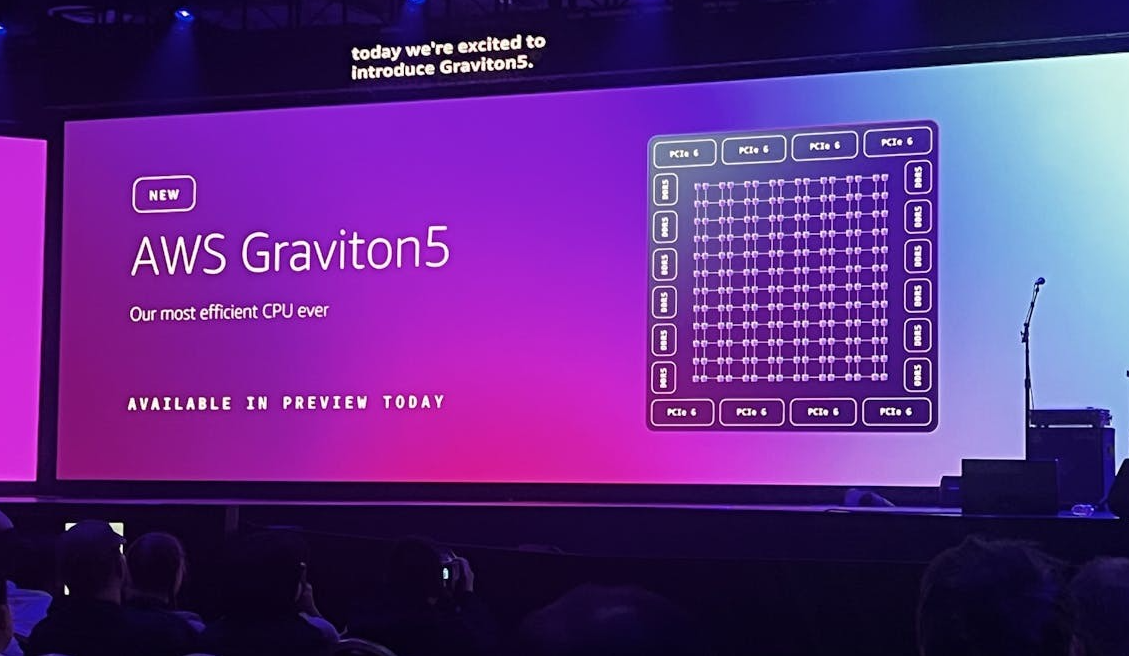
The new offerings were detailed by AWS Principal Developer Advocate Daniel Abib, who said they are designed for applications like Redis OSS, Memcached, and Valkey, as well as containerized microservices running on Kubernetes and Amazon EKS. The R9g and R9gd instances follow the general-purpose M9g and M9gd instances and the compute-heavy C9g and C9gd instances that launched in June, all of which are powered by the Graviton5 CPUs first announced at AWS re:Invent in December.
Graviton5 delivers up to 25% better compute performance compared with its predecessor, according to Abib, along with 35% faster web application execution and machine learning inference, and 30% faster database processing. The chips use DDR5 8800 memory modules supporting 8,800 megatransfers per second, up from 5,600 MT/s in Graviton4, and feature a five-times-larger L3 cache and three-times-higher packet-processing performance. These improvements are intended to reduce the time workloads spend idle while waiting for data.
The R9g and R9gd instances come in 11 sizes, scaling from medium up to metal-48xl configurations with 192 virtual CPUs and 1,536 gibibytes of memory. At the top end, they offer up to 100 gigabytes per second of network bandwidth and 72 Gbps of Amazon Elastic Block Store bandwidth, more than double the previous generation. They also support an Instance Bandwidth Configuration feature that lets users reallocate up to 25% of bandwidth between EBS and virtual private cloud networking to match database or caching throughput needs.
The key difference between the two instance types is storage: R9g relies exclusively on attached EBS volumes, while R9gd supports high-density local NVMe SSD storage up to 11.4 terabytes on the largest 48xlarge sizes. Local storage gives R9gd instances ultra-low-latency performance for temporary caches, scratch disks, and distributed analytics workloads. Both families incorporate the AWS Nitro System, including the Nitro Isolation Engine first introduced with the M9g and C9g families, which offloads virtualization, storage, and networking to dedicated hardware for bare metal-like performance and strict workload isolation.
These launches expand AWS’s Graviton5 portfolio into memory-intensive territory, targeting enterprises running large-scale databases and analytics in the US and abroad. The new instances are positioned to compete on price-performance for workloads that require significant memory bandwidth and low-latency data access.
More hardware news from TechManNews.