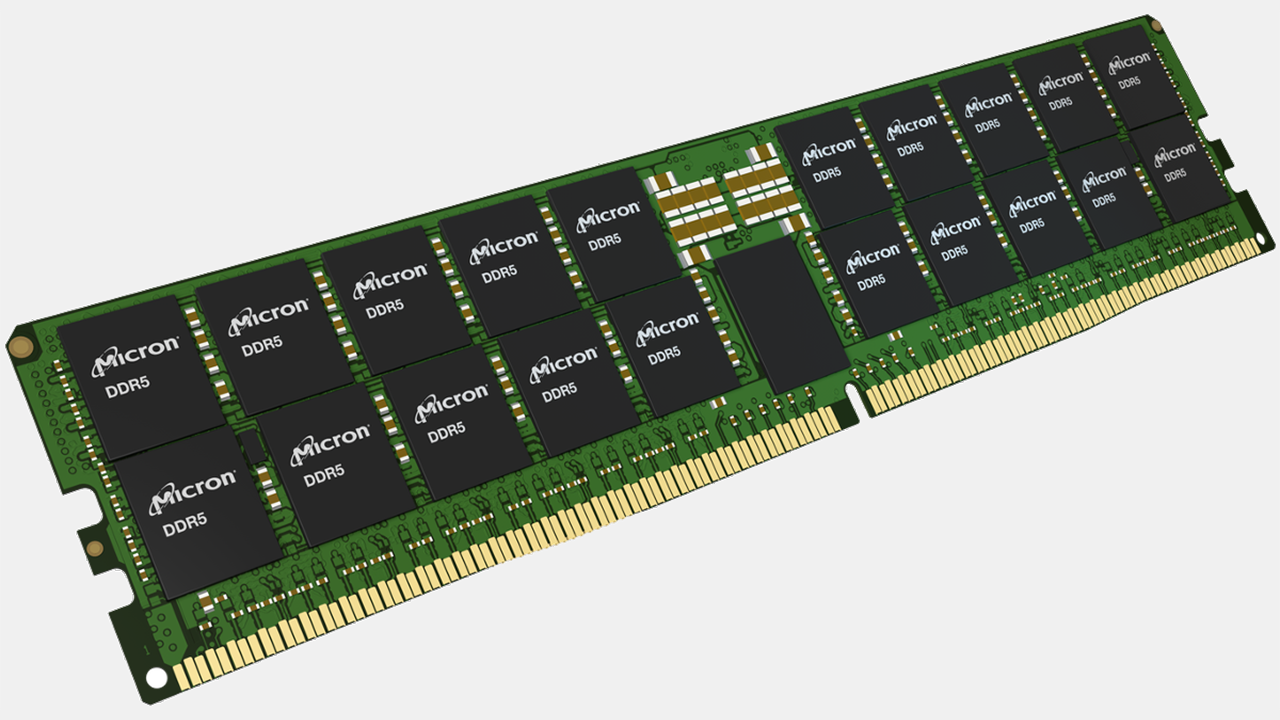
The news logged over the past two days points to a single shift: the constraint in AI infrastructure is moving from processors to the memory and systems wrapped around them. Micron's new 512GB DDR5-9200 modules and Apple's reported return to servers are two expressions of the same pressure. Whoever can pack more memory into a rack, and do it without melting the power budget, is now the company to watch.
Micron Challenges Samsung at the Top of the Stack
Micron's announcement, reported by Tom's Hardware, is the first direct rival to Samsung's 512GB DDR5 modules after five years. It matters less for the capacity figure, which matches Samsung, than for the speed and power claims attached to it. Micron says the modules will reach speed bins up to 9200 MT/s and draw 16W, and that up to 12TB can be packed into a single server. The company also claims the modules are 60% less energy-intensive than four 128GB modules.
The direction of travel is clear. For the past several years, the memory industry sold capacity. Now it is selling capacity per watt, and the marketing language has followed. A hyperscaler deciding what to put in a rack is not simply asking how many terabytes it can fit; it is asking how many terabytes it can fit inside a power envelope that data centers increasingly cannot expand. That framing favors vendors who can credibly claim efficiency gains, and it puts pressure on Samsung to respond on power as well as density.
The Price Problem Hyperscalers Cannot Ignore
Tom's Hardware notes that Micron's prices could be too high even for hyperscalers. That single caveat is the most commercially important line in the story. The largest cloud buyers are the only customers with both the volume and the technical appetite for 512GB modules at these speeds, and they are also the most ruthless negotiators. They will compare Micron's efficiency claim against the cost of simply buying more of the modules they already use, and the comparison is not automatic.
If the efficiency gain does not translate into a lower total cost of ownership, the product becomes a niche part for customers who are power-constrained rather than budget-constrained. That is a real market, but it is a narrower one than the headline capacity number suggests. For Samsung, the competitive threat is credible but not existential. For Micron, the opportunity depends on whether the power savings are large enough, at the rack level, to justify a premium that hyperscalers will actually pay.
Apple Looks at the Server Business Again
Apple's reported plans, covered by The Verge and Ars Technica, come at the same problem from the opposite direction. The Verge reports that Apple is planning to get back into the server game and might pair with NVIDIA, citing The Information. Ars Technica reports that Apple is building a server packed with M-series Ultra chips, with a planned 2029 debut that would make it the company's first enterprise server in decades. Apple retired its Xserve line in 2011.
The timing is notable. A 2029 debut is far enough out that it is not a response to any single product cycle, but close enough to be a serious commitment rather than a skunkworks experiment. The two reports are not identical: one points to an NVIDIA partnership, the other to Apple silicon at the core. Both point to the same underlying judgment, which is that the demand for AI compute is large and durable enough that a company which abandoned enterprise hardware fifteen years ago is willing to re-enter it.