Microsoft developer ecosystem figure Scott Hanselman has released an open-source tool called GPU Taskman that shows Windows users which applications are consuming their video memory. The utility, published on GitHub under the permissive MIT license, is aimed at giving users visibility into how GPU memory is being allocated across running tasks. Hanselman described the project on social media as a way to understand where his GPU memory is going, noting that a great deal is happening inside his GPU.
Screenshots Hanselman shared show the tool running in a terminal-style display that lists VRAM-consuming applications. On his RTX 4080S system, the desktop windows manager was the largest consumer of video memory, and selecting that entry reveals further detail about the task in a panel at the bottom of the window. The examples also show AI and LLM applications using VRAM alongside several standard Windows processes.
A GitHub-embedded image demonstrates the breakdown shown when the llama-server.exe application is selected. The detail panel identifies that Qwen3-0.6B is in use and separates memory use into categories including the model's weights and the KV cache, along with the number of parameters and other information. Hanselman has posted portable Windows downloads of the latest release, version 0.3.0.
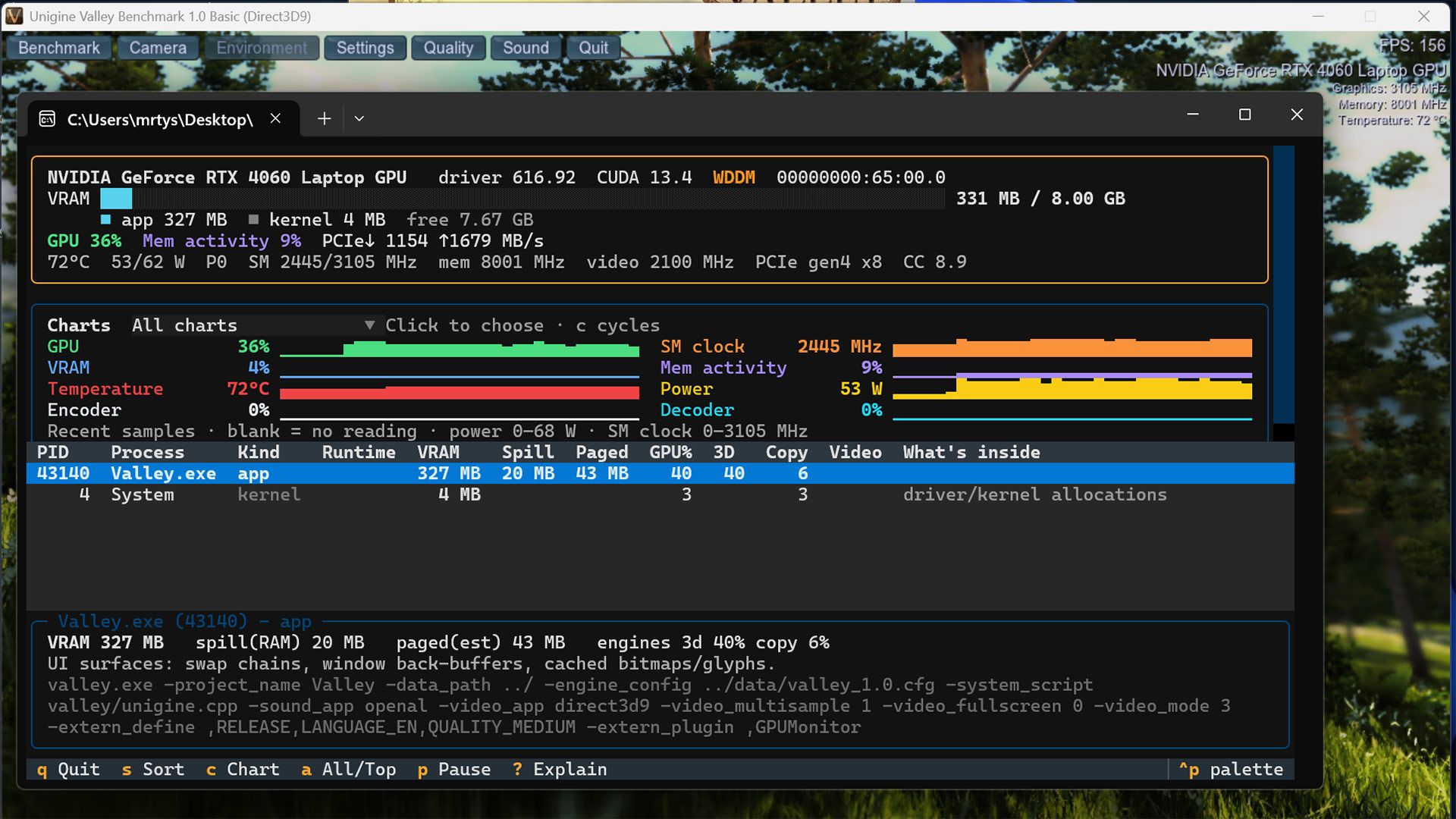
In a test of that release, no tasks were found using the discrete GPU on a laptop until the Unigine Valley GPU benchmark was launched to activate the RTX 4060. Live-streaming charts for GPU load, VRAM use, temperature and similar metrics appeared more prominently in that session than in Hanselman's examples, a difference that may reflect his screenshots coming from an earlier version of the tool.
Further information on GPU Taskman, including how it works and its source code, is available in the linked GitHub repository. Hanselman has described the software as experimental and is distributing it under the MIT license. In comments on social media, he also hinted that broader GPU monitoring capabilities could eventually arrive in Windows as a standard feature.
More software news from TechManNews.