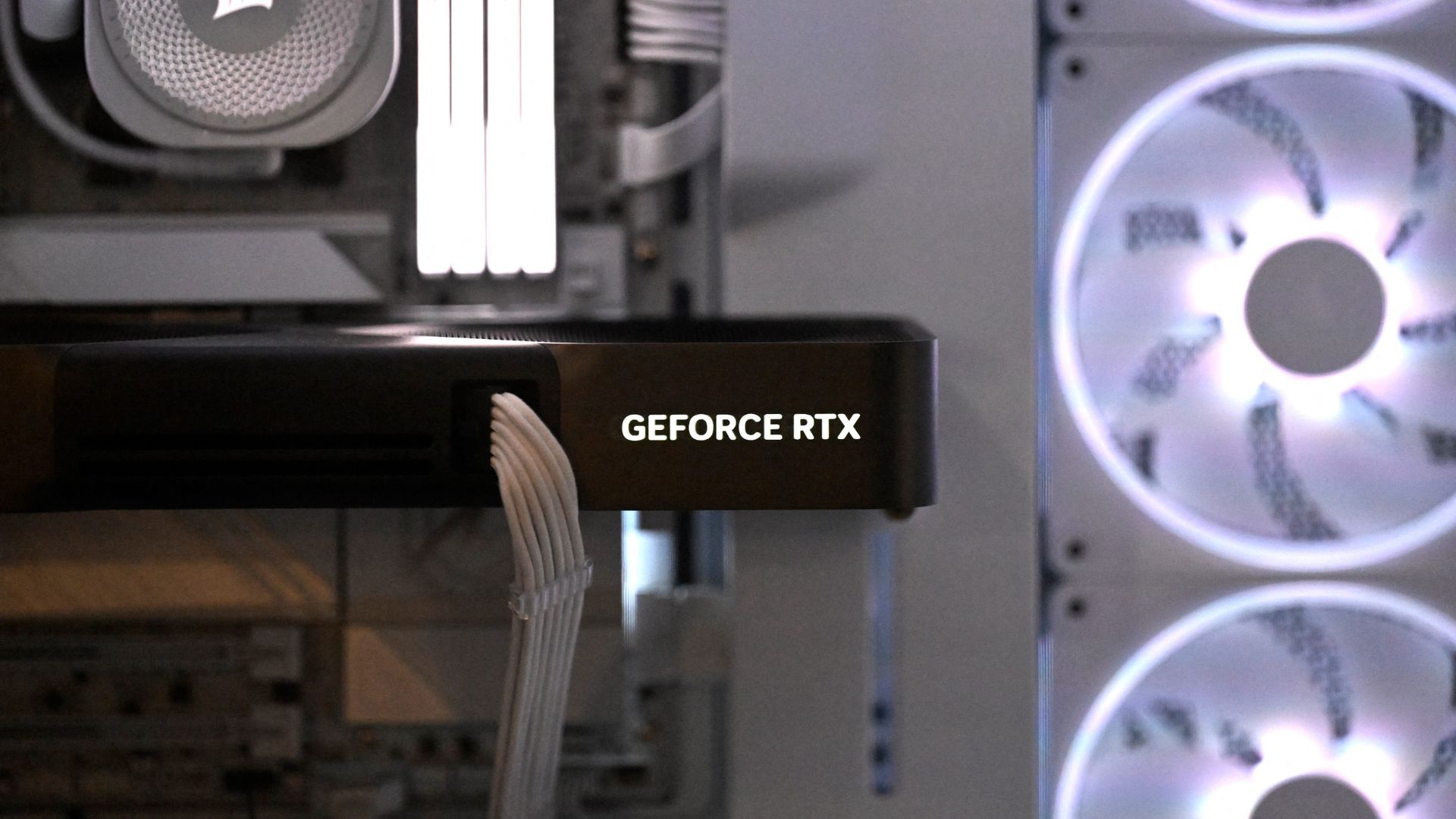
Enabling Nvidia's DLSS 5 upscaling feature can push the 16-pin power connector on high-end graphics cards hotter than the GPU die itself, according to testing published by the Korean outlet QuasarZone. The site ran Cyberpunk 2077 at 4K resolution with DLSS Quality and Ultra image settings for 20 minutes in a controlled 27.5 degrees Celsius environment, monitoring temperatures on the connector. The tests covered the GeForce RTX 5090 Founders Edition, the Asus ROG Astral GeForce RTX 5090, and the GeForce RTX 5080 Founders Edition.
On the RTX 5090 Founders Edition, the connector's latch side measured 77.1 degrees Celsius and the opposite side 80.9 degrees Celsius with DLSS 5 disabled. With DLSS 5 turned on, those readings rose to 83.4 and 91.7 degrees Celsius. The card's average core temperature climbed from 79.4 to 83 degrees Celsius, and its peak went from 82.3 to 86.3 degrees Celsius, leaving the power connector as the hottest point on the board.
The RTX 5080 Founders Edition stayed much cooler. Its connector read 45.8 degrees Celsius on the latch side and 47.6 degrees Celsius opposite before DLSS 5, rising to 52.2 and 48.6 degrees Celsius with the feature active. QuasarZone attributed the gap to the RTX 5080's lower power consumption, which is rated at 360W against the RTX 5090's 575W.
Measuring with HWiNFO, average power draw rose 13% on the RTX 5090 and 17% on the RTX 5080 with DLSS 5 enabled. The outlet then used Nvidia's Power Capture Analysis Tool, which measures directly from the circuit board, and found the RTX 5090's average draw moved from 582.7W to 646.7W, an 11% increase. HWiNFO and PCAT readings differed by 3%.
Current distribution drew scrutiny on the Asus ROG Astral RTX 5090. Across the six power pins, readings ranged from 6.94A to 7.47A before DLSS 5 and 7.83A to 8.51A after. That stays under PCI-SIG's 9.2A per-pin requirement, but leaves only 0.69A of headroom above the highest measurement. In a simulation with one nonfunctional pin, redistributing the load produced a peak of 8.9A without DLSS 5 and 10.1A with it, roughly 10% above specification.
Melting reports for the 16-pin connector continue to surface online, including on Reddit, and have affected media outlets and experienced industry veterans as well as new users. The failures are not limited to Nvidia's Blackwell cards, with similar incidents reported on AMD Radeon graphics cards. At least one user has reportedly reported a connector meltdown while experimenting with DLSS 5. QuasarZone's results track with separate findings that DLSS 5 raises power consumption substantially, though custom RTX 5090 models have shown higher spikes, including 592W at 1080p, 695W at 1440p, and 848W at 4K on the GeForce RTX 5090 32G Lightning Z.
More hardware news from TechManNews.