Apple’s new MacBook Pro arrives at a moment of deep uncertainty in the laptop market, with computer prices at levels not seen in recent history and the possibility that they keep climbing. Buyers weighing a purchase are also asking what computing will look like in a few years, given early developments in both local and agentic artificial intelligence, and what that means for the machine they buy today. The new MacBook Pro sits at the intersection of those questions, and in several respects it straddles different worlds.
Its arrival comes amid a changing of the guard in Apple’s leadership, which could raise questions about the direction of Apple’s ecosystem. It is a mass-market consumer product, but configuring it with enough RAM and storage to feel future-proof pushes its price into territory mostly only well-funded businesses can afford. It remains rooted in the computing paradigms of the past 20 years while showing early signs of new AI workflows, and it is a conventional Apple laptop in most ways but now has a touchscreen, something that would not have happened in a prior Apple era.
On most specs, Apple is not claiming a difference. The new MacBook Pro promises 24 hours of battery life, though that requires conservative use, and it carries the same ports: three Thunderbolt, one HDMI, one SDXC and MagSafe. It has the N1 chip for Wi-Fi 7 and Bluetooth 6 connectivity, and like its immediate predecessor it offers the M5 Pro and M5 Max chips as options. Synthetic benchmarks showed no meaningful difference from the previous model, so performance was not revisited in this review.
The chips are more than fast enough for normal workflows for the foreseeable future, including most 3D work, according to the review. AI inference is the main area where they may be less future-proof: they are strong enough for now, but the field is evolving rapidly and significant improvements in future chips are expected on that front. Bloomberg reported that Apple is skipping Pro and Max versions of the M6 chip introduced earlier this year to focus on a significant rework for the M7 due in 2027, with Bloomberg’s Mark Gurman writing that the M7 line is designed primarily around major advancements to on-device AI processing and would emphasize memory bandwidth, which matters for fast, efficient AI inference.
The review states that the MacBook Pro’s display is the best it has used in a laptop. Apple calls it a tandem OLED display, meaning a panel with two emissive layers, an approach that helps achieve higher peak brightness and can reduce the risk of burn-in, since the layers can share the load at reduced current instead of both running at full power most of the time. The display reaches up to 2,000 nits of peak brightness on HDR highlights and is rated for 1,000 nits of sustained brightness, with per-pixel illumination allowing absolute black levels and very strong contrast.
The screen offers native support for the P3 and Adobe RGB color gamuts and a variable refresh rate from 10 to 120 Hz. The MacBook Pro comes in roughly 14-inch (3,024x1,986 pixels) and 16-inch (3,472x2,226 pixels) variants, and a nano-texture glass option to fight glare costs another $150. The reviewer found the colors vibrant, the contrast outstanding, the blacks inky and the uniformity basically flawless, calling it what you would expect from an ultra-high-end TV or reference monitor rather than a laptop screen.
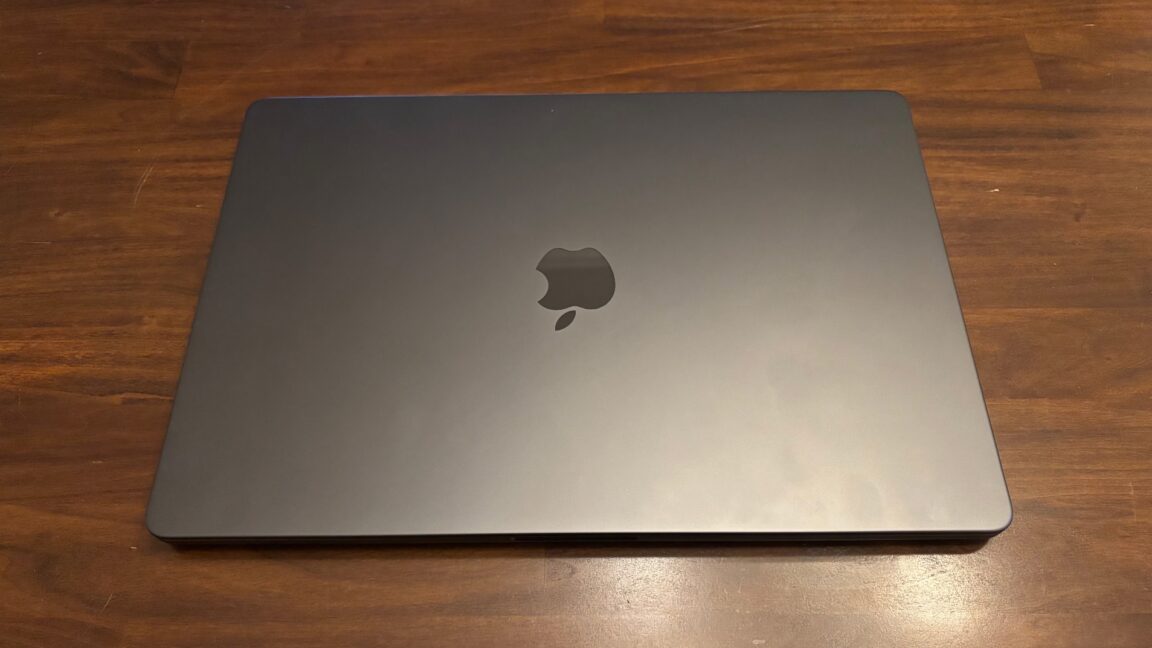
With the lid closed, the new MacBook Pro looks identical to its predecessor, with largely the same dimensions and slightly thinner. It is noticeably lighter by about half a pound, partly due to the switch to OLED, which is easier to make light than MiniLED. From behind, the Apple logo on the lid now lights up as on MacBooks of yore, and from the front the already barely there bezels are even more barely there, while the top-of-screen camera notch has been replaced by a cutout like the Dynamic Island Apple introduced on the iPhone.
More gadget news from TechManNews.