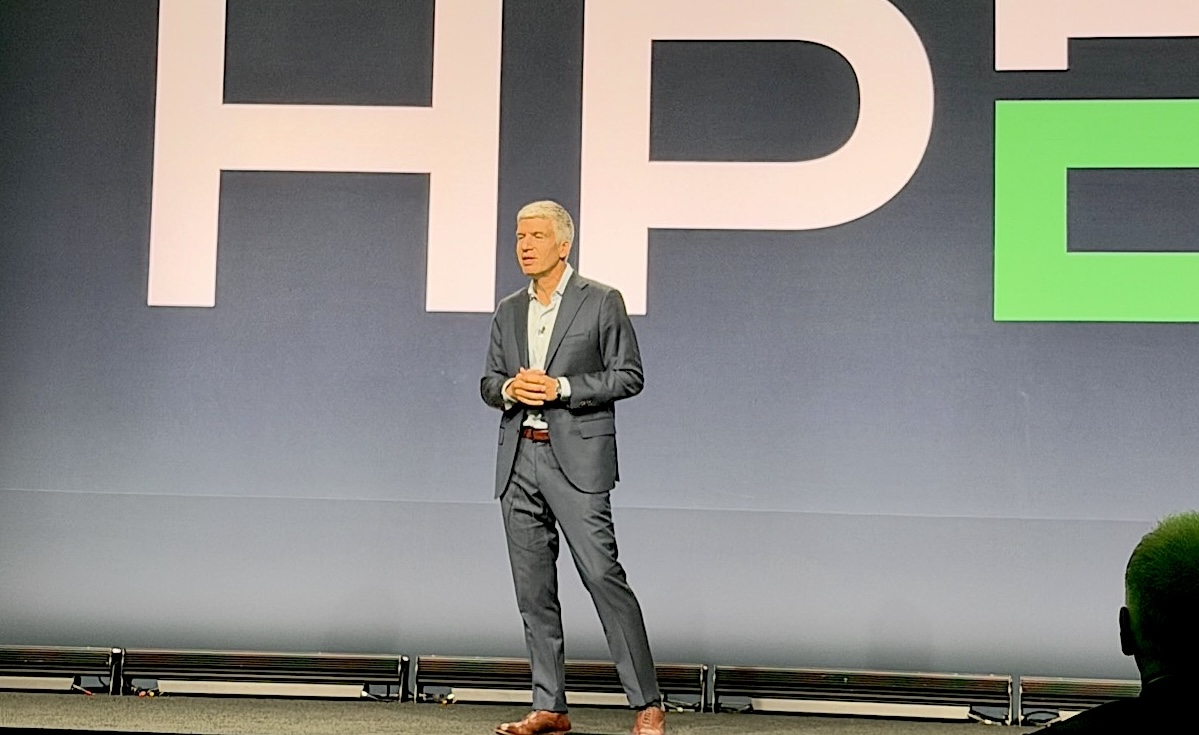
Hewlett Packard Enterprise told investors at its Networking Investor Day that networking has become the company's growth engine, a little over a year after closing its acquisition of Juniper Networks. HPE projected its combined networking business will expand from $9.3 billion in fiscal 2024 to roughly $11.3 billion in fiscal 2026, with operating profit climbing from $1.6 billion to $2.5 billion over the same span.
For fiscal 2027, HPE now expects networking revenue growth in the high-teens to low-20% range, raised from prior guidance of 14% to 17%. The company set a long-term goal of high-teens compound annual growth through fiscal 2029, with operating margins in the mid- to high 20s. Rami Rahim, executive vice president and general manager of HPE Networking and the former Juniper chief executive, attributed the opportunity to AI reshaping the technology stack and making the network more strategic. He said HPE's product breadth and sales reach distinguish it from rivals, provided execution holds.
Rahim said the sales organizations were merged about six months after the deal closed, under one catalog, one compensation plan, and a full portfolio for every seller. Cost synergies have grown from an original target of $450 million to at least $600 million at close, and now $800 million in annual run-rate savings by the end of fiscal 2028. On Nov. 1, all 60,000 HPE partners move to a single program; only about 10% of Aruba and Juniper partners currently overlap.
Data center networking is HPE's fastest-growing segment, with a target of low to high 50% compound annual growth through fiscal 2029 against a market HPE pegs at 44%. Praveen Jain, senior vice president and general manager of data center, described scale-up as connecting graphics processing units within a rack rather than scaling out across racks. The AMD Helios rack brings HPE into scale-up, an opportunity Rahim said exceeds $1 billion over the next two years, with networking tray orders already above $200 million. HPE announced a $1.2 billion order from Vultr, its first for Helios, with each rack using six HPE Juniper Networking QFX5252 scale-up Ethernet switch trays to connect 72 AMD Instinct MI455X GPUs.
Routing, long seen as mature, is now targeted for low to high 20% growth through fiscal 2029. AE Natarajan, senior vice president and general manager of routing infrastructure solutions, said AI makes upstream and downstream traffic similar and uncacheable, and that AI agents generate traffic constantly. Campus and branch, roughly half of HPE Networking revenue, is expected to grow at high single digits versus about 6% for the market as customers upgrade to Wi-Fi 7, with the self-driving network built on Marvis, Juniper Mist's AI engine. Sujai Hajela, executive vice president and general manager of campus and branch, said the philosophy behind self-driving is that up is not the same as good.
Sajeev Nair, senior director of digital core services at ServiceNow, said a manual workload that once took 2,000 to 3,000 hours a year now takes fewer than 60. Security will remain a network feature rather than a standalone business, with HPE forecasting high-single-digit growth against a 12% market, the only category where it does not plan to outgrow the market, according to David Hughes, senior vice president and general manager of SASE and security. Rahim said HPE underestimated how explosive market growth would be, noting third-quarter orders grew 3.5 times faster than revenue and that networking supply commitments doubled from the prior quarter.
More company and startup news from TechManNews.




%20092026%20top%20art%20SOURCE%20Amazon.jpg)