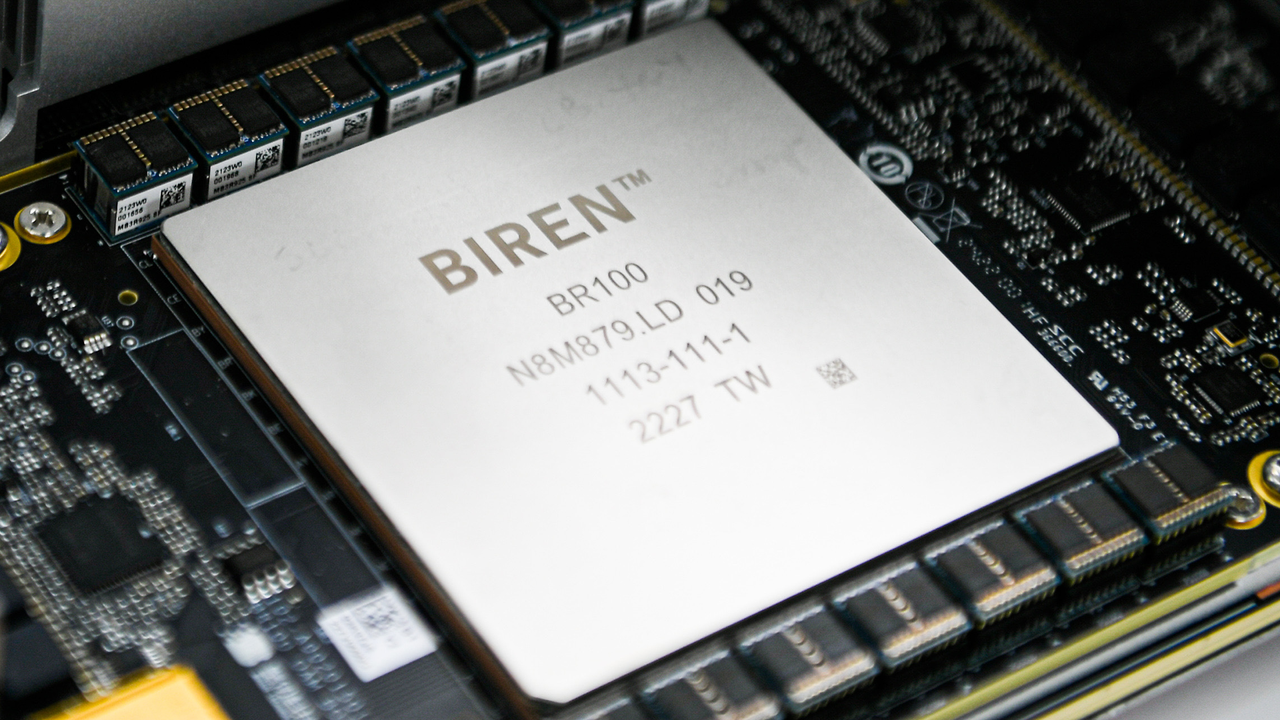
Biren Technology reported first-half revenue of $183.9 million, a 1,998% increase from roughly $8.665 million in the same period of 2025, as US export controls reshaped China's AI accelerator market and thinned the field of American suppliers.
The Chinese company's gross profit reached $78.552 million and its gross margin rose to 42.7%, but it still posted a $56.2 million loss, which it attributed to continued investment in new products, including AI accelerators, optically-interconnected rack-scale solutions and software.
Biren's sales began climbing in the second half of 2025, lifting full-year revenue to $154.17 million. Even so, its share of China's AI accelerator market remained below 3%, according to TrendForce.
The supplier is known for high-end AI GPUs, including the BR106, BR110 and BR166, and is developing the BR20X, BR30X and BR31X accelerators, according to JPR. It has also built its own Birensupa software stack, positioned against Nvidia's CUDA, and is working on a rack-scale solution.
Demand for domestic AI accelerators in China had long been relatively low, because even reduced versions of Nvidia's leading AI GPUs outperformed Chinese designs and their software stacks. Nvidia charged $12,000 to $15,000 per H20 AI GPU in the PRC and still supplied about 2.2 million AI accelerators to the country in the first half of 2025, before the Trump administration's export controls took effect in May, according to TrendForce. Biren shipped thousands, possibly tens of thousands, of accelerators across all of 2025, and its shipments remain far below Nvidia's 2025 totals.
Biren's growth is real, but it is measured from a very small base in the first half of 2025, so the 1,998% figure makes the company appear larger than it is. At $183.9 million in revenue, it remains a comparatively small accelerator supplier in absolute terms.
The open question is whether Biren can obtain enough manufacturing capacity from SMIC or other suppliers to compete with larger Chinese AI accelerator vendors such as Huawei, Kunlunxin and Cambricon. It has more financial resources than a year ago and faces less formidable competition from AMD and Nvidia amid US export restrictions and China's own bans on American AI hardware, but competitive designs are only part of the equation: Biren must now build enough accelerators to meet customer demand and substantially raise its market share.
More company and startup news from TechManNews.