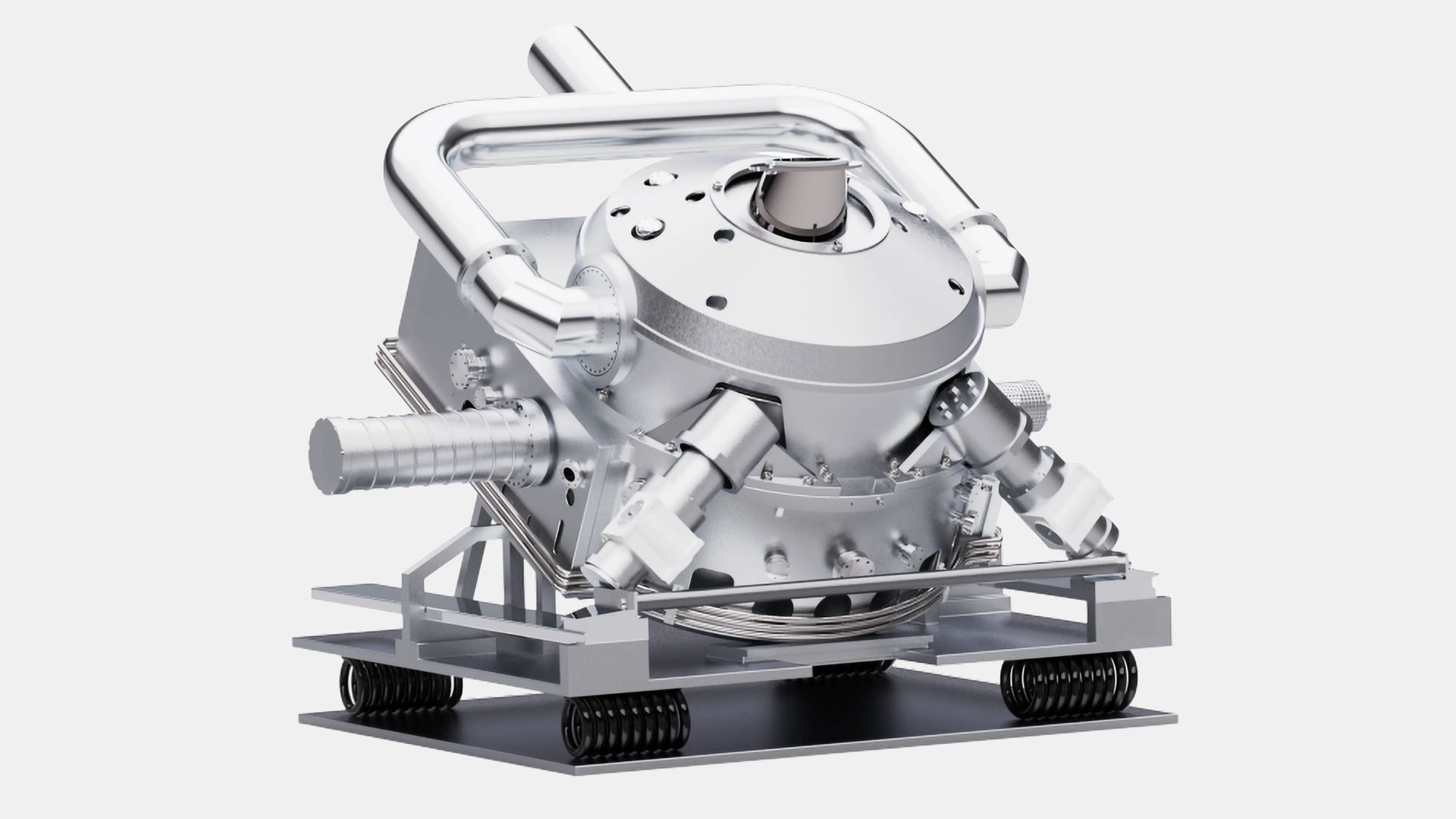
Langdao Silex, a startup founded in 2024 by alumni of Tsinghua University's Gas Discharge Plasma Laboratory, showed a prototype extreme ultraviolet light source at the 26th China International Industry Fair in Shanghai. The company did not power the system on during the exhibition. The device, called FlintNano LPP-OXXO, is a low-power laser-produced plasma source, the same general approach used in modern light sources from ASML.
According to Langdao's specifications, the FlintNano LPP-OXXO pairs a 1,000W driving laser, presumably a CO2 unit, with an operating frequency of 1 kHz to 20 kHz and conversion efficiency above 2%. Its EUV output exceeds 15W, presumably measured at the plasma rather than at intermediate focus, since the company has not demonstrated a complete EUV collection system. Brightness is listed at 100 W/(mm sr), with an etendue of 1 to 10 mm sr and a plasma diameter of 60 micrometers.
Langdao says the source can run continuously for more than 100 hours with plasma stability of 3% RMS and EUV output power stability of 5%. Those figures would suit semiconductor exposure experiments, though the output remains insufficient for high-volume chip production. The company's claim of over 100 hours of availability is notable for a pre-production light source, but there is no way to verify it.
The startup is also developing a high-power EUV source, FlintMicro-LPP, which has completed proof-of-principle validation, according to reports. Langdao has not disclosed that system's output power, conversion efficiency, or operating lifetime.
On paper, Langdao's source is comparable in output to some of the earliest EUV sources from Western and Japanese equipment makers, though the measurement caveat matters. ASML's early EUV demonstration equipment used roughly 10W at intermediate focus from DPP sources in 2007, and Cymer's LPP sources in early NXE:3100 systems delivered up to 11W during wafer exposure in 2012. By 2013, Cymer demonstrated about 40W at intermediate focus over extended operating periods, while Japan's Gigaphoton targeted 25W with its first prototype in 2013 and demonstrated 43W in early 2014, reaching 118W during a 10-minute test late that year. The source notes that differing measurement conditions and operating durations make direct comparisons highly inaccurate.
Langdao claims 90% of the prototype's components are domestically sourced, with most critical parts developed in China, but has not explained whether that figure reflects component count, value, or another metric. Representatives reportedly acknowledged that raising EUV output and improving long-term operational stability are the targets for commercializing the source. Even without complete scanners, the company says the source could support EUV photoresist development, mask inspection research, and work on collection and illumination optics.
Building a full EUV scanner would require advances in collection and illumination systems, high-precision multilayer mirrors, wafer and reticle stages, overlay accuracy, and system integration, all backed by a supply chain that hardly exists in China today. The source also notes that ASML and Cymer took roughly six years to raise LPP source output from 11W to 125W-150W at intermediate focus. ASML introduced 250W-class sources for commercial production in 2018-2019 and has since achieved higher output.
More company and startup news from TechManNews.