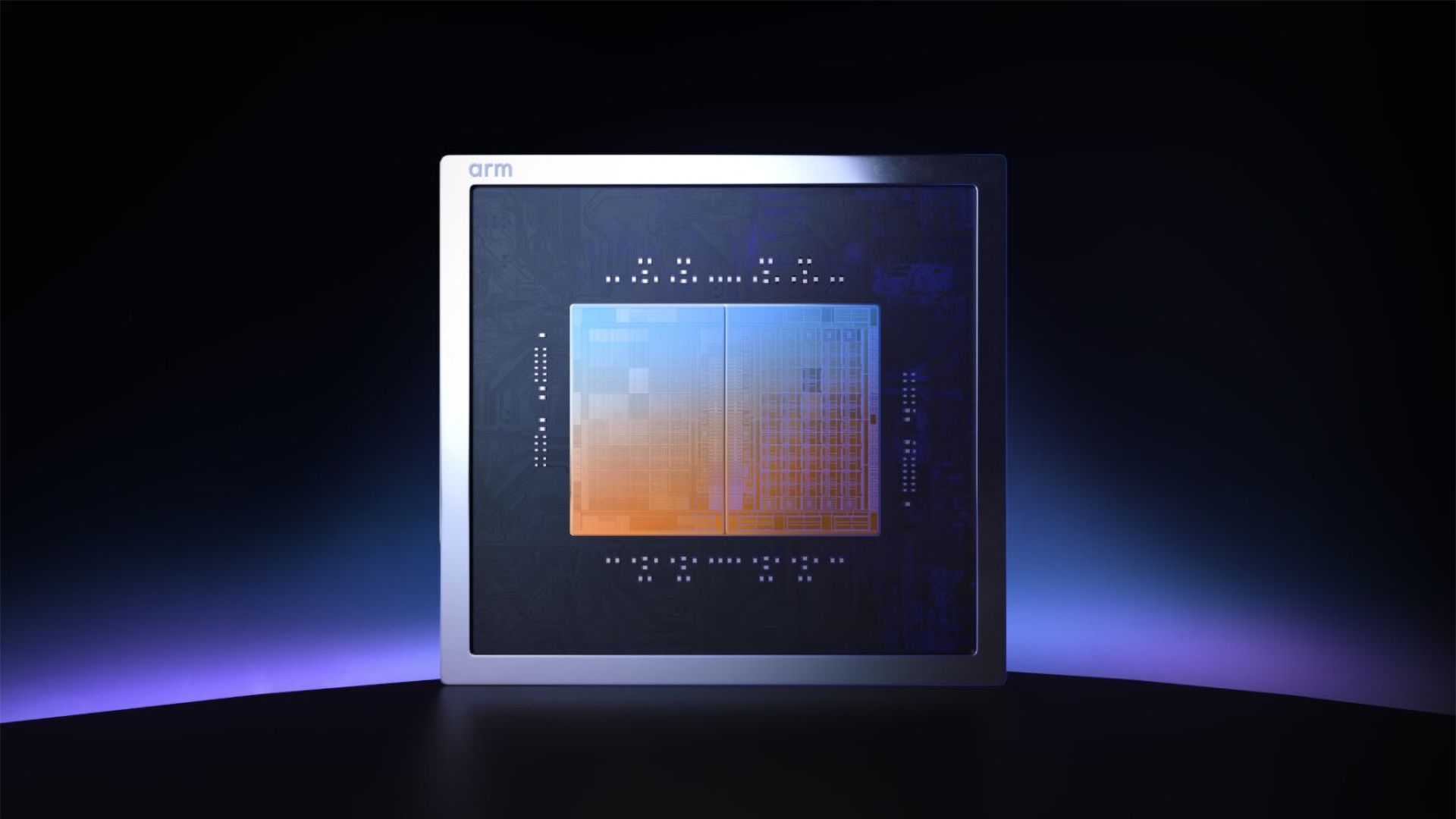
Arm said its AGI CPU delivers nearly twice the performance per rack of AMD's EPYC 9755 in a set of agentic AI CPU tests. The results were verified in an independent analysis commissioned by Arm and conducted by Signal65. According to the source article, the findings do not establish the AGI CPU as the overall leader for agentic AI, because they apply only to the selected processors, workloads, and configuration, and they rely on an evaluation methodology developed by Arm.
Arm argues that agentic AI is changing the CPU's role in AI data centers. CPUs now handle the surrounding work of agents, such as executing tools, serving database and API requests, preparing data, and coordinating accelerators, while accelerators handle inference. Arm contends that CPU performance should be judged by how much useful work a system sustains while staying responsive, not just by how many agents run at once, and that power, cooling, and space limits extend the question to the rack. Arm developed its proposed methodology with support from Fujitsu, Meta, and OpenAI, centering on representative agent workloads, repeatable measurements, and validation against end-to-end task outcomes.
Arm tested seven workloads spanning tooling, agentic workflows, reasoning and planning, plus Sandbench, which measures sandbox-creation overhead. It used two AGI CPU configurations due to hardware availability: a 128-core chip at 2.8 GHz with DDR5-7200 for Terminal-Bench 2 and SWE-bench replay, and a 136-core chip at 3.2 GHz with DDR5-8000 for the other five workloads. The AMD comparison used one socket of the 128-core EPYC 9755 with DDR5-6400. Both platforms ran the same benchmark scripts but different software environments, with Arm using custom Linux 7.1.3 builds and AMD's main recorded configuration using Ubuntu 24.04 and Linux 6.8.
At the chip level, Arm led in five of the seven tests. Against the EPYC 9755 baseline, Arm led by 9% on Terminal-Bench, 13% on SWE-bench, and 97% on fastText, but lagged by 12% in MySQL and 5% in Milvus throughput, averaging a 1.20x per-chip advantage. At the rack level, Arm's modeled performance averages 1.99x AMD's across all seven workloads, using rated server-power estimates of 950 W, 1,050 W, and 1,700 W, which leaves room for 23 or 21 Arm servers versus 13 AMD servers within a 24 kW rack budget after reserving about 8% for networking and power distribution. These projections use modeled whole-server power, not throughput measurements from two fully populated racks.
Arm's model gives AMD servers about twice the RAM, roughly 2 TB versus 1 TB for Arm, allocating 4 GB per hardware thread. Signal65 calculated that allocating memory per physical core instead drops Arm's average modeled rack advantage from 1.99x to approximately 1.81x. Signal65 remotely observed the test runs and examined logs, result files, scripts, and configuration records, and a separate review team reproduced all seven results within 0.5%, but Signal65 did not run a separate hardware rerun in its own lab. Signal65 could independently confirm BIOS and memory settings only for the EPYC 9965 system; those settings were unavailable for independent verification on the Arm and EPYC 9755 systems.
Other chipmakers evaluate agentic CPU performance differently. AMD promotes agents per watt, dollar, and rack, with footnotes on its EPYC 9006 page identifying available CPU threads as a proxy for agent capacity, and its separate workload analysis models a 100 kW rack and claims 2.37 performance for EPYC 9965 over Nvidia's Vera across six infrastructure workloads. Nvidia emphasizes Vera's single-thread performance and memory bandwidth and says a 256-CPU rack supports more than 22,500 concurrent CPU environments. The comparison is against AMD's fifth-generation Turin processor; AMD launched its sixth-generation EPYC 9006 Venice family this year, dedicated to agentic AI.
More AI news from TechManNews.