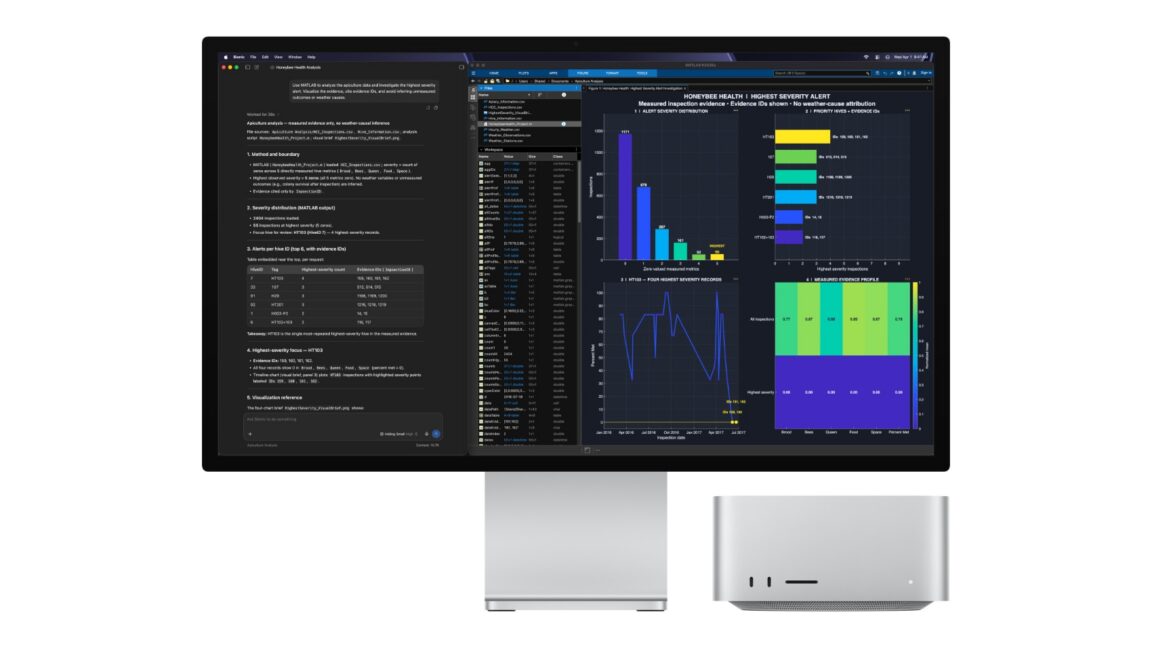
Apple on Tuesday announced new versions of the Mac mini and Mac Studio, along with two new chips, in a refresh aimed squarely at developers and researchers doing local AI work. The company introduced the M6, its first 2nm chip for Macs, and the M5 Ultra, which it touts as the most powerful chip in its lineup, particularly for AI workloads. Both desktops are popular for local AI inference and software development because of their unified memory architecture and the speed of their CPUs and GPUs. The new machines are otherwise spec bumps, with no major new features, but Apple is clearly leaning into these AI use cases in how it is presenting the products.
The surge in using these desktops for production inference began after macOS 26.2 shipped in December. That operating system update enabled low-latency communication between Thunderbolt 5 hosts for distributed AI inference using MLX, Apple’s open source array framework for machine learning on M-series chips. Since then, hobbyists and professionals have been daisy-chaining Mac minis and Mac Studios to run local large language models far larger than anything a single consumer device could handle, offering an alternative to specialized hardware with Nvidia GPUs.
The M6 chip features a 12-core CPU with two super cores, four performance cores, and six efficiency cores, marking the first time Apple has used all three core types in one SoC. Apple claims the M6 is up to 40 percent faster at multi-threaded CPU performance than the M4 from two generations ago, though no independent benchmarks are available yet. It also has a 12-core GPU and faster unified memory with up to 160GB per second of bandwidth, but memory capacity tops out at 32GB.
For heavier workloads, the new M5 Ultra in the updated Mac Studio offers up to 512GB of memory and is essentially two M5 Max chips on one SoC, with 36 CPU cores and 80 GPU cores. Apple says it can achieve up to 1.2TB per second of unified memory bandwidth. That level of memory and speed is overkill for most consumers, but it aligns with what Apple is optimizing for: local AI inference, a growing preference among software developers who are increasingly using AI coding agents like Claude Code or Codex. The cost of running those cloud models is steep, and open-weight models from developers like Qwen and DeepSeek can run locally on a user’s own hardware without per-token charges.
That said, typical consumer hardware like a standard MacBook Pro still lacks the memory capacity to run very large models locally, so developers are turning to chains of Mac minis and Mac Studios to bridge the gap. For buyers not focused on AI, these are standard upgrades: both machines include Apple’s N1 chip with Wi-Fi 7 and Bluetooth 6, storage is up to twice as fast at 15GB per second, and the Mac mini now ships with 2.5Gb Ethernet as standard, with a 10Gb option available.
Pricing for the Mac mini with M6 starts at $899 with 16GB of memory, while configurations with the M5 Pro start at $1,699. The Mac Studio with the M5 Max starts at $2,499, and M5 Ultra configurations start at $5,499, with higher-end options costing considerably more. Preorders for both desktops open today, and they ship on September 22, though the 512GB memory configuration for the Studio won’t ship until late October. Apple also says the machines will ship with macOS 27 Golden Gate, suggesting the annual OS update may arrive for other Mac users around that time.
More AI news from TechManNews.