The thread running through this week's processor news is that the unit of competition in AI hardware is no longer the chip. It is the system, the software path, and the procurement relationship around it. For anyone who follows CPUs and processors, that means the interesting action is moving away from per-chip specs and toward how chips are bundled, scheduled, and sold.
The System Eats the Chip
SiliconANGLE's coverage of the CASPA CEO Summit makes the point directly: faster chips alone no longer define the AI buildout, because hundreds of thousands of processors now work together as one machine. The article describes AI infrastructure hardware being designed and judged as a complete system, running from the optical links between racks to the memory, storage and power that keep GPUs busy. That is a notable framing for a beat traditionally organized around clock speeds, core counts, and process nodes. If the summit's framing holds, the processor's contribution is increasingly judged by how well it fits into a larger machine rather than by standalone benchmarks. For US chip designers, that raises the cost of competing: a strong part with weak surrounding infrastructure looks worse than a merely good part inside a well-tuned system. It also shifts where differentiation lives, toward interconnect, memory hierarchy, and power delivery, all of which are harder to copy than a single design win.
A Common Software Path for CPU Inference
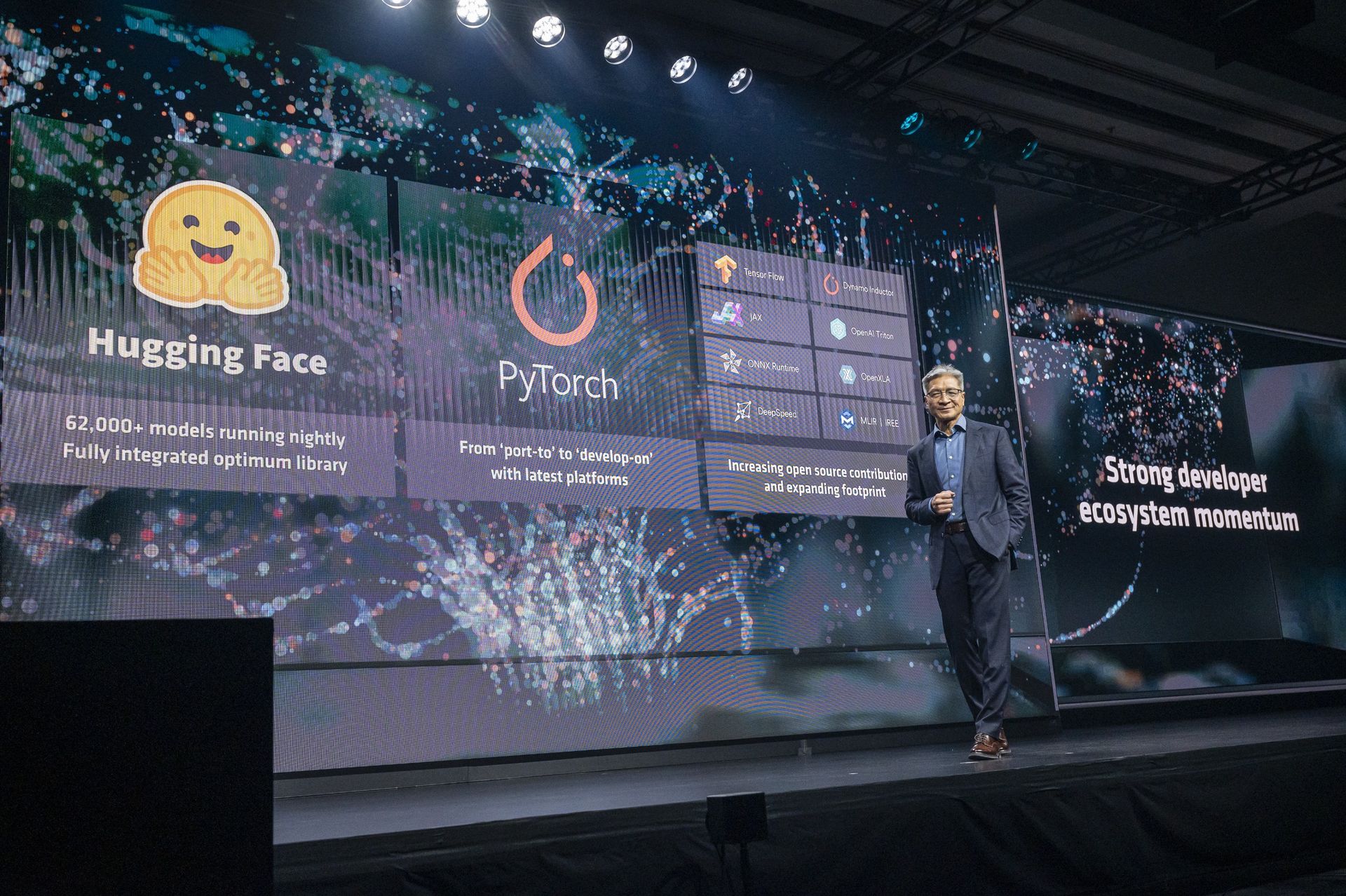
Tom's Hardware reports that AMD and Intel are working together to bring CPU inference optimizations for PyTorch under the unified oneDNN library. Two competitors collaborating on a shared software path is the clearest signal in this batch that the CPU's role in AI is being standardized rather than fought over at the instruction level. The practical effect for US developers is that targeting CPUs for inference becomes less dependent on which vendor's silicon sits underneath. That lowers friction for enterprises that want to run inference on general-purpose servers rather than dedicated accelerators, and it weakens the case for vendor-specific tuning as a selling point. It also suggests both companies see more value in expanding the CPU inference market than in fragmenting it. The caveat is that shared libraries can flatten differentiation: if the software path is common, vendors must compete on price, power, and integration rather than on proprietary optimization.
Hyperscalers as Chip Channels
SiliconANGLE also reports that Oracle plans to make Google's TPU accelerators available through its public cloud, the first time the search giant is supplying the chips to another hyperscaler. According to CNBC, cited in that report, Oracle will also add Cerebras Systems' wafer-scale accelerators and OpenAI's Jalapeño inference processor. This is the procurement side of the same pattern. Accelerators are increasingly distributed through cloud marketplaces rather than sold as components, which means the processor's commercial fate depends on which clouds carry it. For US technology companies, the implication is that distribution agreements may matter as much as fabrication. For US consumers and enterprises, it means more choice in where AI workloads run, though the choice is mediated by whichever hyperscaler holds the relationship. The story also complicates the assumption that chip vendors and cloud vendors are aligned; here a cloud is reselling a rival's silicon, which treats accelerators as inventory rather than as a moat.